


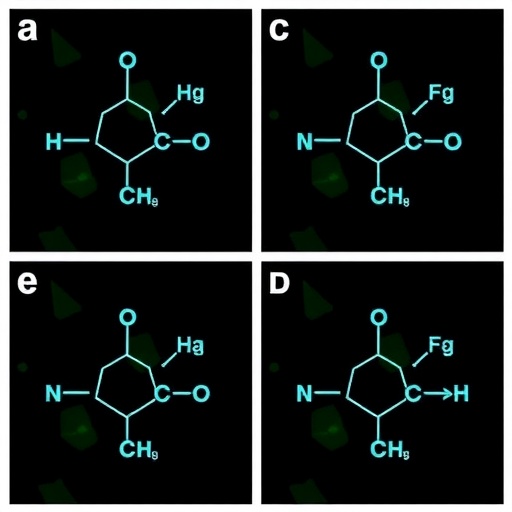
In a groundbreaking advance that could redefine the future of sustainable chemical manufacturing, researchers have unveiled a novel method for selective formamide production through kinetics-controlled radical coupling on dual redox-active sites. This innovative approach, detailed in a recent publication in Nature Communications, promises to enhance the efficiency and selectivity of synthetic pathways critical to the chemical industry. Formamides, key intermediates in pharmaceuticals and agrochemicals, have traditionally been challenging to produce with high selectivity and yield, often relying on energy-intensive processes with significant environmental footprints.
At the heart of this breakthrough lies a carefully engineered catalytic system that exploits the unique interplay between two distinct redox-active sites. These sites facilitate targeted radical reactions, steering the coupling process toward the desired formamide product while suppressing undesired side reactions. The research team, led by Shen, Li, and their colleagues, meticulously dissected the mechanistic underpinnings governing radical intermediates, demonstrating how precise control over kinetic parameters can unlock unprecedented selectivity in complex reaction networks.
Radical chemistry, known for its highly reactive intermediates, has traditionally posed considerable challenges in synthetic control due to the transient nature and propensity for side reactions. However, by harnessing dual redox centers with complementary electron affinity and spatial arrangement, the study reveals a pathway to tame radical species effectively. This kinetic control is achieved by balancing reaction rates at each active site, enabling a stepwise, synchronized coupling event that emphasizes formamide formation.
The dual redox-active sites function through a finely tuned electron transfer mechanism that modulates the radical generation and consumption rates. By selectively accelerating the coupling between carbon-centered and nitrogen-centered radicals, the catalyst structure ensures that formamide is produced predominantly over other potential byproducts. This specificity not only improves yield but also significantly reduces the need for downstream purification, representing a major cost and environmental advantage.
In addition to catalytic innovation, the research extensively utilizes advanced spectroscopic and computational techniques to elucidate the radical coupling pathway. In situ electron paramagnetic resonance (EPR) spectroscopy captures the formation and evolution of radical intermediates in real time, while density functional theory (DFT) calculations decode the energy landscape guiding the reaction kinetics. These combined insights confirm that the dual-site catalyst provides a unique microenvironment conducive to selective radical recombination.
The implications of this study are profound for green chemistry. By enabling selective synthesis under milder conditions with minimal waste, the kinetics-controlled radical coupling strategy aligns perfectly with sustainability goals. Chemical manufacturers can potentially adapt this system to generate a wide range of amide derivatives, reducing reliance on traditional ammonolysis processes that often involve harsh reagents and excessive energy consumption.
Crucially, the success of the dual redox-active catalyst stems from its rational design, which was informed by a deep understanding of electronic structure principles. The team systematically varied the redox potential of the active sites to harmonize the radical lifetimes and reactivity profiles. This delicate tuning ensures that radical species generated at one site are promptly coupled at the adjacent site, minimizing unproductive decay or dispersion into side pathways.
The research opens avenues beyond formamide synthesis, suggesting that similar dual-active-site architectures could mediate other challenging bond formations involving radical intermediates. This strategy could revolutionize cross-coupling reactions, polymerizations, and even transformations in organic electronics where radicals play a pivotal role. The innovative concept of merging kinetic control with spatially resolved redox sites promises broad applicability across synthetic chemistry.
Moreover, the catalytic system demonstrates remarkable robustness over extended reaction cycles, maintaining high selectivity and activity without significant degradation. This durability speaks to the practical viability of the approach for industrial-scale applications, where catalyst lifetime critically impacts process economics. The team’s future efforts will likely focus on scaling and integrating this system into continuous flow reactors to maximize throughput and operational efficiency.
Interdisciplinary collaboration was key to this success, blending expertise from materials science, mechanistic physical chemistry, and computational modeling. The study showcases how combining spectroscopic observations with theoretical predictions can unravel complex reaction dynamics that are otherwise inaccessible. Such integration sets a new standard for catalyst development paradigms and highlights the importance of kinetic control as a design principle.
In summary, the kinetics-controlled radical coupling on dual redox-active sites represents a landmark achievement in catalytic science. It addresses longstanding challenges in selective formamide production, presenting a pathway to tailor radical reactivity through site-specific electron management. This work not only offers a sustainable alternative to conventional synthesis routes but also inspires future innovations in radical-mediated transformations.
As industries increasingly prioritize environmentally benign processes, strategies such as this will be pivotal in meeting global demands for sustainable chemical production. The refinement of catalytic methods grounded in fundamental kinetics and redox chemistry promises to transform the landscape of synthetic organic chemistry, paving the way for greener, more efficient manufacturing technologies.
Looking ahead, further exploration of dual redox-active site catalysts will likely unravel new mechanisms and applications, extending beyond amides to a broad spectrum of nitrogen-containing molecules vital to pharmaceuticals, polymers, and materials science. This pioneering research thus sets a foundational milestone that will influence catalyst design for decades to come.
The research team’s findings underscore the critical interplay between kinetics and redox dynamics in achieving selective chemical synthesis. By harnessing dual, strategically positioned redox-active sites, they have demonstrated a powerful approach that converts radical intermediates from transient nuisances into precise agents of molecular construction. This conceptual advance redefines the possibilities for radical chemistry in complex molecular syntheses.
With its innovative catalyst design and comprehensive mechanistic insight, this study not only advances fundamental science but also offers practical tools for enhancing chemical manufacture sustainability. It lays the groundwork for future explorations that could dramatically reduce the environmental impact of producing key chemical intermediates worldwide, embodying a paradigm shift in radical reaction control.
Cite Scienmag News
Bethany Barker. (April 21, 2026). Selective Formamide Synthesis via Dual Redox Radical Coupling. Scienmag. https://scienmag.com/selective-formamide-synthesis-via-dual-redox-radical-coupling/
Bethany Barker. "Selective Formamide Synthesis via Dual Redox Radical Coupling." Scienmag, 21 April 2026, https://scienmag.com/selective-formamide-synthesis-via-dual-redox-radical-coupling/. Accessed 3 September 2026.
Bethany Barker. "Selective Formamide Synthesis via Dual Redox Radical Coupling." Scienmag. April 21, 2026. https://scienmag.com/selective-formamide-synthesis-via-dual-redox-radical-coupling/


