


To truly comprehend the intricate lives of birds — from their social dynamics to their mating choices and even the subtle variations in their plumage — one must delve into how these creatures perceive the world around them. Unlike humans, birds experience a visual spectrum that extends beyond our typical understanding, revealing a dimension of avian communication and biology largely hidden to us. This expanded perception derives from the distinct anatomical difference in the eyes of birds compared to humans; birds possess four types of cone cells in their retinas, enabling them to see ultraviolet (UV) wavelengths, while humans, as primates, have only three. This surplus dimension of vision allows birds to detect signals invisible to the human eye, potentially influencing their behaviors and interactions in profound ways.
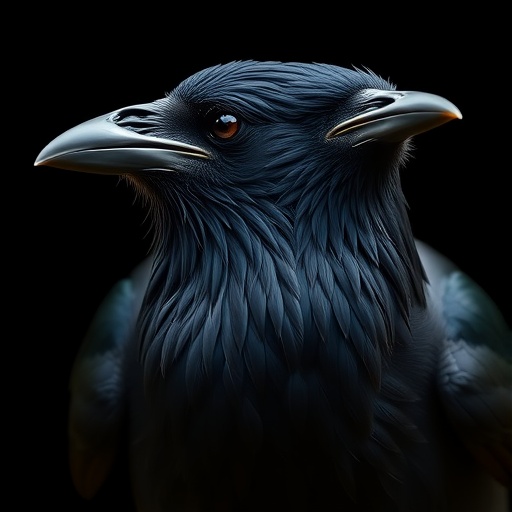
Recent scientific inquiry led by Anne B. Clark, Associate Professor Emerita of Biological Sciences at Binghamton University, in collaboration with Jessica Yorzinski from Texas A&M University, provides a groundbreaking exploration of how American crows perceive each other through their feathers’ coloration. While much is known about the visual cues and feather properties in iridescent birds like fish crows and grackles, less attention has historically been paid to the feathers of melanistic birds such as the American crow. These birds appear uniformly black to humans, without noticeable differences between males and females—a characteristic termed sexual monomorphism. However, the team employed sophisticated full-spectrum photography, coupled with visual modeling techniques that simulate avian color perception, to analyze 28 museum specimens and reveal subtle yet significant variations in crow plumage.
A key finding was the absence of UV-reflective patches on the feathers of American crows. Unlike other species like blue tits and budgerigars, which use UV feather reflections possibly to signal health or sex, crows do not rely on such UV signals to differentiate between males and females, supporting the observed sexual monomorphism in their plumage. Nevertheless, the study uncovered a nuanced relationship between feather coloration and age. As crows mature, particularly reaching three years old—a critical milestone after which they typically start breeding and establishing territories—feathers exhibit slight shifts in hue both within the visible light spectrum and in the ultraviolet range. These subtle variations suggest complex physiological changes, possibly involving melanin content or microstructural alterations in feather composition, indicating a dynamic ontogenetic trajectory in crow plumage.
The biological significance of these age-related color shifts may be tied to reproductive fitness. For crows under three years of age, which generally cannot secure mates or defend territories effectively, the quality and hue of their feathers might serve as honest indicators to conspecifics regarding their maturation stage and health status. This hypothesis aligns with broader evolutionary theories where ornamental traits, such as feather coloration, function as signals of genetic quality and resource availability. Notably, the research also observes that juvenile crows display a brownish tint in their feathers, attributable to the lower quality of feathers before their first molt, while elderly crows tend to exhibit signs of aging in their plumage condition, mirroring senescence patterns seen in many animals where signal quality peaks and then declines.
Another intriguing insight concerns the crow’s forehead feathers, which consistently appear blacker and less reflective than the rest of their plumage. Clark posits that these ultra-black feathers may play a role analogous to a baseball cap by reducing glare from the sun, an adaptation potentially advantageous for the species’ ground-foraging lifestyle. The reduced light reflection likely diminishes visual interference from the ground’s brightness, thereby enhancing the birds’ ability to spot food and threats, demonstrating an ecological adaptation tightly integrated with the birds’ visual system. This hypothesis, while needing further experimental validation, extends across several crow species, underscoring a convergent evolutionary trait favoring improved vision in their particular ecological niche.
Given the similarity in plumage among individuals, the question arises: how do crows distinguish one another? Research including Clark’s observations suggests that crows rely heavily on vocal signatures and physical morphology to recognize individuals. Each crow’s call is distinct, functioning much like a human voice, with female crows generally producing higher-pitched calls, partially due to smaller body size. Differences in body size and bill shape also underpin individual recognition; Clark recounts observing notable variation within a single family, including distinctive bill shapes reminiscent of a Roman nose or slender, straight profiles inherited by offspring in Mendelian fashion. Beyond acoustic and morphological cues, there is an emerging hypothesis that movement patterns, analogous to a bird’s gait or flight style, contribute to individual recognition within their social groups, a complex multimodal system for navigating intricate social interactions.
An anecdotal observation from Clark’s field research illustrates this complex social recognition: an older female crow failed to respond to most crows flying past her territory one evening but noticeably reacted to a particular bird, engaging in a vocal exchange mid-flight. This behavior suggests a sophisticated ability to perceive and respond to individual identity, integrating visual signals, vocalizations, and possibly learned social memory, thereby enhancing social cohesion and territorial management. These findings emphasize the multifaceted nature of crow communication and the subtlety of signals embedded in seemingly uniform black plumage.
In summary, this research fundamentally shifts our understanding of crow plumage from being merely a uniform black cloak to a nuanced, information-rich canvas communicating age, status, and individual identity. The study utilizes cutting-edge visual modeling aligned with avian perception to uncover these cryptic variations, revealing that even sexually monomorphic species harbor a wealth of signaling complexity beneath surface appearances. Moreover, such insights underscore the importance of considering an animal’s sensory world when interpreting ecological and behavioral phenomena, a perspective increasingly vital in behavioral ecology and evolutionary biology.
The pioneering methodology adopted by Clark and colleagues highlights the power of integrating museum specimen analysis, full-spectrum imaging, and computational modeling to probe avian biology, offering a promising framework for further investigations into avian coloration, communication, and sociality. Their approach could be extended beyond crows to other bird taxa with yet unexplored visual signals in UV or other spectral ranges, potentially unlocking new dimensions of animal behavior and evolution.
This research, published in the Journal of Avian Biology, represents a significant advance in ornithology by elucidating the covert visual signals used by a socially complex and ecologically significant bird species. It also serves to remind us that the natural world is replete with layers of communication waiting to be uncovered, especially when approached through the lens of the sensory systems of the animals themselves, rather than human perceptions alone.
Anne B. Clark’s work at Binghamton University contributes to a broader scientific effort to understand not just what animals look like to us but how they look to each other, offering profound implications for conservation, species management, and behavioural science. As we continue to unravel these mysteries, we enrich our appreciation of the intelligence and adaptability underlying the lives of birds that share our environment.
News Publication Date: 20-Mar-2026
Web References: 10.1002/jav.03604
Cite Scienmag News
Drew Townsend. (May 22, 2026). Seeing Beyond Black: New Research Reveals How American Crows Perceive Their Feather Colors. Scienmag. https://scienmag.com/seeing-beyond-black-new-research-reveals-how-american-crows-perceive-their-feather-colors/
Drew Townsend. "Seeing Beyond Black: New Research Reveals How American Crows Perceive Their Feather Colors." Scienmag, 22 May 2026, https://scienmag.com/seeing-beyond-black-new-research-reveals-how-american-crows-perceive-their-feather-colors/. Accessed 4 September 2026.
Drew Townsend. "Seeing Beyond Black: New Research Reveals How American Crows Perceive Their Feather Colors." Scienmag. May 22, 2026. https://scienmag.com/seeing-beyond-black-new-research-reveals-how-american-crows-perceive-their-feather-colors/


