


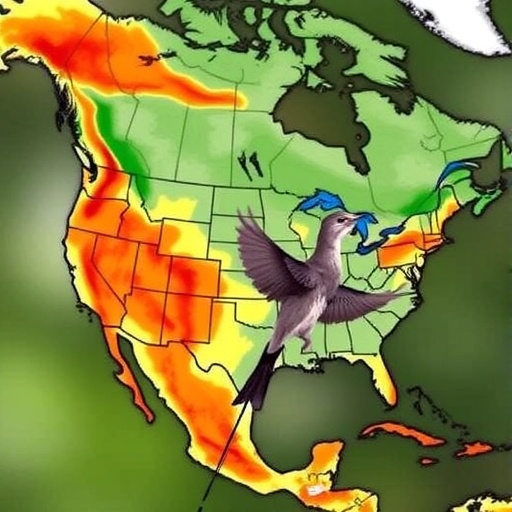
Extreme weather is redrawing the map of North American birdlife—and conventional biodiversity models may be missing the scale of the problem. A new Yale-led study of more than 500 bird species finds that scorching heat, severe cold, drought, and other short-lived climate extremes can sharply restrict where birds are able to survive, even when long-term temperature averages suggest that suitable habitat should exist. The result is a warning for scientists and conservation planners: species may occupy far smaller areas than standard models predict, particularly across the Great Plains and the southwestern United States. When climatic variability is ignored, biodiversity estimates can become inflated, potentially creating a misleading picture of where wildlife is protected and where it remains vulnerable.
The study, published in Global Change Biology, is the first continental-scale analysis to examine how both seasonal weather variability and extreme conditions influence avian biodiversity predictions across North America. Its central finding is straightforward but consequential: average climate is not enough to explain the boundaries of animal distributions. A location may have a temperature suitable for a bird across an entire season, yet still become unusable if a sudden freeze, heat wave, or prolonged drought pushes conditions beyond the species’ physiological limits. “Extreme conditions define the boundaries where organisms can exist,” said Jeremy Cohen, the study’s lead author and an associate research scientist in Yale’s Department of Ecology & Evolutionary Biology. “Seasonal weather averages alone may not tell the full story.”
To investigate the hidden influence of extreme weather, the researchers built species distribution models that combined several large ecological datasets. Satellite observations and ground-based environmental measurements were linked with bird observations submitted to eBird, a global citizen-science database used by members of the public, birdwatchers, and researchers. These models estimate the probability that a species will occur in a particular location by identifying relationships between sightings and environmental conditions. Instead of treating climate as a single long-term average, the Yale team incorporated information about temperature extremes, drought intensity, and the degree to which weather fluctuates through time. This allowed them to estimate not only where conditions are generally favorable, but also where birds can withstand the most difficult episodes of a season.
The researchers then compared those results with two other approaches. One set of models relied largely on average environmental conditions, effectively smoothing away unusual weather. Another included ordinary seasonal variation but did not fully account for the most intense heat, cold, and drought events. The comparison revealed a consistent pattern: models that included extreme conditions produced more accurate predictions and generally smaller habitat ranges. On average, models that omitted environmental variability and extremes overestimated bird ranges by about 10 percent during winter and 6 percent during summer. The difference was especially pronounced in winter, when weather conditions across North America tend to fluctuate more dramatically and sudden cold events can impose severe biological stress.
The consequences were even larger for individual species. For the hooded oriole, a songbird that breeds in the southwestern United States, models that excluded weather variability predicted a range roughly 30 percent larger than the area where the species is actually observed. Predictions for the eastern phoebe, which winters in the southeastern United States, were approximately 20 percent too broad. The varied thrush, a Pacific Northwest songbird that is sensitive to drought, was assigned a range about 10 percent larger than its observed distribution when extreme conditions were left out. These discrepancies illustrate why continent-wide averages can conceal species-specific vulnerabilities. Two birds living in the same broad region may respond very differently to a heat wave, a dry spell, or an abrupt drop in temperature.
The geographic pattern was also striking. The Great Plains and the Southwest showed some of the largest mismatches between conventional biodiversity estimates and models that accounted for extreme weather. Both regions experience strong fluctuations in temperature and water availability, creating conditions in which a species’ presence may depend on whether it can endure occasional climatic shocks. A landscape can therefore appear suitable when viewed through average conditions while remaining inhospitable during the events that determine survival, breeding success, or migration. By incorporating these events, the models provide a more realistic picture of the climatic filters that shape bird communities and the total number of species likely to occur in a given area.
The timing of extreme weather may be as important as its intensity. Birds can encounter dangerous conditions during migration, breeding, winter survival, or periods when food and water are already scarce. A short heat wave can increase dehydration and energy demands, while an intense cold snap can raise metabolic costs and eliminate insects or other food sources. Drought can reduce vegetation, wetlands, and prey availability even if air temperatures remain within a species’ normal range. Because the new models connect observations with these fluctuating environmental conditions, they can reveal why species disappear from places that appear suitable in climate summaries. They also offer a way to detect risks that may be overlooked when researchers focus only on gradual changes in average temperature.
The findings arrive as climate change is making extreme weather more frequent and, in many regions, more intense. “We all know extreme weather is on the rise with climate change,” Cohen said. “This is the first study to look at how increasingly variable and extreme weather affects avian biodiversity at a continental scale.” Walter Jetz, a Yale professor of ecology and evolutionary biology and director of the Yale Center for Biodiversity and Global Change, said that the irregular component of climate must now be treated as central to understanding biodiversity. As weather becomes less predictable, species distribution models based solely on historical averages may become increasingly unreliable, particularly if they fail to represent the rare events that establish the outer limits of survival.
Accurate range estimates are essential for conservation because they influence which habitats are considered priorities, how protected areas are designed, and how governments allocate resources. In parts of the United States, scientists have access to extensive bird observations and detailed population data. Elsewhere, particularly across large remote regions, direct monitoring remains sparse. In those data-poor areas, models often provide the primary evidence used to infer where species occur. If those models overestimate habitat, conservation programs may assume that birds are secure in places where extreme conditions prevent regular occupancy. More precise forecasts could help identify refuges that remain viable during climate shocks, locate landscapes in need of restoration, and anticipate where species may lose habitat before the decline becomes visible in survey records.
The Yale study was co-authored by Shubhi Sharma, Frank La Sorte, and Diego Ellis-Soto, with support from NASA grants and the E.O. Wilson Biodiversity Foundation through the Half-Earth Project. Its broader message extends beyond birds. As climate change accelerates, the future of biodiversity may be determined not only by where average conditions shift, but by how often ecosystems are disrupted by events that living organisms cannot tolerate. A map that includes those extremes can look very different from one based on climate averages alone—and for hundreds of North American bird species, that difference may determine whether conservationists recognize a real refuge, or mistake an increasingly dangerous landscape for a safe one.
News Publication Date: 8-Aug-2026
Web References: http://dx.doi.org/10.1111/gcb.71028
References: Cohen, J., Sharma, S., La Sorte, F., Ellis-Soto, D., and Jetz, W. “Continental-Scale Biodiversity Predictions Are Influenced by Climatic Variability and Extreme Weather.” Global Change Biology. DOI: 10.1111/gcb.71028
Cite Scienmag News
Margaret Porter. (August 12, 2026). Study finds extreme weather increasingly predicts North American bird species distributions. Scienmag. https://scienmag.com/study-finds-extreme-weather-increasingly-predicts-north-american-bird-species-distributions/
Margaret Porter. "Study finds extreme weather increasingly predicts North American bird species distributions." Scienmag, 12 August 2026, https://scienmag.com/study-finds-extreme-weather-increasingly-predicts-north-american-bird-species-distributions/. Accessed 4 September 2026.
Margaret Porter. "Study finds extreme weather increasingly predicts North American bird species distributions." Scienmag. August 12, 2026. https://scienmag.com/study-finds-extreme-weather-increasingly-predicts-north-american-bird-species-distributions/


