


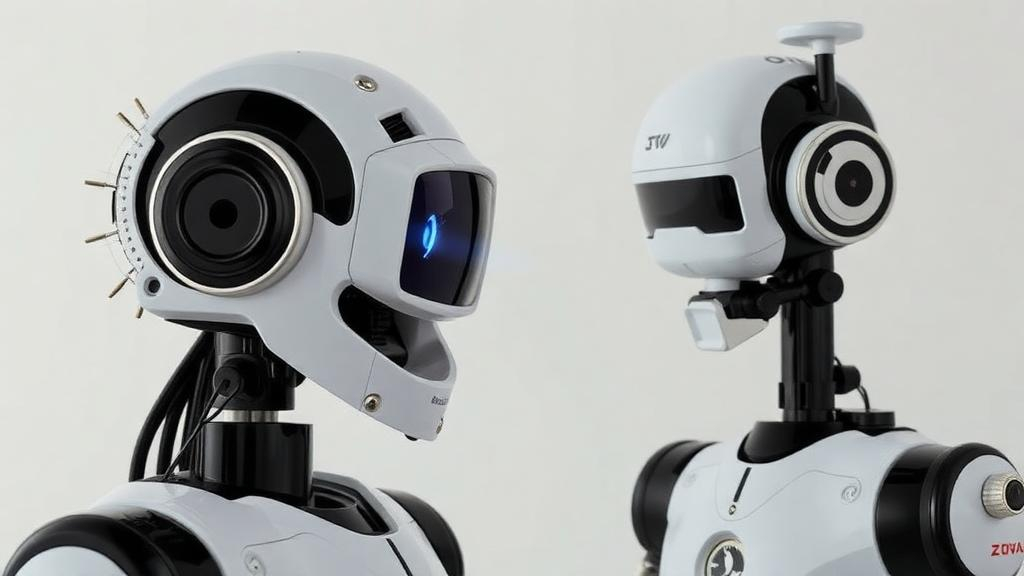
Robots that can chat about fashion are no longer science fiction, but whether people actually feel they are talking to someone depends on far more than fluent sentences. Researchers at the University of Lübeck have now systematically compared how different cognitive abilities shape the sense of social presence that a robot projects during face-to-face conversation. In a study published in Frontiers in Robotics and AI, Thomas Sievers and Nele Russwinkel equipped two humanoid Pepper robots with large language models, vision, and memory, and measured how 32 participants perceived them. Their central question was deceptively simple: does a robot that sees you, or one that remembers you, feel more like a genuine social partner? The answer carries weight well beyond the laboratory, because the demographic pressure of aging societies is making social robots for eldercare an increasingly serious proposition rather than a technological curiosity.
The motivation is stark. According to the German Federal Statistical Office, Germany faces a projected shortage of between 280,000 and 690,000 nursing staff by 2049 as its population ages. With interpersonal interactions often declining in older age, loneliness and social isolation become clinical problems in their own right, and care workers rarely have time for individualized conversation. Social robots equipped with artificial intelligence could help fill that gap, breaking up monotonous daily routines in nursing homes and fostering social connections. Yet the authors are careful to frame this as supplementation rather than replacement: both users and nursing staff consistently say robots should take over certain tasks, not substitute for human caregivers. Ethical concerns about autonomy, privacy, and social isolation also loom large, which makes understanding exactly what makes a robot feel socially real a design question with moral dimensions, not merely an engineering one.
The theoretical anchor of the study is Social Presence Theory, originally formulated by Short, Williams, and Christie in 1976 as the degree of salience of the other person in an interaction. Modern definitions describe social presence as the feeling of being with a real person, dependent on how easily one perceives access to that person’s intelligence, intentions, and sensory impressions. It matters because without a distinct sense of presence, interaction with a robot collapses into a purely physical exchange with an artificial object. Previous research has linked social presence to acceptance of assistive robots by older adults, to customer satisfaction with chatbots, and even to children forming stronger bonds with robots they perceive as socially present. Notably, prior work also shows that people treat robots as if they were moral actors capable of beliefs and intentions, even though they are not, which is why anthropomorphism, the attribution of human characteristics to machines, is considered desirable in social robots in measured doses.
For the technical implementation, the Lübeck team combined three cognitive layers. Unrestricted natural language came from large language models hosted by the European company Mistral AI, chosen partly because European-hosted models comply with GDPR data protection requirements. Visual perception relied on Mistral’s multimodal Pixtral 12B vision-language model, fed an image from the robot’s front camera every four seconds so the robot could comment on clothing, accessories, and surroundings during dialogue. Memory was handled by the ACT-R cognitive architecture, implemented in Python, which models human declarative and procedural memory. Keywords and recollection phrases generated by the language model from each dialogue turn were stored as chunks in declarative memory, and a production-rule system later retrieved matching memories based on chunk activation and similarity. These recollections were injected into the language model’s system prompt, allowing the robot to refer back to details from a previous conversation while simultaneously reducing the risk of hallucinated facts.
The experiment used a within-subjects design in which every participant conversed with two differently dressed Pepper robots, named Charlie and Kim, across four rounds. The first two rounds were introductory conversations in which both robots relied solely on speech; the following rounds added either vision for Charlie or memory for Kim, with the order randomized. Participants, aged 19 to 60 with an average age of 27, were recruited at the university and were not told in advance about the robots’ differing capabilities. After each conversation lasting roughly two to three minutes, they completed two questionnaires: seven social presence items on a five-point Likert scale, covering feelings such as talking to a real person, being listened to, and finding the conversation captivating, and the 16-item Human-Robot Interaction Evaluation Scale, which measures the anthropomorphic dimensions of sociability, animacy, agency, and disturbance on seven-point scales.
The statistical analysis was deliberately conservative. Because differences between measurements were not normally distributed, the researchers used the Wilcoxon signed-rank test instead of a paired t-test, and they applied the Holm-Bonferroni correction across 22 significance tests to control the family-wise error rate. After this correction, only two results survived: the social presence item asking whether the robot was really paying attention, which rose significantly when Charlie could see, and the anthropomorphic dimension of disturbance, which dropped significantly for the remembering robot Kim. With a sample of 32, statistical power is limited, and the authors caution that non-significant findings after correction should not be taken as evidence that no effects exist. Even so, the pattern of results is informative about which cognitive abilities move the needle and which do not.
The vision results were the more encouraging of the two. The overall average social presence score for Charlie climbed from 2.73 to 3.00 on the five-point scale when visual perception was added, with notable increases on feeling that the robot was paying attention, responding personally, being a living being, and offering a captivating conversation. The researchers interpret this as evidence that vision helps establish shared attention, shared mental models, and common ground between human and robot. Participants immediately noticed when the robot referenced what it could see, reacting with surprise and amazement. On the anthropomorphic side, however, vision changed little; sociability even dipped slightly, though not significantly, suggesting that extra perceptual abilities did not make the already humanoid Pepper feel more human-like, only more attentive. The authors also candidly note a technical weakness: the robot sometimes insisted repetitively on visual details and occasionally hallucinated objects that were not actually present.
Memory told a different story. Kim’s social presence scores were nearly identical with and without recollection, averaging 2.68 and 2.74, and the apparent rise on feeling like talking to a real person did not survive correction. Yet the remembering robot produced a statistically significant drop in the HRIES disturbance dimension, from 8.19 to 6.78, meaning participants found it less unsettling the second time around. The authors speculate that the short interval between conversations may simply have been too brief for memory to enhance social presence, and that familiarity with the robot from the earlier encounter could also have contributed to the reduced disturbance. They argue that studies with repeated interactions over extended periods, closer to real caregiving relationships, are needed to determine whether long-term memory genuinely deepens the sense of being with another mind.
An unexpected finding concerned gender. Male participants scored higher than female participants on nearly all social presence items and on the anthropomorphic dimensions of sociability, animacy, and agency across all conversations. But the researchers attribute this pattern most plausibly to professional background rather than gender itself: most female participants came from psychology, medicine, or nursing, while most male participants had technical or computer science backgrounds, and these differing attitudes and interests likely shaped their evaluations. The authors did not hypothesize these differences in advance and flag them as a worthwhile subject for future investigation.
The study’s limitations are acknowledged openly. Participants were young adults in a university room, not older residents of nursing facilities, so generalization to the intended target group remains an open question. Turn-taking problems, a monotonous robotic voice, and occasional memory errors all detracted from naturalness. Still, the core message is clear and actionable for the field: of the cognitive abilities tested, incorporating live visual impressions into conversation did more to make a robot feel socially present than recalling past encounters, at least over short timescales. As social robots edge toward real deployment in care settings, the difference between a machine that notices you and one that merely stores facts about you may prove to be the difference between an engaging companion and an unsettling fixture.
Subject of Research: The effect of robots' cognitive abilities, such as vision and memory, on perceived social presence and anthropomorphism in human-robot interaction
Article Title: How to express social presence: a comparison of perceptions of social robots’ cognitive abilities
Article References: Sievers, T., & Russwinkel, N. (2026). How to express social presence: a comparison of perceptions of social robots’ cognitive abilities. Frontiers in Robotics and AI, 13, Article 1938840. https://doi.org/10.3389/frobt.2026.1938840
Image Credits: AI Generated
DOI: 10.3389/frobt.2026.1938840
Keywords: social presence, social robots, human-robot interaction, anthropomorphism, large language models, vision-language models, ACT-R, memory, eldercare, Pepper robot, cognitive architecture, conversation AI
Cite Scienmag News
Denise Maddox. (October 16, 2026). Seeing Beats Remembering: What Makes a Robot Feel Socially Present. Scienmag. https://scienmag.com/seeing-beats-remembering-what-makes-a-robot-feel-socially-present/
Denise Maddox. "Seeing Beats Remembering: What Makes a Robot Feel Socially Present." Scienmag, 16 October 2026, https://scienmag.com/seeing-beats-remembering-what-makes-a-robot-feel-socially-present/. Accessed 16 October 2026.
Denise Maddox. "Seeing Beats Remembering: What Makes a Robot Feel Socially Present." Scienmag. October 16, 2026. https://scienmag.com/seeing-beats-remembering-what-makes-a-robot-feel-socially-present/


