


For millions of older adults living with sarcopenia and frailty, the question of which exercise actually works has long been answered with a vague shrug: just move more. A new network meta-analysis published in BMC Geriatrics by Kai Wang, Ting-Fu Lai, and colleagues at Dong-A University in Busan, South Korea, and Taipei Medical University in Taiwan, replaces that shrug with something far more useful: a ranked, quantified, and deficit-targeted prescription map. Drawing on 61 randomized controlled trials involving 3,706 participants, the study is among the most comprehensive efforts to date to compare specific exercise modalities head-to-head and to identify the optimal dose parameters for each.
The technical machinery behind the analysis is a frequentist random-effects network meta-analysis, a statistical framework that allows interventions to be compared both directly, within the same trials, and indirectly, across the wider network of studies. Rather than asking whether exercise works in general, the researchers asked which modality works best for which physical function deficit. Rankings were determined using the surface under the cumulative ranking curve, or SUCRA, a metric that assigns each intervention a probability of being the most effective treatment, expressed as a percentage from 0 to 100. The certainty of the evidence supporting each ranking was then evaluated using the GRADE minimally contextualized framework, which grades confidence from high to low based on study limitations, inconsistency, indirectness, imprecision, and publication bias.
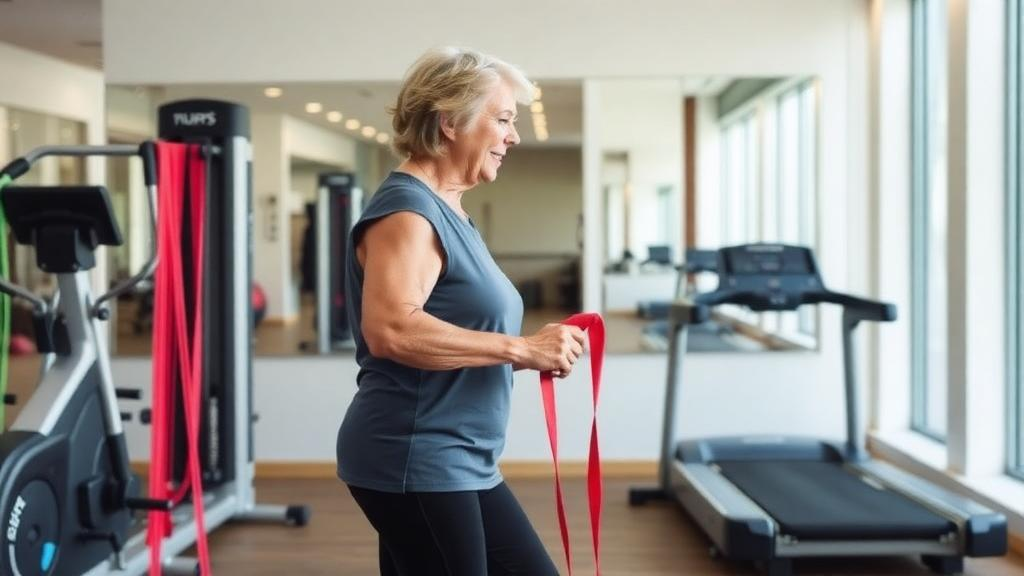
The headline finding concerns elastic band resistance training, a low-cost, accessible modality that emerged as the most effective intervention for handgrip strength, one of the most clinically meaningful markers of whole-body muscle function in older adults. Elastic band training increased handgrip strength by a mean difference of 1.95 kilograms, with a 95 percent confidence interval of 1.13 to 2.76 kilograms, and achieved a SUCRA ranking of 98.6 percent, meaning it was almost certainly the top-performing modality for this outcome. Critically, this evidence was rated as moderate certainty under network GRADE, the highest confidence level awarded to any single modality-specific strength finding in the analysis.
Machine-based resistance training showed a different profile. For knee extension strength, a direct measure of quadriceps capacity that underpins standing, stair climbing, and chair rise, machine-based training produced a mean difference of 2.96 kilograms, with a 95 percent confidence interval of 1.59 to 4.34 kilograms and a SUCRA ranking of 65.3 percent, indicating possible intermediate effectiveness. The certainty of this evidence was low, however, meaning clinicians should interpret the magnitude with caution. The distinction matters because it suggests that different resistance modalities may target different strength deficits with different efficiency, a finding that runs counter to the one-size-fits-all approach embedded in many current guidelines.
The dose-response analyses add a layer of prescription precision that few prior syntheses have attempted. For elastic band training, greater strength gains were observed with higher training volume, meaning more total repetitions or sets per session produced progressively larger improvements. For machine-based resistance training, the opposite prescription logic applied: the modality was more effective at high intensity, meaning heavier loads relative to maximum capacity drove the best results. These findings imply that the optimal dose parameters are modality-specific, and that simply telling an older adult to do resistance exercise twice a week misses the point of how the exercise should be configured.
For the broader picture of functional mobility, the ability to walk, transfer, and navigate daily environments, multicomponent training that includes resistance training provided the most comprehensive benefits. Multicomponent programs typically combine resistance, balance, aerobic, and flexibility elements into a single intervention, and the network meta-analysis found that those incorporating resistance work ranked highest for overall functional mobility gains. The certainty of this evidence was low, however, reflecting heterogeneity across the included trials and imprecision in the effect estimates. Still, the finding aligns with the biological rationale that mobility is a compound capacity requiring multiple physiological systems, including muscle strength, power, balance control, and cardiovascular endurance, to be trained simultaneously.
Sarcopenia, the age-related loss of muscle mass and function, and frailty, a state of decreased physiological reserve and heightened vulnerability to stressors, affect a substantial and growing share of the global older population. Exercise remains the primary non-pharmacological intervention for both conditions, yet the comparative effects and optimal prescription parameters of specific modalities have remained unclear despite decades of trials. This analysis addresses that gap by synthesizing evidence from PubMed, Ovid MEDLINE, Embase, ClinicalTrials.gov, PEDro, and the Cochrane Library, with studies included up to June 1, 2025. The systematic review was registered in PROSPERO under registration number CRD420251042815, ensuring transparency in the review protocol.
The clinical implications of the findings are straightforward but consequential. Rather than prescribing exercise generically, clinicians working with older adults with sarcopenia and frailty can now adopt a modality-specific, deficit-targeted approach: if the primary deficit is handgrip strength, elastic band resistance training carries the strongest and most certain evidence; if the deficit is knee extension strength, machine-based training at high intensity may be the better choice, though with lower certainty; and if the goal is overall functional mobility, multicomponent training that includes resistance work offers the most comprehensive benefits. The dose-response findings further refine this logic, suggesting that elastic band programs should prioritize volume while machine-based programs should prioritize intensity.
The GRADE certainty ratings embedded throughout the analysis serve as an honest accounting of what the evidence can and cannot support. Moderate certainty for elastic band training and handgrip strength means the true effect is likely close to the estimated 1.95 kilogram improvement, though further research could still refine the magnitude. Low certainty for machine-based training, multicomponent training and mobility, and other modality-specific findings means the true effects could differ substantially from the point estimates, and that future trials may change the rankings. This transparency is a feature, not a flaw, of the analysis, and it gives clinicians a calibrated sense of how much confidence to place in each prescription decision.
The study was supported by the Ministry of Education of the Republic of Korea and the National Research Foundation of Korea under grant NRF-2025S1A5A2A03012772. The corresponding author is Hyuntae Park of Dong-A University, and the research team includes investigators from the Department of Health Sciences and the Digital Healthcare Institute at Dong-A University in Busan, along with Ting-Fu Lai of the School of Gerontology and Long-Term Care at Taipei Medical University in Taiwan. As the global population ages and the burden of sarcopenia and frailty grows, the shift from generic exercise advice to modality-specific, deficit-targeted prescriptions represents a meaningful step toward precision geriatric medicine, where the right exercise, at the right dose, for the right deficit, becomes the standard of care rather than the exception.
Subject of Research: Geriatrics
Article Title: Modality-specific, deficit-targeted exercise prescriptions for physical function in sarcopenia and frailty: a network meta-analysis
Article References: Wang, K., Lai, T.-F., Noh, E.-S., Yang, J., Min, C., Bae, S., & Park, H. (2026). Modality-specific, deficit-targeted exercise prescriptions for physical function in sarcopenia and frailty: a network meta-analysis. BMC Geriatrics. https://doi.org/10.1186/s12877-026-08352-3
Image Credits: AI Generated
DOI: 10.1186/s12877-026-08352-3
Keywords: sarcopenia, frailty, exercise prescription, network meta-analysis, resistance training, elastic band training, machine-based training, multicomponent training, handgrip strength, functional mobility, older adults, dose-response
Cite Scienmag News
Beatrice Stafford. (October 16, 2026). Elastic Bands, Machines, and Multicomponent Workouts: New Analysis Reveals Which Exercise Best Fights Sarcopenia and Frailty. Scienmag. https://scienmag.com/elastic-bands-machines-and-multicomponent-workouts-new-analysis-reveals-which-exercise-best-fights-sarcopenia-and-frailty/
Beatrice Stafford. "Elastic Bands, Machines, and Multicomponent Workouts: New Analysis Reveals Which Exercise Best Fights Sarcopenia and Frailty." Scienmag, 16 October 2026, https://scienmag.com/elastic-bands-machines-and-multicomponent-workouts-new-analysis-reveals-which-exercise-best-fights-sarcopenia-and-frailty/. Accessed 16 October 2026.
Beatrice Stafford. "Elastic Bands, Machines, and Multicomponent Workouts: New Analysis Reveals Which Exercise Best Fights Sarcopenia and Frailty." Scienmag. October 16, 2026. https://scienmag.com/elastic-bands-machines-and-multicomponent-workouts-new-analysis-reveals-which-exercise-best-fights-sarcopenia-and-frailty/


