


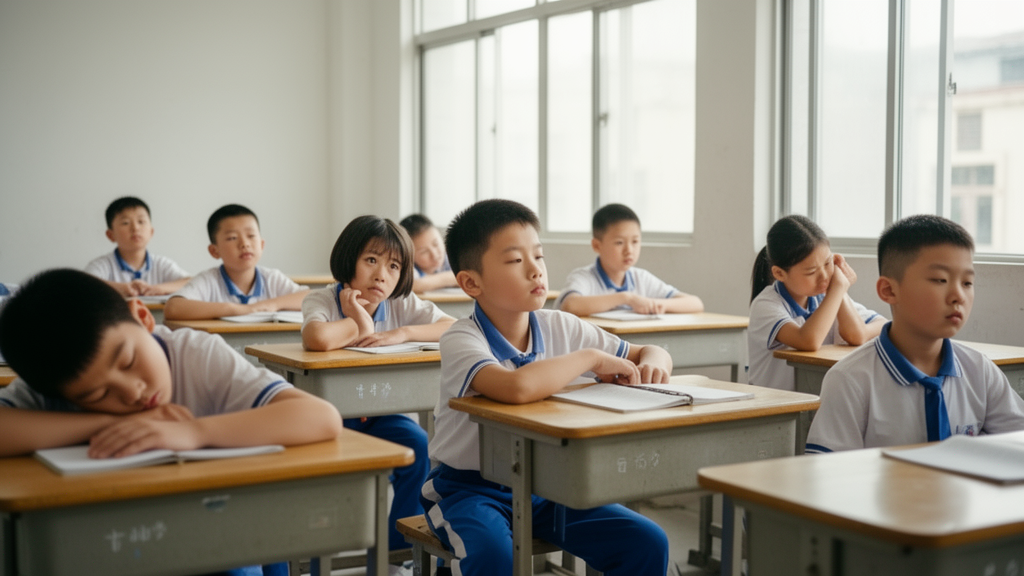
Childhood mental health has long been treated as a single sliding scale from well to unwell, but a new study of more than 3,000 Chinese school-aged children suggests that emotional and behavioral difficulties come in distinct flavors, each with its own risk signature. The research, published in BMC Psychology, used a statistical technique called latent profile analysis to sort children into five groups based on their patterns of emotional symptoms, conduct problems, hyperactivity, peer difficulties and prosocial behavior. The findings point a spotlight squarely at the family environment and daily habits, with physical punishment, family conflict, weekend screen time and short sleep each linked to specific profiles of difficulty rather than a generic elevation of risk.
The study team, led by pediatric researchers from Ningde Municipal Hospital and Pingnan County Hospital in Fujian Province, surveyed 3,050 children aged 6 to 12 years. Parents completed the Strengths and Difficulties Questionnaire, a widely validated screening instrument that measures five dimensions: emotional symptoms, conduct problems, hyperactivity and inattention, peer relationship problems, and prosocial behavior. Rather than simply adding these subscales into a total difficulties score, the researchers applied latent profile analysis, a person-centered method that asks whether the population contains subgroups of children who share similar response patterns across all five dimensions simultaneously.
The technical logic behind this approach matters. Variable-centered methods, such as ordinary correlation and regression on summary scores, assume that the sample is homogeneous and that associations apply uniformly to everyone. Latent profile analysis instead models the data as a mixture of unobserved subpopulations, estimating the probability that each child belongs to each profile. The researchers fit a series of competing models and selected the optimal solution using standard fit criteria, including the Akaike information criterion, the Bayesian information criterion, entropy as a measure of classification precision, and the requirement that each resulting class contain a practically meaningful proportion of children. The five-profile solution emerged as the best balance of statistical parsimony and interpretive clarity.
The largest group, comprising 56.8 percent of the children, was labeled the Normative profile, showing no marked elevations on any subscale. But nearly half the sample fell into one of four atypical profiles. The most common of these, at 18.1 percent, was Elevated Emotional Symptoms, in which children showed heightened anxiety and low mood without corresponding behavioral dysregulation. A further 12.3 percent belonged to a profile the authors called Low Hyperactivity and Low Prosocial Behavior, a quieter pattern in which children were neither restless nor particularly socially engaged. Two smaller but clinically concerning groups completed the picture: Elevated Conduct Problems and Low Prosocial Behavior, at 7.6 percent, and High Emotional and Multi-Domain Difficulties, at 5.2 percent, the latter representing children struggling across nearly every measured domain.
The most striking results came from the analysis of what distinguishes these profiles. Physical punishment showed a graded, dose-like cross-sectional association with profile membership. Compared with children who had never been physically punished, those with frequent exposure had substantially higher odds of belonging to the Elevated Conduct Problems and Low Prosocial Behavior profile and to the High Emotional and Multi-Domain Difficulties profile. Family conflict followed a strikingly similar pattern, with adjusted odds ratios of 3.42 for the conduct-problems profile and 3.55 for the multi-domain difficulties profile. In other words, children growing up amid frequent family conflict were roughly three and a half times more likely to land in the most troubled groups than their peers from low-conflict households, even after accounting for other measured characteristics.
Lifestyle factors told a complementary story. Excessive weekend screen time, defined in the study as more than two hours per day, was associated with higher odds of membership in the Elevated Emotional Symptoms profile and, with an adjusted odds ratio of 1.91, in the Elevated Conduct Problems and Low Prosocial Behavior profile. Short sleep duration, below the nine-hour threshold recommended for school-aged children, showed its most pronounced association with the conduct-problems profile, where it carried an adjusted odds ratio of 2.12. These associations were profile-specific: a given risk factor did not raise the odds of every atypical profile equally, which is precisely the kind of differentiated signal that a person-centered analysis is designed to detect and that a single total-difficulties score would obscure.
The differential patterning is what gives the study its practical bite. Emotional symptoms in middle childhood often fly under the radar because they do not disrupt classrooms the way hyperactivity or aggression do, yet the Elevated Emotional Symptoms profile captured nearly one in five children in this sample. The finding that weekend screen time, but not necessarily the family-conflict variables, was the factor most clearly tied to this profile suggests that different intervention levers may be needed for internally directed versus externally directed difficulties. Conversely, for children in the conduct-problems and multi-domain profiles, the dominant correlates were punitive discipline, household conflict and insufficient sleep, pointing toward family-system and sleep-hygiene interventions rather than screen-time limits alone.
The authors frame their conclusions as a call to prioritize the family parenting environment and healthy lifestyle habits in child health management. That framing is consistent with a substantial body of developmental science linking harsh discipline to externalizing behavior and linking sleep restriction to emotional and behavioral dysregulation, but the present study adds granularity by showing that these exposures cluster with particular symptom configurations. It is worth emphasizing the study’s cross-sectional design: the data capture associations at a single point in time, so they cannot establish whether physical punishment causes conduct problems, whether children with difficult behavior elicit harsher discipline, or whether both are shaped by unmeasured factors. Longitudinal follow-up would be needed to disentangle those directions of effect.
Methodologically, the study has notable strengths. The sample of 3,050 children is large enough to support stable profile estimation, and the use of multiple fit indices guards against over-extracting or under-extracting latent classes. The Strengths and Difficulties Questionnaire is one of the most extensively validated child mental health screens worldwide, and the anonymous administration of the survey, along with ethics approval from Pingnan County Hospital and informed consent from parents, addresses common concerns about reporting sensitive family variables. The research was supported by the Ningde Natural Science Foundation, and the authors report no competing interests.
For clinicians, educators and policymakers, the message is that childhood mental health screening may benefit from moving beyond aggregate scores toward pattern recognition. A child with moderate scores spread thinly across several subscales and a child with a sharp spike in emotional symptoms alone may both escape attention under a total-difficulties cutoff, yet they belong to different profiles with different correlates and potentially different intervention needs. As screen time and sleep debt continue to rise among school-aged children worldwide, and as debates over disciplinary practices persist, this study offers a data-driven map of how those everyday exposures align with the actual shapes of childhood distress, and a reminder that the household remains the most powerful lever available for shaping it.
Subject of Research: Latent profiles of emotional and behavioral problems and their environmental and lifestyle correlates among Chinese school-aged children
Article Title: Latent profiles of emotional and behavioral problems in Chinese school-aged children and their associations with environmental and lifestyle factors
Article References: Lu, Y., He, D., wang, T., Qian, F., Lin, Z., Zheng, Y., Zheng, M., Zhang, J., & Wang, J. (2026). Latent profiles of emotional and behavioral problems in Chinese school-aged children and their associations with environmental and lifestyle factors. BMC Psychology. https://doi.org/10.1186/s40359-026-05680-2
Image Credits: AI Generated
DOI: 10.1186/s40359-026-05680-2
Keywords: latent profile analysis, emotional and behavioral problems, school-aged children, Strengths and Difficulties Questionnaire, physical punishment, family conflict, screen time, sleep duration, prosocial behavior, child mental health, BMC Psychology, China
Cite Scienmag News
Glenn Wilkins. (October 8, 2026). Screen Time, Sleep and Punishment: Five Distinct Mental Health Profiles Emerge in Chinese Schoolchildren. Scienmag. https://scienmag.com/screen-time-sleep-and-punishment-five-distinct-mental-health-profiles-emerge-in-chinese-schoolchildren/
Glenn Wilkins. "Screen Time, Sleep and Punishment: Five Distinct Mental Health Profiles Emerge in Chinese Schoolchildren." Scienmag, 8 October 2026, https://scienmag.com/screen-time-sleep-and-punishment-five-distinct-mental-health-profiles-emerge-in-chinese-schoolchildren/. Accessed 8 October 2026.
Glenn Wilkins. "Screen Time, Sleep and Punishment: Five Distinct Mental Health Profiles Emerge in Chinese Schoolchildren." Scienmag. October 8, 2026. https://scienmag.com/screen-time-sleep-and-punishment-five-distinct-mental-health-profiles-emerge-in-chinese-schoolchildren/


