


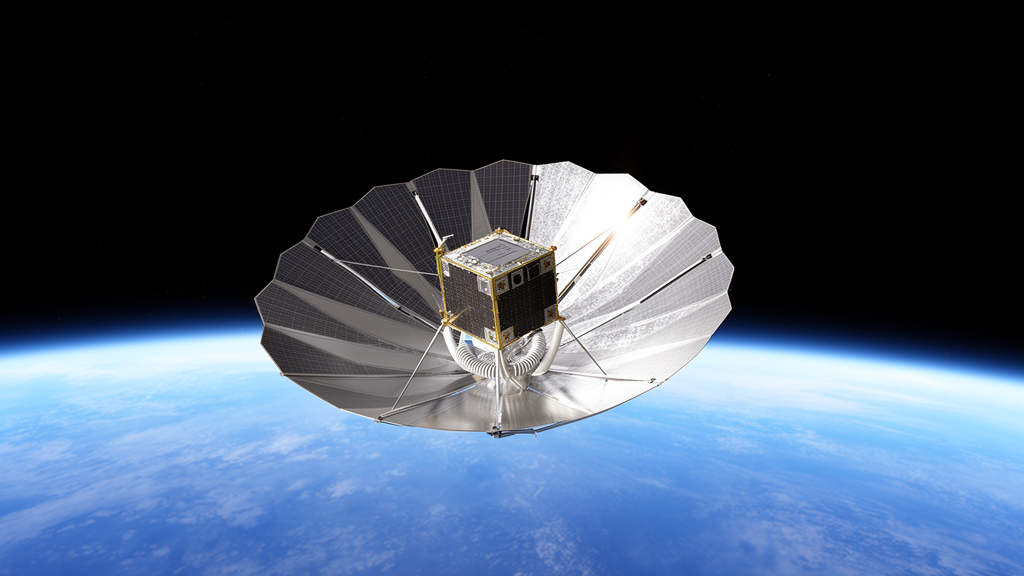
In a milestone that could reshape how the planet connects to the internet, researchers at Institute of Science Tokyo have completed the world’s first in-orbit demonstration of a deployable phased-array transceiver capable of correcting for the warping of its own foldable antenna. The achievement, presented at the IEEE International Microwave Symposium in Boston on June 10, 2026 and published online on July 29, 2026, proves that a sophisticated, high-performance radio system can be packed into the cramped body of a small satellite, unfolded in space, and made to work despite the inevitable imperfections of a membrane that refuses to lie perfectly flat. For a field racing to build vast constellations of inexpensive spacecraft in the Beyond 5G and 6G era, the demonstration removes one of the most stubborn engineering obstacles standing in the way.
The logic behind the research begins with a simple economic reality. Large geostationary communications satellites can deliver enormous capacity, but they are expensive to build and costly to launch. Small satellites, by contrast, are cheap, light, and increasingly capable, which makes it practical to fly them in constellations: hundreds or thousands of spacecraft working in concert to blanket the globe with coverage. Such constellations promise affordable high-speed connectivity for remote regions, ships at sea, aircraft in transit, and communities that terrestrial fiber infrastructure has never reached. Yet small satellites face a fundamental constraint. The volume and weight allowances on a launch vehicle are brutally limited, and conventional radio hardware, particularly the large antennas needed for high-gain directional communication, simply does not fit inside a compact spacecraft bus.
The solution pursued by the Science Tokyo team, led by Professor Hiraku Sakamoto of the Department of Mechanical Engineering, Associate Professor Atsushi Shirane of the Laboratory for Future Interdisciplinary Research of Science and Technology, and Professor Kenichi Okada of the Department of Electrical and Electronic Engineering, draws on the ancient art of origami. Foldable membrane antennas are thin, lightweight structures that can be stowed compactly during launch and then unfolded in orbit into a large radiating aperture. The concept is elegant on paper: the satellite gains a big antenna without carrying a big antenna through the atmosphere. But elegance collides with physics the moment the membrane deploys. Thin flexible structures do not spring into a perfectly planar shape. They warp, bend, and ripple, and those small geometric deviations have outsized consequences for a phased-array system.
A phased-array transceiver works by coordinating many individual radiating elements so that their signals combine constructively in one direction and destructively in all others, steering a focused beam electronically without any moving parts. The technique depends on exquisite synchronization: the relative timing and phase of each element’s signal must correspond precisely to the physical positions of the elements. When a membrane antenna deploys with even small non-planar deformations, the actual spacing between elements no longer matches the assumed geometry. The beam pattern degrades, sidelobes grow, and the carefully engineered directional performance collapses. This deformation problem has been the central barrier preventing foldable membrane arrays from graduating from laboratory curiosities to operational satellite hardware.
The Science Tokyo team’s breakthrough was to build a transmitter that measures and compensates for its own deformation. Their Ka-band, 16-element active phased-array transmitter was mounted across two separate boards on a deployable membrane and carried aboard the RAISE-4 small satellite, which launched on December 14, 2025 as part of the HELIOS-R project within JAXA’s Innovative Satellite Technology Demonstration-4 program. After the membrane unfolded in orbit, the system applied a calibration method previously validated in ground testing to estimate the actual bend between its two boards. With that estimate in hand, the transceiver electronically adjusted the signal timing of each antenna element, restoring the coherent coordination that the warped geometry would otherwise have destroyed.
The in-orbit experiments, which began on March 13, 2026, delivered unambiguous results. Directional beam control operated correctly both independently on each transmitter board and simultaneously across both, and the calibration scheme successfully compensated for the membrane’s non-planar shape after deployment. In practical terms, the satellite demonstrated that a folded, flexible, imperfectly deployed antenna could still deliver the precise electronic beam steering that modern satellite communications demand. The team also examined how transmitter temperature affected communication performance, gathering flight data that will inform the design of future systems expected to endure the thermal swings of the space environment, where surfaces cycle between intense sunlight and frigid eclipse every orbit.
The significance of the demonstration extends well beyond a single successful experiment. By showing that a high-performance phased-array transceiver can be reliably packaged inside a small satellite, the work establishes a foundation for scaling up to larger deployable arrays. Larger apertures mean higher gain, stronger links, and greater data throughput, which are exactly the qualities next-generation satellite networks require. The architecture validated on RAISE-4 suggests a path by which constellations of modest, inexpensive spacecraft could collectively deliver the kind of capacity and coverage traditionally reserved for their giant, costly counterparts, bringing genuinely global broadband coverage a step closer to reality and promising better connectivity for underserved regions that have waited decades for it.
Sakamoto and his colleagues see the work as a catalyst for the coming generation of wireless infrastructure. “We expect our results to accelerate the adoption of satellite constellation-based wireless communication systems in the 6G era, helping realize a society in which anyone can connect anytime and anywhere,” Sakamoto said. The statement captures the broader vision driving the field: a future in which the boundary between terrestrial and space communications dissolves, and connectivity follows people rather than the other way around. Direct-to-device services, resilient disaster communications, and ubiquitous broadband all depend on the kind of compact, deployable, electronically steered antenna technology that this demonstration has now proven in the harshest test environment available: space itself.
The project also carried a human dimension that the researchers regard as central to its legacy. More than 20 students from Science Tokyo participated in the development of the space-demonstration system, gaining hands-on experience in every stage of designing, building, and operating flight hardware. “The project therefore contributes not only to technological advancement but also to the education and training of future professionals in the increasingly important fields of space technology and wireless communications,” Sakamoto concluded. As the space economy expands and the demand for satellite communications expertise intensifies, that pipeline of trained engineers may prove as consequential as the technology itself.
From origami-inspired membranes to self-calibrating electronics, the RAISE-4 experiment weaves together mechanical engineering, radio-frequency design, and orbital operations into a single working system. The research, published in the IEEE International MTT Symposia under the title “On-Orbit Demonstration of a Deployable Ka-Band 16-Element Active Phased-Array Transmitter,” marks the moment deployable phased-array technology moved from promise to proof. If the vision holds, the satellites that carry humanity’s 6G traffic may well unfold in orbit like paper sculptures, quietly bending to the realities of space while keeping their beams locked on the users below.
Subject of Research: In-orbit demonstration of a deployable Ka-band phased-array transceiver with non-planar deformation correction for small satellite communications
Article Title: Wireless communications breakthrough: a deployable phased-array transceiver for small satellites
Article References: Wireless communications breakthrough: a deployable phased-array transceiver for small satellites. (n.d.). Original publication
Image Credits: AI Generated
DOI: Not provided
Keywords: small satellites, phased-array transceiver, deployable membrane antenna, origami antenna, 6G, Beyond 5G, satellite constellations, RAISE-4, JAXA, Ka-band, beam steering, Science Tokyo
Cite Scienmag News
Grant Pearson. (October 8, 2026). Foldable Antenna Flies: Small Satellites Take a Giant Leap Toward 6G. Scienmag. https://scienmag.com/foldable-antenna-flies-small-satellites-take-a-giant-leap-toward-6g/
Grant Pearson. "Foldable Antenna Flies: Small Satellites Take a Giant Leap Toward 6G." Scienmag, 8 October 2026, https://scienmag.com/foldable-antenna-flies-small-satellites-take-a-giant-leap-toward-6g/. Accessed 8 October 2026.
Grant Pearson. "Foldable Antenna Flies: Small Satellites Take a Giant Leap Toward 6G." Scienmag. October 8, 2026. https://scienmag.com/foldable-antenna-flies-small-satellites-take-a-giant-leap-toward-6g/


