


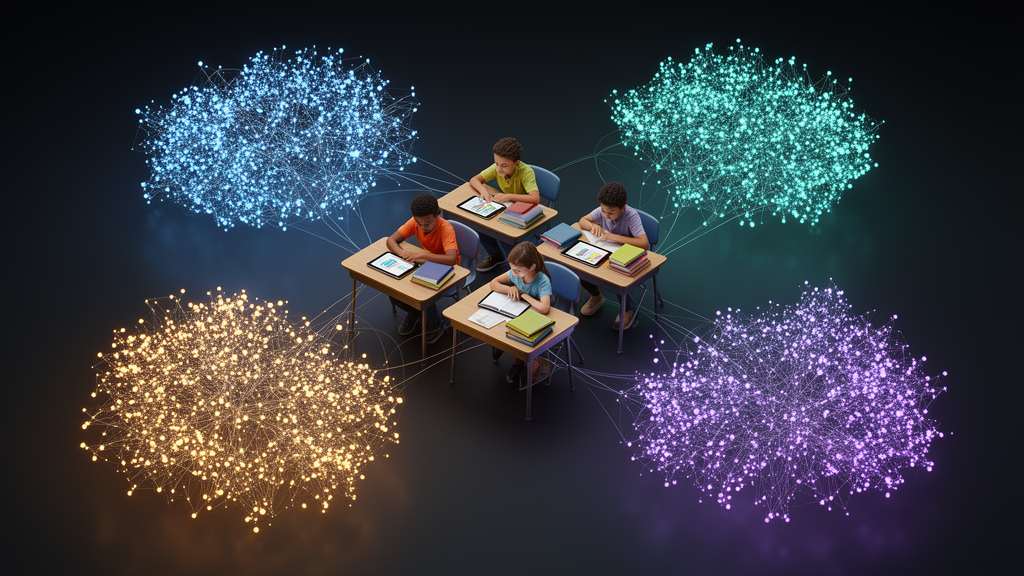
A scientometric analysis of 1,154 validated Scopus-indexed documents found that research on artificial intelligence in K–12 teaching and learning expanded rapidly after 2019, particularly from 2023 onward, and increasingly organized around four themes: AI literacy, large language models, early childhood education and broader K–12 contexts. The study, published in Discover Education, used publication counts, co-citation networks, thematic clustering and citation-burst analysis to characterize how the scholarly field has developed. It did not test whether AI tools improve learning, but mapped the literature’s intellectual structure and changing concentration of research attention.
The corpus covered English-language journal articles, conference papers, conference reviews and review articles published from 2016 through 29 May 2026. The search combined terms for artificial intelligence with educational processes and school levels, including K–12, primary, secondary, elementary, middle, high, compulsory and school-age education. Records were restricted to Scopus’s Social Sciences subject area. A content-level validation process examined titles and abstracts for direct K–12 relevance, identified possible higher-education contamination and detected duplicates. After borderline, ambiguous, duplicate and non-relevant records were excluded, 1,154 documents remained, representing 60.23% of the initially retrieved set.
Annual output was initially limited: the validated corpus contained five publications in 2016, four in 2017 and five in 2018. Production then rose to 15 documents in 2019, 18 in 2020, 40 in 2021 and 61 in 2022. It increased to 90 in 2023, 214 in 2024 and 469 in 2025. By 29 May 2026, Scopus had indexed 233 additional records, although this incomplete-year count cannot establish the final annual total. The authors associate the acceleration with the diffusion of generative AI, increased attention to AI competencies in curricula and policy, and continued experimentation with AI-supported educational technologies. The temporal pattern is an observational feature of the literature rather than evidence that any particular technology caused the growth.
Co-citation analysis was performed with CiteSpace version 7.0.R0 using annual time slices, a g-index selection of k = 25 and no network pruning. The resulting network contained 537 nodes and 1,734 links, with a density of 0.012. That density is far below the theoretical maximum of 1, but the authors characterized the network as moderately cohesive and increasingly interconnected. Its weighted mean silhouette score was 0.7922 and its modularity score was 0.6527, measures reported as indicating good consistency within clusters and reasonable differentiation among them. Clustering was interpreted through latent semantic indexing, log-likelihood ratio and mutual information, with log-likelihood ratio terms prioritized for the final labels and representative cited works inspected manually.
Artificial intelligence literacy formed the largest major cluster, with 109 co-cited documents, a silhouette score of 0.701 and a mean publication year of 2022. Terms associated with this group included AI literacy education, generative AI, explainable AI, prompt engineering, critical thinking and responsible integration. The cluster linked curriculum design and teacher preparation with students’ and teachers’ capacity to understand, evaluate and ethically engage with AI systems. Representative works examined a conversational platform intended to help children aged eight to 11 understand machine-learning concepts, embodied and culturally responsive approaches for early-childhood AI education, professional development for computer-science teachers, teacher misconceptions and curriculum co-design with elementary students and teachers. Across these studies, literacy was treated as more than operational tool use, extending to conceptual understanding, critical reflection and ethical awareness.
The large language model cluster contained 74 documents and had a silhouette score of 0.861, indicating strong thematic consistency. Its mean publication year was 2023, consistent with the rapid emergence of generative systems such as ChatGPT. The group connected LLMs and chatbots with instructional support, programming learning, AI-mediated assessment, feedback, teachers’ digital competence and changing classroom roles. One cited study examined ChatGPT-generated grading of programming assignments and reported strong correlations with teacher-generated assessments, while also raising concerns about hallucinations, reproducibility and continuing human oversight. Other influential work assessed teachers’ attitudes, finding optimism about opportunities for personalized learning alongside concerns about ethics, data privacy, professional identity and infrastructure. The mapping therefore records a research emphasis on generative systems and assessment, not proof that automated grading is dependable in every classroom.
Early childhood education was the third major cluster, comprising 68 documents, with a silhouette score of 0.813 and a mean publication year of 2020. Its central concern was developmentally appropriate instruction for younger learners through visual, interactive, playful and embodied approaches to machine learning. Influential contributions included a systematic mapping of visual tools such as Scratch and App Inventor, a framework for holistic AI-education design in K–12 schools, and the Cognimates project, in which children aged seven to 14 learned about AI by programming and teaching intelligent agents. The associated literature emphasized conceptual understanding, creativity, communication, ethical reflection and collaboration rather than technical operation alone. Much of this strand was described as exploratory and conceptual, focusing on principles for introducing AI into elementary education rather than evaluating large-scale implementation outcomes.
The fourth cluster, K–12 context, contained 60 documents and had a silhouette score of 0.855, the highest of the four major groups, while its mean publication year was 2020. It addressed AI-supported learning environments, high-school education, youth experiences, motivation, curriculum transformation, ethics and the social consequences of integrating intelligent systems into schools. Representative contributions included PoseBlocks, a block-based toolkit through which students created projects involving body tracking, emotion recognition and machine-learning models; a framework distinguishing AI-directed learning, AI-supported collaboration and AI-empowered learner agency; and an elementary curriculum framework that organized AI literacy into knowledge, skills and attitudes. Privacy, fairness, algorithmic bias, accountability, explainability and responsible innovation made this cluster broader than a category of technical tools, framing school AI as a sociotechnical issue involving curriculum, learners, institutions and human judgment.
Citation-burst analysis added a temporal view by identifying publications that experienced rapid increases in citation attention. The strongest burst was associated with Touretzky and colleagues’ 2019 paper, “Envisioning AI for K–12: What Should Every Child Know About AI?”, with a burst strength of 10.44. It was followed by Long and Magerko’s 2020 paper, “What is AI Literacy? Competencies and Design Considerations,” with a burst of 9.27. Other notable bursts involved Scratch-based instruction for high-school students, machine learning with very young children, the PopBots early-childhood curriculum, documentation of the international expansion of AI curricula, educational resources and teacher professional-development initiatives, teacher participation in curriculum co-design, and a one-year middle-school AI curriculum. The burst pattern traces a progression from foundational competency frameworks and constructionist activities toward structured curricula, teacher-supported implementation and age-appropriate educational design.
Taken together, the clusters show a research field moving beyond isolated technical applications toward questions about literacy, pedagogy, equity and responsible implementation. Teacher readiness repeatedly appeared alongside professional development, curriculum adaptation, ethical governance, explainability and learner agency. The analysis also shows partial overlap among the groups rather than a rigid division: large language models appear within discussions of literacy and school context, while early-childhood studies address ethics, curriculum and teacher design. The authors identify longitudinal research on achievement, identity development, creativity and career trajectories, adaptation to culturally diverse and resource-constrained settings, and the agency and power relations among students, teachers and generative systems as important gaps. These are proposed research priorities, not demonstrated benefits or tested policy prescriptions.
The findings are bounded by the study design. The corpus was limited to English-language Scopus-indexed records in the Social Sciences subject area, so relevant work in other databases, languages or technical disciplines may be underrepresented. Although title-and-abstract screening, duplicate detection and strict relevance filtering reduced false positives, classifying interdisciplinary or borderline records may retain interpretive subjectivity. The 2026 publication count is incomplete, and co-citation and burst patterns reflect the structure and timing of scholarly attention rather than the effectiveness of classroom interventions. Within these limits, the analysis presents AI research for K–12 schools not only as a technical innovation but as a field increasingly concerned with literacy, teacher expertise, age-appropriate design, ethical oversight and the interaction between automated systems and human judgment in real classrooms.
Subject of Research: Scientometric mapping of artificial intelligence research in K–12 teaching and learning
Article Title: Mapping research trends in artificial intelligence for K–12 teaching and learning: a scientometric analysis
Article References: Parra-Sánchez, D. T., & Uribe-Arengas, J. J. (2026). Mapping research trends in artificial intelligence for K–12 teaching and learning: a scientometric analysis. Discover Education, 5(1), Article 1205. https://doi.org/10.1007/s44217-026-02316-w
Image Credits: AI Generated
DOI: 10.1007/s44217-026-02316-w
Keywords: artificial intelligence, K–12 education, scientometrics, AI literacy, large language models, generative AI, early childhood education, teacher readiness, curriculum design, educational ethics, Mapping, research
Cite Scienmag News
Courtney Benton. (October 21, 2026). Scientometric map reveals four AI research clusters in K–12 education. Scienmag. https://scienmag.com/scientometric-map-reveals-four-ai-research-clusters-in-k-12-education/
Courtney Benton. "Scientometric map reveals four AI research clusters in K–12 education." Scienmag, 21 October 2026, https://scienmag.com/scientometric-map-reveals-four-ai-research-clusters-in-k-12-education/. Accessed 21 October 2026.
Courtney Benton. "Scientometric map reveals four AI research clusters in K–12 education." Scienmag. October 21, 2026. https://scienmag.com/scientometric-map-reveals-four-ai-research-clusters-in-k-12-education/


