


Researchers at the University of Gothenburg warn that today’s hunting quotas of about 3,000 animals pose a risk to the long-term survival of the grey seal in the Baltic Sea. The conclusions of this new study are based on statistics from 20th century seal hunting and predictions of future climate change.

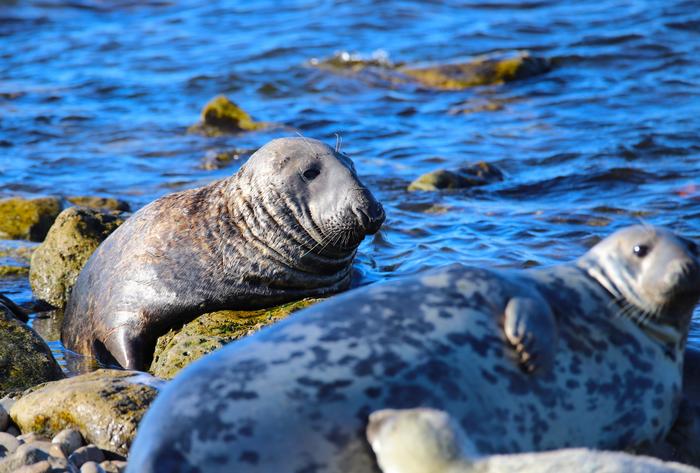
Credit: Daire Carroll
Researchers at the University of Gothenburg warn that today’s hunting quotas of about 3,000 animals pose a risk to the long-term survival of the grey seal in the Baltic Sea. The conclusions of this new study are based on statistics from 20th century seal hunting and predictions of future climate change.
After decades of hard hunting and environmental contamination by toxins such as PCBs, there were only 5,000 grey seals left in the entire Baltic Sea by the 1970s, falling from an initial size of more than 90,000 at the beginning of the century. Since then, the population has partially recovered, and today stands at around 55,000 animals for all countries combined.
Baltic grey seals are genetically isolated from the closest grey seal populations in the Atlantic. They are generally slightly smaller and, unlike solely land breeding seals found in the British Isles, can give birth to young on both drift ice and on land. The population is now facing new challenges in a world with a warming climate and a shortage of appropriately sized prey fish. Using a mathematical model, the researchers showed that increased seal hunting could cause the population to decline once more.
“It has taken three generations for the grey seal to recover. The seal population is now growing, but our research shows that, if the current hunting quota of 3,000 animals per year is met, the survival of the grey seal in the Baltic Sea will once again be threatened,” says Daire Carroll, Associate researcher at the University of Gothenburg and lead author of the study published in the Journal of Animal Ecology.
At present, about 1,500 seals are killed each year in the Baltic Sea.
The hunting quota must be reduced
The researchers created a mathematical model for grey seal population growth and examined several different scenarios for the future. They tested the effect of different hunting pressures, different levels of food availability, and the consequences of less sea ice.
“We saw that killing 3,000 seals each year always led to a decrease in seal population size, even in the most optimistic scenarios for the climate and marine environment. Our conclusion is that the current hunting quota in the Baltic Sea is unsustainable. If the seal population is to continue to recover, the maximum number that can be hunted is 1,900 animals. But if there are other environmental changes that have a negative impact on population, that figure should also be reduced,” says Daire Carroll.
The countries around the Baltic Sea have agreed that the grey seal population should be allowed to recover after coming close to extinction in the 20th century due to hunting and environmental contamination. Conflict with fisheries during this period led to a bounty on seals. A biproduct of this is that there are detailed statistics on how many seals were killed each year. Researchers at the University of Gothenburg were helped by their colleagues at the Swedish Museum of Natural History in Stockholm to produce data on the development of the grey seal in modern times. Thanks to the fact that seals are now used as an environmental indicator for the Baltic Sea, there is good data on the seals’ numbers, fertility, and health.
Advantage of breeding on ice
“We created a model of how the seal population would have grown over the last 20 years if there had been no hunting. In this way, we can estimate the long-term effect of today’s hunting quotas on the seal population. We have also simulated what a warmer climate would mean for the grey seal,” says Daire Carroll.
Baltic grey seal pups have a greater chance of survival if they are born on sea ice instead of on land. On ice floes, mothers and pups can spread out over a larger area and the pups face fewer threats from other predators, humans, or infections that are easily spread in dense seal colonies on land.
As the seal population has grown, so has the conflict with the fishing industry, and in 2020, the protective hunt was supplemented with a licensed hunt in Finland and Sweden. In total, more than 3,000 animals could potentially be killed.
“The culling of individual seals that visit or destroy fishing gear has always been allowed and is not problematic for the survival of the population. It was a few hundred individuals per year and did not affect entire groups of seals. But the new licensed hunting, it is different, it risks hitting the survival of the grey seal hard,” says Karin Hårding, Professor of Ecology at the University of Gothenburg and co-author of the study, who has been researching seals since the late 1980s.
Researchers at the University of Gothenburg warn that today’s hunting quotas of about 3,000 animals pose a risk to the long-term survival of the grey seal in the Baltic Sea. The conclusions of this new study are based on statistics from 20th century seal hunting and predictions of future climate change.
After decades of hard hunting and environmental contamination by toxins such as PCBs, there were only 5,000 grey seals left in the entire Baltic Sea by the 1970s, falling from an initial size of more than 90,000 at the beginning of the century. Since then, the population has partially recovered, and today stands at around 55,000 animals for all countries combined.
Baltic grey seals are genetically isolated from the closest grey seal populations in the Atlantic. They are generally slightly smaller and, unlike solely land breeding seals found in the British Isles, can give birth to young on both drift ice and on land. The population is now facing new challenges in a world with a warming climate and a shortage of appropriately sized prey fish. Using a mathematical model, the researchers showed that increased seal hunting could cause the population to decline once more.
“It has taken three generations for the grey seal to recover. The seal population is now growing, but our research shows that, if the current hunting quota of 3,000 animals per year is met, the survival of the grey seal in the Baltic Sea will once again be threatened,” says Daire Carroll, Associate researcher at the University of Gothenburg and lead author of the study published in the Journal of Animal Ecology.
At present, about 1,500 seals are killed each year in the Baltic Sea.
The hunting quota must be reduced
The researchers created a mathematical model for grey seal population growth and examined several different scenarios for the future. They tested the effect of different hunting pressures, different levels of food availability, and the consequences of less sea ice.
“We saw that killing 3,000 seals each year always led to a decrease in seal population size, even in the most optimistic scenarios for the climate and marine environment. Our conclusion is that the current hunting quota in the Baltic Sea is unsustainable. If the seal population is to continue to recover, the maximum number that can be hunted is 1,900 animals. But if there are other environmental changes that have a negative impact on population, that figure should also be reduced,” says Daire Carroll.
The countries around the Baltic Sea have agreed that the grey seal population should be allowed to recover after coming close to extinction in the 20th century due to hunting and environmental contamination. Conflict with fisheries during this period led to a bounty on seals. A biproduct of this is that there are detailed statistics on how many seals were killed each year. Researchers at the University of Gothenburg were helped by their colleagues at the Swedish Museum of Natural History in Stockholm to produce data on the development of the grey seal in modern times. Thanks to the fact that seals are now used as an environmental indicator for the Baltic Sea, there is good data on the seals’ numbers, fertility, and health.
Advantage of breeding on ice
“We created a model of how the seal population would have grown over the last 20 years if there had been no hunting. In this way, we can estimate the long-term effect of today’s hunting quotas on the seal population. We have also simulated what a warmer climate would mean for the grey seal,” says Daire Carroll.
Baltic grey seal pups have a greater chance of survival if they are born on sea ice instead of on land. On ice floes, mothers and pups can spread out over a larger area and the pups face fewer threats from other predators, humans, or infections that are easily spread in dense seal colonies on land.
As the seal population has grown, so has the conflict with the fishing industry, and in 2020, the protective hunt was supplemented with a licensed hunt in Finland and Sweden. In total, more than 3,000 animals could potentially be killed.
“The culling of individual seals that visit or destroy fishing gear has always been allowed and is not problematic for the survival of the population. It was a few hundred individuals per year and did not affect entire groups of seals. But the new licensed hunting, it is different, it risks hitting the survival of the grey seal hard,” says Karin Hårding, Professor of Ecology at the University of Gothenburg and co-author of the study, who has been researching seals since the late 1980s.
Journal
Journal of Animal Ecology
Method of Research
Data/statistical analysis
Article Title
120‐years of ecological monitoring data shows that the risk of overhunting is increased by environmental degradation for an isolated marine mammal population: The Baltic grey seal
Article Publication Date
27-Mar-2024
Cite Scienmag News
Violet Maxwell. (April 4, 2024). Scientists warn: The grey seal hunt is too large. Scienmag. https://scienmag.com/scientists-warn-the-grey-seal-hunt-is-too-large/
Violet Maxwell. "Scientists warn: The grey seal hunt is too large." Scienmag, 4 April 2024, https://scienmag.com/scientists-warn-the-grey-seal-hunt-is-too-large/. Accessed 4 September 2026.
Violet Maxwell. "Scientists warn: The grey seal hunt is too large." Scienmag. April 4, 2024. https://scienmag.com/scientists-warn-the-grey-seal-hunt-is-too-large/

