


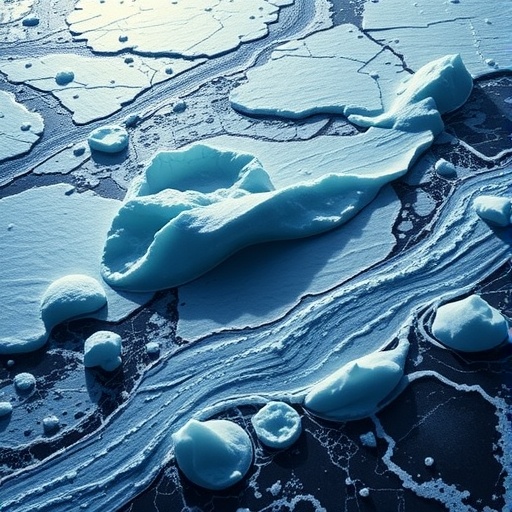
Water ice scattered across the Solar System could determine where humanity builds its first long-term footholds beyond Earth. At the Moon’s shadowed poles, beneath the Martian surface, and inside the frozen crusts of Europa and Enceladus, water is more than a clue to planetary history or a possible ingredient for life. It is also a potential source of drinking water, oxygen, hydrogen fuel and industrial feedstock. A new review in Space Science Reviews brings together decades of discoveries and engineering studies to examine how spacecraft might locate, drill, melt and collect that ice under conditions unlike anything encountered in conventional terrestrial mining. The authors argue that extraterrestrial water-ice exploration has reached a decisive stage: finding ice remotely is no longer enough. Future missions must determine its physical state, extract it without destroying scientific information and operate equipment that is lightweight, power-efficient, autonomous and reliable enough to survive years from Earth.
The scientific case begins with the remarkable diversity of icy environments. Lunar water is expected primarily in permanently shadowed regions near the poles, where crater interiors can remain extremely cold because sunlight never reaches their floors. These “cold traps” may preserve water delivered by comets, asteroids or solar-wind chemistry over geological time. Some deposits could be mixed unevenly through fine-grained regolith, while others may occur as surface frost or buried layers. Mars presents a different opportunity: radar observations and orbital measurements indicate extensive subsurface ice, including exposed or shallowly buried sheets in some mid-latitude regions. On the icy moons of the outer Solar System, water ice forms the dominant outer shell, often above a global ocean. Europa and Enceladus are especially compelling because their interiors may contain liquid water in contact with rock, creating environments that could support chemical energy gradients relevant to life. Yet the ice that is scientifically most interesting is often the ice that is hardest to reach.
The review emphasizes that “water ice” is not a single engineering material. Its behavior depends on temperature, pressure, porosity, grain size, impurities, fractures and the amount of regolith or salt mixed into it. At the lunar poles, a drill may encounter abrasive dust, compacted soil and ice concentrations that vary over centimeter scales. On Mars, ice can be cemented into soil or layered with dust and carbon-dioxide frost. In the outer Solar System, ice may be exceptionally cold, mechanically strong or altered by radiation. The mechanical properties of such material remain uncertain before a spacecraft arrives, and even small errors in estimating hardness or cohesion can cause a drill to jam, overheat or consume more power than its lander can supply. Weak gravity creates an additional problem: on the Moon and small bodies, the downward force that helps a terrestrial drill bite into the ground is greatly reduced. The machine must push against the surface without lifting or destabilizing the spacecraft.
Mechanical drilling is therefore both familiar and hazardous. A rotating or reciprocating drill can break ice and regolith, while auger flights or other mechanisms transport cuttings toward the surface. Coring systems can preserve a cylindrical sample, allowing scientists to study the sequence of layers and the distribution of volatile compounds. But rotation generates reaction torque, which must be resisted by the lander or a dedicated anchoring system. The drill’s cutting teeth may wear rapidly in abrasive material, and loose chips can clog transport paths in a vacuum. In a conventional borehole, fluids may cool the drill and carry debris away; in space, those fluids could boil, freeze or contaminate the sample. The review identifies a central design tension: systems optimized for rapid excavation may mix or heat the material, whereas systems optimized for pristine scientific sampling are slower, heavier and more complex. A successful device may need interchangeable tools capable of switching between reconnaissance, resource extraction and carefully documented sample collection.
Thermal melting probes offer a radically different strategy. Instead of mechanically crushing ice, a heated tip melts a narrow pathway and moves downward through it. The melted water can sometimes be routed or refrozen behind the probe, while electrical or nuclear power supplies the heat. Because the probe does not need to remove large quantities of cuttings, it can potentially penetrate deeper than a conventional drill and avoid some problems caused by mechanical debris. This approach is particularly attractive for ocean-world concepts, in which a cryobot could descend through kilometers of ice to release instruments or a submersible into an underlying ocean. However, the physics is unforgiving. Heat must be sufficient to melt ice at the probe’s tip but not so excessive that energy is wasted into the surrounding material. Under low pressure, water may boil or rapidly sublime rather than form a stable meltwater channel. Dust layers, bubbles, fractures and salts can change the melting rate, while refreezing may trap the probe or seal communications and power pathways.
Deep-ice missions also face a communications problem that is easy to underestimate. A probe traveling below an ice shell cannot rely on a direct radio link to a spacecraft or lander at the surface. It may need a tether carrying power, data and perhaps mechanical strength, but deploying a tether through a narrow, winding melt channel introduces friction, tension and the risk of snagging. An autonomous cryobot must also know where it is, detect obstacles and recognize transitions between different ice layers. Acoustic navigation, inertial sensors, temperature probes, pressure measurements and optical or chemical instruments could work together to build a map of the subsurface. The review points toward intelligent sampling systems that can change their behavior as conditions evolve. A probe might reduce speed in a dusty layer, alter heater power when the ice becomes porous, or select a side path after detecting a fracture. Such autonomy is not simply a convenience: at the Moon, Mars or an icy moon, communication delays and limited opportunities for intervention make real-time control from Earth impossible.
Surface sampling devices remain crucial because many missions will begin with shallow investigations rather than ambitious deep drilling. Robotic arms, scoops, scrapers, corers and small drills can test whether a suspected deposit contains accessible water and can measure how that resource is distributed. The Phoenix lander demonstrated the scientific value of acquiring icy soil on Mars, while more recent lunar exploration has strengthened the case for studying both surface and subsurface hydration. At the lunar poles, however, the environment complicates even a simple scoop. Permanently shadowed terrain may be colder than the equipment’s operating range, while nearby sunlit slopes can expose instruments to severe thermal cycling. Regolith grains can cling electrostatically to mechanisms, obscure cameras and abrade seals. A sampling tool must also prevent volatile loss: once ice is excavated and exposed to vacuum, it can sublimate directly into vapor, changing the sample before it reaches an analyzer. Containment, temperature control and rapid transfer may be as important as the cutting action itself.
The technological challenge becomes more severe when the goal shifts from detecting water to using it. In-situ resource utilization systems would heat ice-bearing soil, capture the released vapor and separate water from contaminants. Water could then be purified for life support or electrolyzed into hydrogen and oxygen, producing propellant and breathable oxygen. But extraction efficiency depends on concentration, grain size, temperature and the strength of the bond between water and surrounding minerals. A system designed for lunar polar ice may not work for hydrated minerals at lower latitudes, where water is chemically bound rather than present as discrete ice. Processing equipment must operate with little power, limited maintenance and no possibility of importing replacement parts. It must also balance industrial throughput against planetary protection and scientific preservation. Excavating a resource deposit could disturb a record of cometary delivery, solar-wind chemistry or ancient climate. The review therefore treats sampling and resource use as linked but distinct objectives, requiring mission planners to decide how much material can be consumed and how much must be archived.
Sample return remains one of the most powerful future directions because laboratory instruments on Earth are vastly more capable than most spacecraft payloads. A returned ice or volatile-bearing sample could be examined with high-resolution spectroscopy, mass spectrometry, microscopy and isotope analysis, revealing its molecular history and possible biological signatures. Yet returning ice is harder than returning dry rock. The sample may warm, melt, sublime or chemically react during collection, ascent, transit and landing. Containers must maintain a controlled temperature and pressure while surviving launch vibrations and the journey between worlds. If material from Europa or Enceladus is ever collected, contamination control will become especially stringent because scientists must distinguish indigenous chemistry from terrestrial biological or organic contamination. A sample-return architecture may consequently require cryogenic storage, sealed transfer chambers and multiple layers of sterilization and verification. The review presents such missions not as a single technological leap but as a chain of tightly coupled systems, in which a failure at any stage can erase the scientific value of the sample.
The authors conclude that the future of extraterrestrial ice exploration will depend less on one spectacular drilling design than on the integration of many capabilities. The most valuable systems will combine compact mechanical tools, thermal methods, surface collectors, sensors and analytical instruments in packages able to adapt to uncertain terrain. Low mass and low power are essential because every kilogram launched into deep space carries a major transportation cost, while every watt may compete with communications, heating and science operations. High reliability is equally important: extreme cold can embrittle materials, vacuum can degrade lubricants and radiation can damage electronics. Multifunctional robots could first map a deposit, then characterize its mechanical properties, extract a controlled sample and finally support limited water production. If these technologies mature, water ice could become both a scientific archive and the infrastructure of exploration—a substance that helps answer how worlds evolve while also supplying the resources needed to visit them. The frozen Solar System may be difficult to mine, but it could ultimately make the Solar System far easier for humans to explore.
Cite Scienmag News
Grant Pearson. (August 28, 2026). Scientists Review Technologies for Exploring and Sampling Water Ice on Extraterrestrial Bodies. Scienmag. https://scienmag.com/scientists-review-technologies-for-exploring-and-sampling-water-ice-on-extraterrestrial-bodies/
Grant Pearson. "Scientists Review Technologies for Exploring and Sampling Water Ice on Extraterrestrial Bodies." Scienmag, 28 August 2026, https://scienmag.com/scientists-review-technologies-for-exploring-and-sampling-water-ice-on-extraterrestrial-bodies/. Accessed 3 September 2026.
Grant Pearson. "Scientists Review Technologies for Exploring and Sampling Water Ice on Extraterrestrial Bodies." Scienmag. August 28, 2026. https://scienmag.com/scientists-review-technologies-for-exploring-and-sampling-water-ice-on-extraterrestrial-bodies/


