


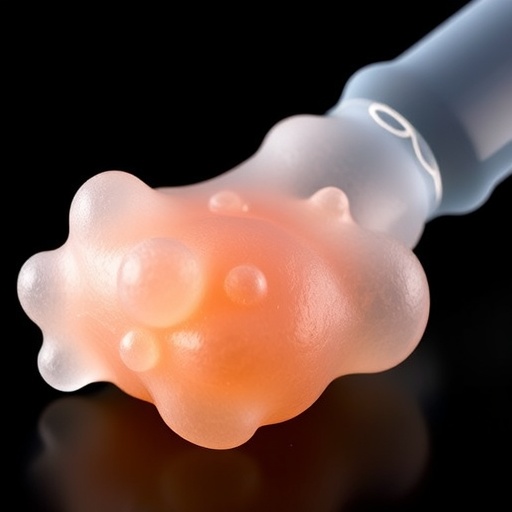
Artificial cartilage has long faced a problem that sounds simple but has resisted elegant solutions: materials must be strong enough to bear heavy loads while remaining slippery enough to let joints move with almost no friction. A hydrogel developed by researchers in China may bring those two demands unusually close together. The material, made from polyvinyl alcohol and chitosan, combines high mechanical strength, substantial stretchability, fatigue resistance and cartilage-like lubrication in a single physically crosslinked network. In laboratory tests, the optimized hydrogel reached a tensile strength of approximately 19 megapascals at 550 percent strain, withstood a compressive stress of about 11 megapascals at 39 percent strain, and maintained a friction coefficient near 0.05 for 100,000 back-and-forth sliding cycles. The results suggest a possible route toward water-lubricated coatings and implant materials designed to replace or protect damaged articular cartilage.
Articular cartilage is a specialized connective tissue that covers the ends of bones inside movable joints. Its smooth surface distributes loads and allows bones to glide against one another, but cartilage has limited capacity for self-repair because it contains few cells and lacks a direct blood supply. Once damaged by injury, aging or osteoarthritis, it can progressively deteriorate. Synthetic hydrogels are attractive substitutes because they contain large amounts of water, like natural cartilage, and can be engineered to provide a soft, hydrated interface. Yet the same water-rich structure that makes hydrogels slippery can make them mechanically fragile. Under repeated compression and sliding, conventional gels may deform permanently, lose water, tear or shed debris. The challenge is therefore not merely to make a soft material stronger, but to reinforce it without destroying its ability to preserve a lubricating water layer.
The new design addresses this challenge through two physically connected networks formed inside a blend of PVA and CS. PVA, or polyvinyl alcohol, is a water-compatible synthetic polymer whose chains can organize into crystalline regions. Chitosan is a natural polysaccharide derived from chitin, the structural material found in sources such as crustacean shells. It contains functional groups capable of forming hydrogen bonds and interacting ionically with other components. Rather than relying primarily on permanent chemical bonds, the researchers used a sequence of processing steps—freeze-thawing, salting-out, annealing and rehydration—to create a dense architecture held together by several reversible interactions. These include hydrogen bonds between polymer chains, nanoscale crystalline domains within PVA and ionic coordination associated with the PVA/chitosan system.
The processing sequence is central to the material’s performance. During freeze-thawing, water freezes and concentrates the polymers in the unfrozen regions. This brings neighboring PVA chains into close contact, encouraging the formation of crystallites that function as physical junctions. The salting-out step further reduces polymer solubility and promotes chain association, effectively tightening the network. Annealing at a controlled temperature allows crystalline domains and intermolecular interactions to develop more fully, while subsequent rehydration restores the gel’s water-rich character. The result is a dual-physical network: one part of the structure provides load-bearing reinforcement, while the other helps dissipate energy and limits catastrophic crack growth. Because the bonds are physical rather than exclusively covalent, some interactions can break under stress and reform afterward, a feature that can contribute to toughness and recovery.
The team found that composition and annealing temperature could be used to tune the hydrogel’s behavior. Increasing or decreasing the relative amounts of PVA and chitosan changes the balance between crystallinity, hydrogen bonding, ionic interactions and water content. Annealing similarly affects the number and organization of PVA crystalline domains. In an optimized formulation, the material could be stretched to roughly five and a half times its original length before reaching a tensile strength of about 19 megapascals. That combination of extensibility and strength is important because a cartilage substitute must tolerate deformation rather than simply resist it. A material that is strong but brittle could fracture under an abrupt movement, whereas a tough material can absorb mechanical energy and distribute stress across its network.
Compression tests produced a stress of approximately 11 megapascals at a strain of 39 percent, indicating that the gel could withstand substantial deformation under loading. Compression is especially relevant to cartilage because joints experience forces many times greater than body weight during activities such as climbing stairs, running or rising from a chair. The researchers also reported outstanding toughness and antifatigue behavior, which they attributed to the cooperation of the physical interactions. In a physically crosslinked network, hydrogen bonds and ionic associations can act as sacrificial links: they absorb energy by temporarily dissociating, protecting the primary polymer framework from immediate failure. Crystalline regions provide stronger anchors, while the surrounding amorphous chains allow molecular rearrangement. Together, these mechanisms can prevent a small defect from rapidly becoming a large tear.
Strength alone, however, would not make the material suitable for a joint. The researchers therefore examined its tribological performance—the engineering study of friction, lubrication and wear. They slid an aluminum oxide ball over the hydrated hydrogel while applying a 30-newton load at a frequency of 1 hertz, using water as the lubricating medium. Under these conditions, the optimized gel exhibited a friction coefficient of approximately 0.05, a value described by the researchers as close to the lubrication performance of native cartilage. A low coefficient of friction means that less tangential force is required to move one surface across another. In a hydrated hydrogel, lubrication can arise from fluid trapped within the polymer network, as well as from a water-rich surface layer that reduces direct polymer-to-counterface contact. The material’s nanoscale crystalline domains appear to help preserve the structural integrity needed to retain that lubricating interface under load.
The most striking durability result came from the extended reciprocating test. After 100,000 sliding cycles, the hydrogel maintained stable long-term lubrication without destructive wear or obvious structural damage, according to the study. Repeated sliding is a severe test because it combines shear, compression and fluid transport. Each cycle can potentially expel water, abrade the surface or rearrange the polymer network. A material that performs well for only a few hundred cycles would have limited value as an implant coating or cartilage substitute. The reported endurance does not demonstrate that the gel will survive years inside a human joint, but it does show that the dual-physical architecture can resist substantial laboratory wear while preserving low friction. The absence of destructive damage also raises the possibility of reducing the release of wear particles, a concern for many artificial joint materials.
The researchers describe the hydrogel as biocompatible and envision applications including cartilage-mimicking, water-lubricated coatings and biomedical implants. Such uses could involve placing a hydrogel layer on a load-bearing substrate or developing a shaped implant that reproduces selected mechanical functions of cartilage. The material’s physical crosslinking strategy may also be attractive from a manufacturing perspective because it avoids depending entirely on harsh chemical crosslinkers, although the study does not by itself establish a complete clinical manufacturing process. Before translation to patients, the hydrogel would need to undergo extensive testing for biological compatibility, sterilization, adhesion to implant surfaces, long-term swelling and dehydration, resistance to inflammatory environments and performance under realistic joint motions. It would also need to be evaluated in animal models and ultimately in carefully controlled clinical studies.
The work’s broader significance lies in its attempt to solve the strength–lubrication trade-off through structure rather than through a single additive. Natural cartilage is not simply a soft sponge; it is a hierarchically organized composite in which collagen, proteoglycans, water and specialized surface molecules work together to bear load and maintain low friction. The PVA/chitosan hydrogel does not reproduce that biology in full, but its dual-network design echoes the principle that different structural elements can perform different mechanical tasks. Nanoscale crystallites reinforce the polymer matrix, reversible bonds dissipate energy, and the hydrated network supplies a slippery interface. If future studies confirm its durability and safety under physiological conditions, this combination could help move hydrogel-based cartilage repair beyond the familiar compromise between a material that carries weight and one that slides smoothly.
Cite Scienmag News
Denise Maddox. (August 28, 2026). Nanocrystalline PVA Hydrogel Mimics Cartilage Lubrication and Enhances Load-Bearing Performance. Scienmag. https://scienmag.com/nanocrystalline-pva-hydrogel-mimics-cartilage-lubrication-and-enhances-load-bearing-performance/
Denise Maddox. "Nanocrystalline PVA Hydrogel Mimics Cartilage Lubrication and Enhances Load-Bearing Performance." Scienmag, 28 August 2026, https://scienmag.com/nanocrystalline-pva-hydrogel-mimics-cartilage-lubrication-and-enhances-load-bearing-performance/. Accessed 3 September 2026.
Denise Maddox. "Nanocrystalline PVA Hydrogel Mimics Cartilage Lubrication and Enhances Load-Bearing Performance." Scienmag. August 28, 2026. https://scienmag.com/nanocrystalline-pva-hydrogel-mimics-cartilage-lubrication-and-enhances-load-bearing-performance/


