


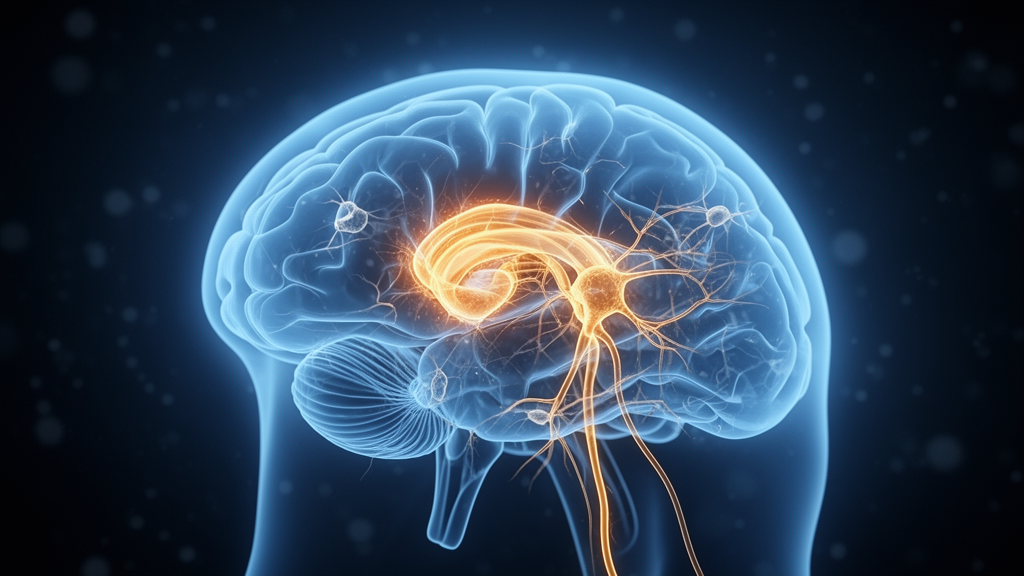
Depression rarely arrives all at once. For millions of people, it creeps in after weeks or months of unrelenting stress, emerging from a shadowy transition that clinicians have never been able to observe directly. Now a team of neuroscientists at the University of Lausanne has captured that transition in unprecedented detail, mapping the precise molecular and electrical changes that unfold in a tiny brain region as stress tips over into depression-like behavior. The study, published in Nature Neuroscience, identifies a sharply defined window during which the brain’s stress machinery can still be pulled back to normal with antidepressant treatment.
The research focuses on the lateral habenula, a pea-sized structure perched above the thalamus that has long been nicknamed the brain’s anti-reward center. Unlike circuits that fire in response to pleasure, the lateral habenula activates during disappointment, punishment and aversive experiences, and in animals it drives many hallmark features of depression, from helpless passivity to loss of motivation. Previous work had shown that chronic stress hyperactivates this region, but the critical question of when, and where exactly within the structure, these harmful changes begin had remained unanswered.
To catch the transition in the act, the team, led by Patricia Molina and Manuel Mameli, turned to chronic corticosterone, the rodent equivalent of the human stress hormone cortisol, delivered continuously in drinking water to groups of mice. Instead of examining the brain only after depression-like behaviors were fully established, the researchers sampled at multiple time points: one day, seven days and twenty-one days after stress hormone exposure began. This longitudinal design let them trace the unfolding of stress susceptibility rather than just its endpoint.
The first layer of analysis was molecular. Using spatial transcriptomics, a technology that reads out gene expression across intact tissue slices while preserving each measurement’s physical location, the team built a spatially resolved molecular atlas of the lateral habenula. They sequenced 32 coronal sections, registering thousands of gene-expression spots into a common coordinate framework. Even under baseline conditions, the structure turned out to be organized along a striking medial-to-lateral molecular gradient, allowing the researchers to subdivide it into medial, central and lateral subterritories with distinct genetic identities.
When they compared stressed and unstressed mice, a dramatic pattern emerged. Pronounced transcriptional remodeling appeared at day seven of corticosterone exposure in every subterritory, but the lateral domain was by far the most affected, showing nearly three times as many differentially expressed genes as the central region. The gene encoding the glucocorticoid receptor, the molecular dock for stress hormones, was itself enriched laterally and dynamically regulated across the treatment. Cell-type deconvolution confirmed that the stress-sensitive changes were concentrated in neurons rather than glia, and Gene Ontology analysis showed that the altered genes were involved in membrane potential, ion channel activity and behavioral responses, exactly the machinery that would be expected to change how neurons fire.
Gene expression, however, is only a proxy. To see whether the molecular shift was matched by real changes in neural activity, the researchers deployed one of the most demanding techniques in modern neuroscience: longitudinal two-photon calcium imaging of the deep brain. They delivered a genetically encoded calcium indicator into the lateral habenula and implanted a gradient-index lens roughly fifty micrometers above the injection site, giving them a stable window onto the same individual neurons across weeks. Seventeen mice were imaged repeatedly, at baseline and after one, seven, fourteen and twenty-one days of corticosterone treatment, while receiving unpredictable air puffs to the eye as an aversive stimulus.
The recordings revealed six functional clusters of habenula neurons, some excited by the air puff, some unresponsive and some inhibited. Under chronic stress, the proportions shifted dramatically: neurons that had been silent or inhibited became progressively more excited, and the overall population response to threat grew steadily stronger. Crucially, the trajectory of these changes had an onset that matched the molecular data almost exactly, at day seven. And when the researchers mapped each recorded neuron back onto an anatomical reconstruction of the habenula, the plasticity was again concentrated in the lateral territory, the same zone where the genetic remodeling was most intense. Three biological layers, genes, single-neuron activity and anatomy, were converging on the same place at the same time.
Behavior told the same story. By combining scores from tests of threat escape, active coping in the tail suspension test and self-care grooming into a single three-dimensional behavioral state, the team could detect exactly when stressed mice began separating from healthy controls. After one to five days of corticosterone, their behavioral profiles were indistinguishable from untreated animals. At day six, divergence began; by day seven it was statistically significant, and it persisted through day twenty-one. A parallel experiment using chronic restraint stress, an entirely different stress paradigm, produced a similar trajectory, suggesting the timing is not an artifact of the hormone model.
The most clinically provocative results came when the researchers intervened inside that seven-day window. Ketamine, the fast-acting antidepressant, administered at the onset of remodeling, normalized the exaggerated air puff responses in the lateral habenula, restoring them to baseline levels. Chemogenetic silencing of the habenula using inhibitory designer receptors had the same effect on behavior, and even selectively dampening only the lateral subterritory’s output was enough to pull stressed mice’s behavioral profiles back toward those of healthy controls. When ketamine was given late, after twenty-one days of stress, the behavioral rescue largely failed, demonstrating that the window is not merely a correlation but a genuine period of therapeutic opportunity.
The implications reach beyond the animal laboratory. If a similar trajectory exists in humans, and the authors are careful to note that this remains to be shown, the findings argue that the timing of antidepressant treatment may matter as much as the choice of drug, and that early intervention during the accumulation of stress could lock in lasting benefit. The openly available spatial atlas and the demonstration that molecular, electrophysiological and behavioral onsets align within a single brain structure also give researchers a framework for studying how other psychiatric conditions emerge over time. For a disorder whose diagnosis is often delayed until symptoms are fully entrenched, the message from the habenula is unusually concrete: the brain broadcasts its slide into depression well before the collapse, and it listens to treatment most readily on the way down.
Subject of Research: Spatiotemporal remodeling of the lateral habenula during chronic stress and the onset of depression-related behaviors
Article Title: Spatiotemporal remodeling in habenula marks the onset of depression-related phenotypes
Article References: Molina, P., Osypenko, D., Garnica, J., Amossé, Q., Bouteldja, F., Camelot, L., Mondoloni, S., Congiu, M., Kathe, C., & Mameli, M. (2026). Spatiotemporal remodeling in habenula marks the onset of depression-related phenotypes. Nature Neuroscience. https://doi.org/10.1038/s41593-026-02488-6
Image Credits: AI Generated
DOI: 10.1038/s41593-026-02488-6
Keywords: lateral habenula, depression, chronic stress, spatial transcriptomics, two-photon calcium imaging, ketamine, corticosterone, neural circuits, stress susceptibility, antidepressant, molecular atlas, chemogenetics
Cite Scienmag News
Cassandra Pierce. (October 19, 2026). Scientists Pinpoint the Moment Stress Turns Into Depression in the Brain. Scienmag. https://scienmag.com/scientists-pinpoint-the-moment-stress-turns-into-depression-in-the-brain/
Cassandra Pierce. "Scientists Pinpoint the Moment Stress Turns Into Depression in the Brain." Scienmag, 19 October 2026, https://scienmag.com/scientists-pinpoint-the-moment-stress-turns-into-depression-in-the-brain/. Accessed 19 October 2026.
Cassandra Pierce. "Scientists Pinpoint the Moment Stress Turns Into Depression in the Brain." Scienmag. October 19, 2026. https://scienmag.com/scientists-pinpoint-the-moment-stress-turns-into-depression-in-the-brain/


