Tongkat ali, the twisted-rooted Malaysian herb whose name literally means “Ali’s walking stick,” has been prized for centuries as a traditional tonic, and today its root extracts are among the most sought-after botanical ingredients in the world. But the plant is in trouble. Harvested non-selectively from Southeast Asian forests at a pace that far outstrips natural regeneration, Eurycoma longifolia Jack is sliding toward extinction in the wild. Now a research team at Universiti Putra Malaysia has worked out, with unusual precision, exactly how much light and water young tongkat ali seedlings need to thrive — a recipe that could transform the plant from a vanishing forest treasure into a farmable crop.
The study, published in Frontiers in Plant Physiology, is one of the first systematic attempts to domesticate this endangered medicinal species by quantifying its responses to two of the most fundamental environmental variables: irradiance and water availability. Led by Hooman Rowshanaie and Hawa Z. E. Jaafar of the Department of Crop Science, with Omid Rowshanaie of the Department of Chemical and Environmental Engineering, the team grew six-month-old seedlings under three shade levels and three irrigation regimes for four and a half months, tracking how every combination reshaped the plant’s roots, shoots, height, stem thickness, and total biomass.
The experimental design was rigorous. The researchers used a split-plot layout based on a randomized complete block design with three replications, with light intensity as the main plot factor and water treatment as the subplot. Three light regimes were imposed using black polypropylene shade nets: full sunlight at a photosynthetic photon flux density of roughly 700–800 µmol m⁻² s⁻¹ as the control, 50% shading that halved the light, and 70% shading that cut transmission to about 30% of ambient. Water was supplied through a drip irrigation system calibrated to actual volumetric water content at 100%, 75%, and 25% of field capacity — spanning well-watered, mildly stressed, and severely drought-stressed conditions. Nine treatment combinations in total, each replicated three times, were tested in a greenhouse maintained at 28–30°C with 80–90% relative humidity.
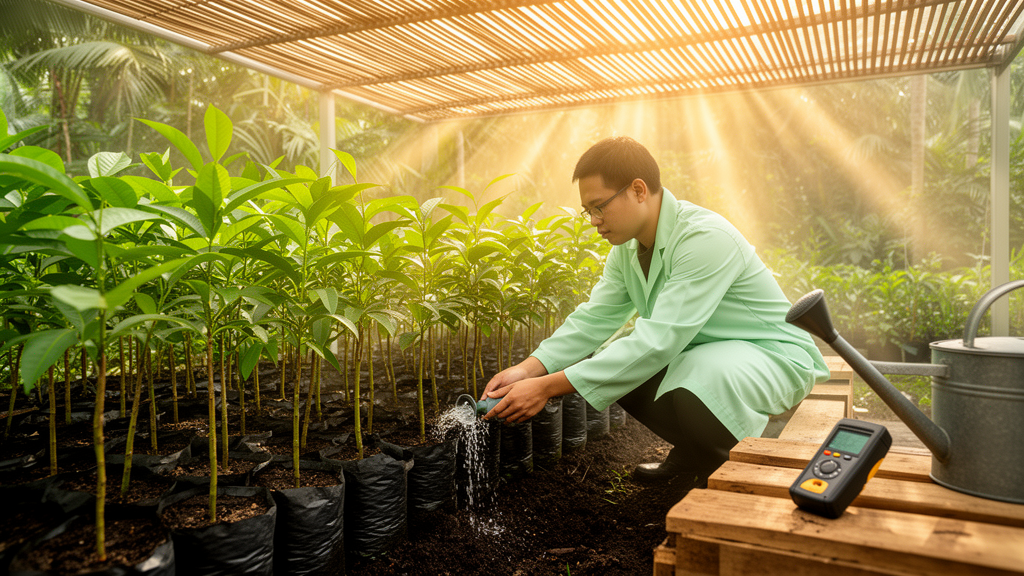
Seedlings were planted in white polyethylene bags filled with 6 kilograms of a hand-mixed substrate of local Serdang topsoil, river-washed sand, and coco peat in a 3:2:1 ratio. Every six weeks, the team harvested three plants per treatment and replication — 81 pots per harvest across three sampling dates — carefully washing the roots, separating leaves, stems, and roots, and drying everything at 40°C until constant weight. From these measurements they calculated three classic indices of morphological plasticity: the root mass ratio, the root-to-shoot ratio, and the height ratio, alongside direct measurements of plant height and stem diameter recorded with a ruler and digital caliper.
The results tell a striking story about how this rainforest herb balances its budget between light above and water below. Severe shading at 70% proved punishing across the board. Seedlings grown under deep shade showed root mass ratios 10–12.5% lower and root-to-shoot ratios 24–29% lower than those under moderate shade or full sun, while their height ratios were 8–11% higher — a classic shade-avoidance signature in which plants stretch upward for light at the expense of the robust root systems that make tongkat ali commercially valuable. The researchers concluded that deeply shaded seedlings exhibit a lower ability to compete for both water and light, which could explain the species’ reduced capacity to extend its populations in the wild and its vulnerability to extinction.
Water stress told a more nuanced tale. When the growth-limiting factor was belowground — as under drought — seedlings shifted biomass toward their roots, and the effect was strongest when light was not limiting. Under full sun or 50% shade combined with severe water stress at 25% field capacity, the root-to-shoot ratio climbed to its highest recorded values by the end of the eighteen-week treatment period. Interestingly, mild water stress at 75% field capacity actually produced higher root mass ratios than non-stress conditions, and under severe drought the root mass ratio reached its peak at every light level — evidence that tongkat ali seedlings actively invest in root architecture when water becomes scarce, provided enough light remains to power photosynthesis.
The interaction between the two stresses proved critical. Drought effects were ameliorated at intermediate irradiance, becoming more severe at both higher and lower light levels — a pattern the authors say mirrors how plants in many natural ecosystems simultaneously face water and heat stress. Under the conditions of this experiment, moderately stressed plants receiving moderate shade appeared to save water while capturing maximum light, developing what the researchers describe as a stress-tolerance mechanism that ensures long-term survival. This aligns with a growing body of evidence that plants in the tropics require sufficient shade to optimize growth and yield under intense solar radiation, but that too much shade tips the balance toward starvation.
When it came to the traits that matter most for growers, moderate shade emerged as the clear winner. By eighteen weeks, seedlings under 50% shading had achieved the greatest shoot height at roughly 25.75 centimeters and the thickest stems — 7.3% greater than unshaded plants and 23.39% greater than deeply shaded ones. Biomass told the same story: the best total dry weight, 9.35 grams, belonged to seedlings grown under mild water stress combined with 50% shading, followed closely by well-watered plants under the same moderate shade at 9.1 grams. Seedlings under 70% shading managed only 5.9 grams by the third harvest, compared with 7.57 and 7.31 grams under 50% shading and full sun respectively. The high photon flux of 450–550 µmol m⁻² s⁻¹ under moderate shade promoted higher fresh weight, dry weight, and a health index in young plants, enabling them to reach peak biomass at a moderate light intensity.
Statistically, the analysis of variance confirmed that both light and water treatments had highly significant effects on plant height, stem diameter, and biomass, with significant interaction effects between the two factors at multiple harvesting stages. The authors note that a strict allometric relationship exists between plant height and stem diameter in tongkat ali, and that low-light conditions impede growth and productivity by affecting gas exchange, while excessive light intensity damages the photosynthetic apparatus. Stress lowers the photosynthetic rate by imposing stomatal or non-stomatal constraints, and the regulation of leaf stomatal conductance is vital both for preventing desiccation and for survival.
For conservationists and cultivators alike, the practical recommendation is unambiguous: because there is no significant difference between 50% shading and non-shading for most growth parameters, and because moderate shade conserves water, 50% shading is recommended as the optimum light intensity for farming and domesticating tongkat ali. The study establishes the best levels of shading and light intensity given ideal water levels for propagation at the nursery stage, where the species’ future is decided. The researchers caution that information on the herb’s other growth requirements remains scarce, and they recommend further investigation under salinity, heat stress, carbon dioxide enrichment, and varying fertilizer levels — as well as similar work on kacip Fatimah, another Malaysian medicinal plant facing the same pressures. For now, the message is clear: the survival of one of Southeast Asia’s most legendary herbs may depend on getting the light just right.
Subject of Research: Conservation and domestication of young tongkat ali (Eurycoma longifolia Jack) via evaluating root and shoot traits by combining different light intensities and water levels
Article Title: Conservation and domestication of young tongkat ali (Eurycoma longifolia Jack) via evaluating root and shoot traits by combining different light intensities and water levels
Article References: Rowshanaie, H., Jaafar, H. Z., & Rowshanaie, O. (2026). Conservation and domestication of young tongkat ali (Eurycoma longifolia Jack) via evaluating root and shoot traits by combining different light intensities and water levels. Frontiers in Plant Physiology, 3, Article 1702781. https://doi.org/10.3389/fphgy.2025.1702781
Image Credits: AI Generated
DOI: 10.3389/fphgy.2025.1702781
Keywords: Conservation, domestication, young, tongkat, Eurycoma, longifolia, Jack, evaluating, root, shoot, traits, combining
Cite Scienmag News
Drew Townsend. (October 17, 2026). Scientists Find the Sweet Spot of Light and Water That Could Save Malaysia’s Legendary Tongkat Ali. Scienmag. https://scienmag.com/scientists-find-the-sweet-spot-of-light-and-water-that-could-save-malaysias-legendary-tongkat-ali/
Drew Townsend. "Scientists Find the Sweet Spot of Light and Water That Could Save Malaysia’s Legendary Tongkat Ali." Scienmag, 17 October 2026, https://scienmag.com/scientists-find-the-sweet-spot-of-light-and-water-that-could-save-malaysias-legendary-tongkat-ali/. Accessed 17 October 2026.
Drew Townsend. "Scientists Find the Sweet Spot of Light and Water That Could Save Malaysia’s Legendary Tongkat Ali." Scienmag. October 17, 2026. https://scienmag.com/scientists-find-the-sweet-spot-of-light-and-water-that-could-save-malaysias-legendary-tongkat-ali/