


…
… 9 paragraphs
The transformation observed in Baringo County between 2010 and 2015 cannot be fully appreciated without situating it within the broader history of communication marginalization in Kenya’s semi-arid lands. During the colonial period and much of the post-colonial era, the national media system was structured around urban centers and agricultural heartlands, leaving pastoralist and agro-pastoralist communities largely outside the flow of public information. This exclusion meant that environmental crises affecting places like Baringo—recurring droughts, shrinking water sources, and the loss of tree cover—rarely entered national debate unless they escalated into humanitarian emergencies. The study’s archival evidence from the Kenya National Archives illustrates how state-controlled communication historically treated such regions as subjects of administrative messaging rather than as audiences capable of producing knowledge. Understanding this inherited asymmetry is essential, because the arrival of mobile phones and social networking platforms did not occur on a level playing field; it disrupted, but did not erase, decades of communicative disadvantage.
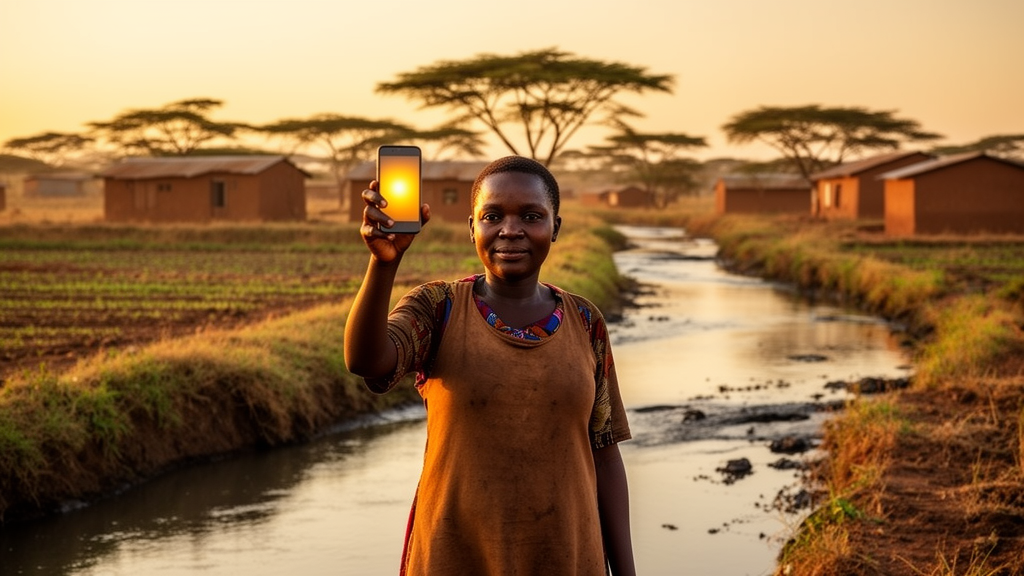
The concept of communicative power offers a useful lens for interpreting what happened in the county. Drawing on networked theories of communication, the authors argue that decentralized digital networks can outflank institutional gatekeepers who traditionally decided which environmental issues deserved public attention. In practice, this meant that a resident of Kositei or Bartabwa who witnessed a drying spring or illegal logging could document it with a mobile phone and circulate the account through Facebook or WhatsApp, bypassing editors in Nairobi. This does not mean traditional gatekeeping disappeared. Mainstream journalists in Kenya still controlled the largest audiences and retained considerable authority, but the terms of engagement shifted: reporters increasingly found story leads, images, and testimony originating from citizen producers. In agenda-setting terms, ordinary people gained a capacity to place local ecological concerns before the very institutions that had historically overlooked them, which the study identifies as the central reconfiguration of the period.
The finding that citizen journalism in Baringo emerged first as a survivalist strategy carries significant theoretical weight. Much of the international scholarship celebrates citizen journalism as an expression of democratic participation or watchdog accountability. In Baringo, however, the earliest digital reporting practices arose from immediate practical needs: communities needed to warn one another about drought conditions, coordinate responses to water scarcity, and mobilize around threats posed by deforestation and the expansion of geothermal infrastructure. Communication functioned, above all, as a tool for collective survival in an environment where ecological stress translated directly into threats to livelihoods, livestock, and safety. This reframing suggests that scholars examining citizen journalism in vulnerable regions should pay closer attention to the material stakes of environmental information, rather than assuming that participation is driven primarily by civic ideals or professional aspiration.
The coexistence of digital platforms with radio deserves particular emphasis, because it complicates popular narratives of wholesale technological displacement. Across the interviews and focus group discussions conducted in locations such as Barwesa, Kinyach, Maji Moto, Solian, Mogotio, and Kabartonjo, radio remained the most trusted source of environmental information, especially for older residents and those without reliable connectivity. Younger and more digitally literate community members increasingly turned to mobile phones and social media, but these channels often worked in tandem with broadcast media rather than against it. A report circulating on WhatsApp could be amplified when a radio station picked it up, and radio bulletins could spark digital discussion among dispersed family and community networks. This layered media ecology reflects what communication scholars describe as media hybridity, where older and newer forms interpenetrate, each compensating for the limitations of the other in specific social and infrastructural contexts.
The interpretation offered by the study is explicitly interpretivist, and this methodological stance shapes its conclusions in important ways. Rather than treating technology diffusion as a uniform process that unfolds identically across regions, the researchers approached each community’s adoption of digital tools as embedded in local meanings, histories, and social relations. The oral interviews with elders, activists, journalists, and civil society leaders revealed that the significance of a mobile phone in a semi-arid village differed markedly from its significance in an urban newsroom. For irrigation farmers and digital content creators participating in focus groups, digital communication was tied to advocacy strategies and market awareness; for elders, it was often mediated through younger relatives who translated and relayed information. This variability cautions against policy frameworks that assume a single national trajectory of digital transformation and instead supports locally attuned interventions that recognize differentiated patterns of use.
Infrastructural inequality emerged as one of the most persistent constraints on inclusive participation. Weak internet access, unreliable electricity, and uneven mobile network coverage meant that the benefits of digital environmental reporting accrued unevenly within the county. Communities closer to towns or along better-served corridors could participate more consistently in digital discourse, while residents of remote settlements remained dependent on intermittent connectivity or on secondhand relay through radio and word of mouth. The study’s evidence therefore aligns with a substantial body of research on the digital divide, which emphasizes that access is not merely a matter of device ownership but of the reliability, affordability, and quality of connectivity. In Baringo, the divide did not prevent citizen journalism from emerging, but it structured who could speak, how often, and with what visibility—a stratification that has consequences for whose environmental grievances reach policymakers.
Digital illiteracy constituted a second barrier closely intertwined with the first. Even where connectivity existed, the skills required to produce, verify, and circulate credible environmental reports were unevenly distributed, often following generational and educational lines. The study suggests that this skills gap limited the depth of participation for many residents, confining them to the role of consumers rather than producers of digital content. Related to this was the problem of misinformation, which the authors identify as a genuine cost of decentralized reporting. Without editorial verification mechanisms, inaccurate claims about ecological events could spread rapidly through social networks, potentially eroding trust or prompting ill-founded responses. The Baringo experience thus illustrates a dilemma widely discussed in environmental communication research: the same openness that enables marginalized communities to report on their own conditions also removes the quality controls that institutional journalism, whatever its biases, traditionally provided.
The environmental issues documented through these digital channels—drought, deforestation, water scarcity, and geothermal expansion—reflect the distinctive pressures confronting Kenya’s Rift Valley in this period. Geothermal development, in particular, represents a compelling case of how citizen journalism reframed contested development. While geothermal energy is often framed nationally as a clean and progressive resource, communities hosting such infrastructure experienced land acquisition, environmental disturbance, and questions about benefit-sharing. Digital platforms gave affected residents a means to document these tensions and insert them into public debate, illustrating how environmental communication can mediate between national development narratives and local experience. Similarly, reports of drought and water scarcity generated by citizens provided granular, real-time documentation that formal monitoring systems, constrained by limited coverage in remote areas, often could not match in timeliness.
The temporal framing of the study, ending in 2015, is deliberate and analytically significant. The authors argue that the practices consolidated during this five-year window provided a foundation for post-2015 environmental activism in Kenya’s semi-arid regions. The period corresponds with rapid growth in mobile penetration across East Africa and with the maturation of social media platforms as mass communication channels in Kenya. By the middle of the decade, the habit of documenting environmental grievances digitally had moved from novelty to normalized practice, and a generation of digitally engaged residents had acquired skills and networks that later advocacy would build upon. In this sense, the 2010–2015 period should be understood less as a completed transformation than as a formative phase in which the groundwork for subsequent mobilization was laid under conditions of considerable constraint.
Finally, the study makes a valuable contribution simply by redirecting scholarly attention toward rural semi-arid Kenya, a setting that remains underrepresented in digital media research dominated by studies of Nairobi and other urban centers. The Kenyan case demonstrates that the democratizing effects of digital communication are real but conditional: they depend on infrastructure, literacy, trust in media forms, and the historical legacies of marginalization that shape who participates and on what terms. For researchers, the Baringo record argues for historical and ethnographic approaches that track how communities themselves adopt, adapt, and repurpose technologies. For practitioners and policymakers, it suggests that supporting environmental communication in marginalized regions requires investing in connectivity and digital skills alongside, rather than in place of, trusted channels such as radio. The reconfiguration of communicative power that the authors document was partial and uneven, yet it fundamentally altered who could speak about the environment and whose concerns counted in public life.
Subject of Research: The role of digital media and citizen journalism in environmental reporting in Baringo County, Kenya, from 2010 to 2015
Article Title: Digital media and citizen journalism in environmental reporting in Baringo County-Kenya, 2010–2015
Article References: Kemei, J. N., Okoth, P. G., & Lusambili, K. M. (2026). Digital media and citizen journalism in environmental reporting in Baringo County-Kenya, 2010–2015. Frontiers in Sustainable Resource Management, 5, Article 1915428. https://doi.org/10.3389/fsrma.2026.1915428
Image Credits: AI Generated
DOI: 10.3389/fsrma.2026.1915428
Keywords: citizen journalism, digital media, environmental communication, Baringo County, Kenya, social media, agenda-setting, digital divide, drought, geothermal expansion, environmental activism, rural media
Cite Scienmag News
Gavin Prescott. (October 17, 2026). How Mobile Phones and Citizen Journalists Rewired Environmental Reporting in Rural Kenya. Scienmag. https://scienmag.com/how-mobile-phones-and-citizen-journalists-rewired-environmental-reporting-in-rural-kenya/
Gavin Prescott. "How Mobile Phones and Citizen Journalists Rewired Environmental Reporting in Rural Kenya." Scienmag, 17 October 2026, https://scienmag.com/how-mobile-phones-and-citizen-journalists-rewired-environmental-reporting-in-rural-kenya/. Accessed 17 October 2026.
Gavin Prescott. "How Mobile Phones and Citizen Journalists Rewired Environmental Reporting in Rural Kenya." Scienmag. October 17, 2026. https://scienmag.com/how-mobile-phones-and-citizen-journalists-rewired-environmental-reporting-in-rural-kenya/


