


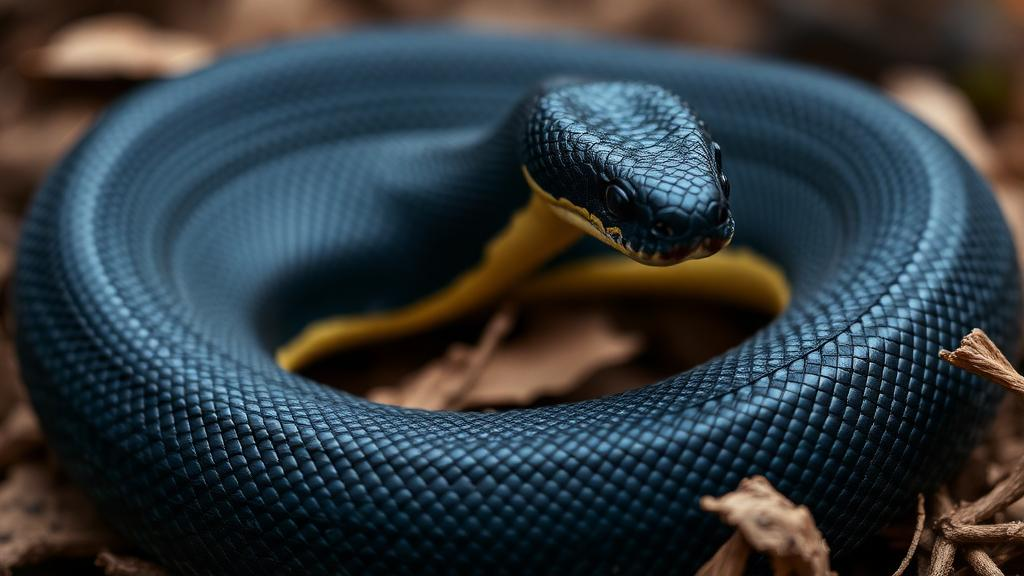
Deep in the Harenna Forest, one of the last great natural forests of the Horn of Africa, a glossy black snake has been quietly slipping through the branches of wild coffee trees. Scientists have now confirmed that this serpent is not the familiar montane egg-eater it superficially resembles, but an entirely new species. Named Dasypeltis albigularis, or the White-throated Egg-eater, the snake was formally described in the journal Herpetozoa after a seven-year investigation that combined fieldwork, captive breeding, and molecular genetics.
Egg-eating snakes of the genus Dasypeltis are among the most specialised reptiles in Africa. They feed almost exclusively on bird eggs, swallowing them whole and then cracking the shells against modified, saw-like scales on their spine before regurgitating the crushed fragments. As recently as the mid-2000s, only six species were recognised. That number has since expanded dramatically as researchers realised that colour patterns and geography conceal multiple evolutionary lineages. In the Horn of Africa, however, any uniformly dark egg-eater was almost always assumed to be D. atra, the so-called Montane Egg-eater, whose black colouration is legendary among herpetologists.
The mystery began in May 2019, when herpetologist Arthur Tiutenko obtained a dorsally black juvenile female from a local collaborator in the Harenna Forest, on the south-eastern slope of the Somalian Plateau in Ethiopia. Judged on colour alone, the snake looked like a textbook D. atra. But closer inspection revealed a set of anatomical oddities: the interstitial skin between its scales was a striking bluish grey, the scales of the throat and the front of the belly were brilliant white, the first row of dorsal scales on each flank was smooth, and the head bore small extra scales, including a loreal scale, that are normally absent in the genus.
What followed was an experiment worthy of a detective novel. To test whether those unusual head scales were inherited traits or simply a mutation, and to gauge how closely the Harenna snake was related to true D. atra, Tiutenko bred the female with a male D. atra from Chuka on Mount Kenya. Copulation lasted roughly fifteen hours, and after an unusually long gestation of almost seven months the female deposited nineteen eggs. Only a single hatchling survived, a female that arrived after one hundred days of incubation at a constant 23 degrees Celsius, ruling out the possibility of parthenogenesis.
The hybrid offspring carried a mosaic of traits from both parents. It inherited the small extra scale between the nasal, prefrontal, and internasal scales on one side of its head, the bluish interstitial skin, and a mixed black-and-grey throat, but lacked its mother’s loreal scale and had the strongly keeled lateral scales of its father. Remarkably, this F1 female reached sexual maturity at only about eight months, roughly a year earlier than typical for the genus, and later produced fertile clutches with a male D. atra. Her F2 offspring, however, looked entirely like D. atra: none showed the blue skin, white throat, or extra snout scales of their Harenna Forest grandmother. Tellingly, the male D. atra eventually lost interest in the Harenna female altogether, and she stopped producing fertile eggs, suggestive of early reproductive barriers between the two lineages.
Encouraged by these results, the researchers assembled sixteen specimens from the Harenna Escarpment of the Bale Mountains at elevations of 1,500 to 1,700 metres, alongside comparative material from museum collections across Europe and Africa. The consistency of the morphological traits was striking. Every specimen was black above with white infralabials, chin shields, throat scales, and a block of 20 to 62 white anterior ventral plates, whereas black D. atra always have black or dark grey underparts. All individuals hatched from eggs laid in captivity matched their parents in appearance, confirming that the traits are stable and inherited.
The molecular evidence proved decisive. For the first time in a study of this genus, the team combined mitochondrial markers, cytochrome b and 16S rRNA, with nuclear genes, c-mos and RAG2, building phylogenies under both Bayesian and maximum-likelihood frameworks. The Harenna Forest population emerged as the sister species of D. atra, with the two sharing a common ancestor with D. gansi of West Africa. Genetic distances told the same story: at the nuclear RAG2 gene, the Harenna snakes differ from Kenyan D. atra by 1.5 percent, nearly double the 0.8 percent separating D. atra from the more distantly related D. confusa of Nigeria. On the mitochondrial 16S locus, divergence between the Harenna population and Kenyan D. atra reaches 3.1 percent. A haplotype network for c-mos further revealed that the new species carries a private allele separated from D. atra by a distinct mutational step.
Beyond its genes, the White-throated Egg-eater is a physically distinctive animal. Females grow to about 92 centimetres in total length while males stay below 60, making it noticeably smaller than its closest relatives, which can exceed 108 and even 112 centimetres. Its hatchlings weigh just 2.17 to 2.34 grams, up to a gram lighter than those of D. atra. Most specimens are jet black with a bluish sheen between the scales and a conspicuous white throat, but a brown morph also exists, decorated with an irregular series of narrow saddles, elongated flank bars, and small white spots. Curiously, the species appears poorly equipped for stridulation, the rasping defence display typical of the genus, because its specialised scale rows are flatter and smoother than in accomplished rasping species such as D. scabra.
The species’ ecology is tuned to the rhythms of the forest. It lives high in trees by day, descending to the ground to hunt bird nests, find mates, or lay eggs in wet soil under logs. Adults favour the relatively soft-shelled eggs of tree-nesting birds, and large females can swallow prey up to the size of a small chicken egg, consuming eggs at every developmental stage. Courtship follows the pattern seen in its relatives, with males biting females to restrain them during mating, after which the pair remains attached for up to eighteen hours. Clutches of seven to 22 eggs are laid from October to November, hatching about three months later, at the very start of the rainy season in April and May, a timing synchronised with the local bird nesting season rather than the earlier schedule of Kenyan D. atra.
Perhaps the most intriguing aspect of the discovery is what it says about hidden diversity in the Horn of Africa. The Harenna Forest population is separated by 300 to 800 kilometres of lowland savannah, swamps, and desert from its nearest relatives in the Kenyan and western Ethiopian highlands, habitats far too arid for forest-dwelling egg-eaters. A reddish population just 20 kilometres to the south-east, provisionally called D. sp. ‘Borena’, is only distantly related, and a population 300 kilometres to the north clusters with still another unnamed lineage from Somaliland. The authors conclude that a plain black coat is no guarantee of identity in this genus, and they predict that further molecular surveys of dark, plain-coloured egg-eaters across Ethiopia will reveal yet more species. For now, a rare black serpent in a vanishing Ethiopian forest has earned its own name, and its survival depends on one of the region’s last remaining strongholds of wild nature.
Subject of Research: Description of a new species of egg-eating snake from the Harenna Forest, Ethiopia, using morphology, hybridisation experiments, and molecular phylogenetics
Article Title: A new species of ‘black’ egg-eating snake of the genus Dasypeltis Wagler ( Squamata , Colubridae , Colubrinae , Boigini )
Article References: Tiutenko, A., Heller, T. L., & Bates, M. F. (2026). A new species of ‘black’ egg-eating snake of the genus Dasypeltis Wagler (Squamata, Colubridae, Colubrinae, Boigini). Herpetozoa, 39, 343-366. https://doi.org/10.3897/herpetozoa.39.e205043
Image Credits: AI Generated
DOI: 10.3897/herpetozoa.39.e205043
Keywords: Dasypeltis albigularis, egg-eating snake, Ethiopia, Harenna Forest, herpetology, new species, molecular phylogenetics, biodiversity, reptiles, Somalian Plateau, hybridisation, species delimitation
Cite Scienmag News
Margaret Porter. (October 15, 2026). Scientists Discover Striking New Black Egg-Eating Snake Hidden in Ethiopia’s Ancient Forest. Scienmag. https://scienmag.com/scientists-discover-striking-new-black-egg-eating-snake-hidden-in-ethiopias-ancient-forest/
Margaret Porter. "Scientists Discover Striking New Black Egg-Eating Snake Hidden in Ethiopia’s Ancient Forest." Scienmag, 15 October 2026, https://scienmag.com/scientists-discover-striking-new-black-egg-eating-snake-hidden-in-ethiopias-ancient-forest/. Accessed 15 October 2026.
Margaret Porter. "Scientists Discover Striking New Black Egg-Eating Snake Hidden in Ethiopia’s Ancient Forest." Scienmag. October 15, 2026. https://scienmag.com/scientists-discover-striking-new-black-egg-eating-snake-hidden-in-ethiopias-ancient-forest/


