


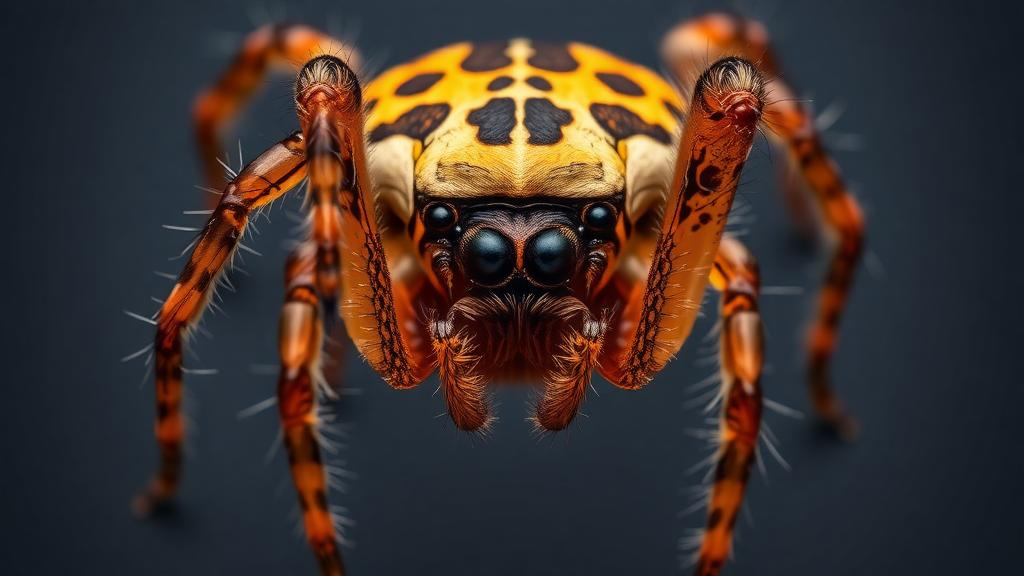
When a lineage of animals leaves almost no fossils, reconstructing its evolutionary history is an uphill battle. That is the predicament facing biologists who study mygalomorph spiders—the ancient group that includes tarantulas and trapdoor spiders—whose burrowing habits make them extraordinarily unlikely to be preserved in sediment. A new study of folding-door spiders in the genus Antrodiaetus offers a way around this problem: instead of relying on the fossil record, the researchers used competing biogeographic hypotheses as calibration points to estimate when lineages split, and in the process uncovered a divergence in the Pacific Northwest older than any previously documented across one of the region’s best-studied biogeographic breaks.
The work, published in Frontiers of Biogeography, focuses on Antrodiaetus, a genus of fossorial spiders with no ballooning dispersal, lifespans estimated at 15 to 30 years, strong habitat preferences, and a nearly nonexistent fossil record. The only fossil representing the family, Cretacattyma raveni, was found in Mongolia and dates to the Cretaceous Period, anchoring the group’s minimum age but offering little help for dating splits among living species. Because burrowing spiders rarely become trapped in sediment layers, the researchers turned to the landscape itself as a clock.
The centerpiece of the study is the Pacificus species complex, a group of cryptic spider lineages distributed disjunctly across the Pacific Northwest. One set of lineages inhabits the Coastal and Cascade mountain ranges from northern California to Alaska, while others live in the interior forests of the Rocky Mountains in Idaho. Between them lies the inhospitable Columbia Basin and Oregon Highlands, a dry expanse that separates mesic forest communities on either side. Decades of research on other dispersal-limited plants and animals across this same break have produced two competing explanations: an Ancient Vicariance hypothesis, in which mountain uplift and subsequent drying fragmented a once-contiguous forest, and an Inland Dispersal hypothesis, in which spiders moved eastward through temporary mesic corridors opened at the edges of retreating Pleistocene glaciers.
Critically, the two hypotheses make different predictions about the shape of the evolutionary tree. Ancient Vicariance implies that coastal populations should be more closely related to each other, with inland populations representing older, isolated refugia. Inland Dispersal implies that inland populations should nest within or sister to particular northern or southern coastal populations, depending on the route of dispersal. Because each hypothesis carries its own timeframe—millions of years for the ancient scenario versus thousands for the recent one—choosing between them also provides a date that can calibrate a molecular clock.
To generate the genomic data needed to test these ideas, the team employed ultraconserved elements, or UCEs—thousands of loci captured using a spider-specific probe kit and sequenced with Illumina technology. UCEs have proven highly informative in mygalomorph systematics, but not all loci behave equally well for dating analyses. The researchers applied a “gene shopping” strategy, using the SortaDate software to rank 1,671 recovered loci by root-to-tip variance, agreement with the preferred tree topology, and overall tree length. Starting from a 95 percent occupancy matrix of 71 loci, they distilled the dataset down to the top 20 most clock-like loci, trading breadth of genomic coverage for a cohesive, consistent evolutionary signal.
Phylogenetic analyses using both concatenated supermatrices in IQTree2 and coalescent-based species trees in ASTRAL-III confirmed the major species groupings within Antrodiaetus. A phylogenetic network built with SplitsTree revealed significant discordance among loci at certain deep nodes, particularly within the Inland Pacific Northwest group, likely the result of rapid ancient radiations that left too little sequence divergence for even genomic-scale data to fully resolve. Despite this noise, one pattern held across every analysis: the enigmatic “pacificus SE” lineage, a small population in the southern Rocky Mountains, was consistently sister to the northern and southern “pacificus WEST” populations—the exact topology predicted by Ancient Vicariance.
Hypothesis testing then became a formal statistical exercise. The researchers compared eight models in BEAST 2’s StarBeast3 package, crossing strict and relaxed molecular clocks with Yule and Fossilized Birth-Death branching models and with either the ancient or recent calibration. Nested sampling ranked a relaxed-clock, Fossilized Birth-Death model with the ancient calibration as the best fit, but relaxed-clock runs failed to reach stationarity or convergence, producing trees with negative branch lengths and implausible topologies. Bayes factor comparisons told a clearer story: the Ancient Vicariance model was strongly supported over Inland Dispersal under both clock models, with Bayes factors of 25.7 under a strict clock and 10.5 under a relaxed clock. The team therefore adopted the next-best model—a strict clock with the ancient calibration and a Fossilized Birth-Death branching process—which converged reliably.
Under that model, the researchers estimated a mean strict-clock rate of 4.499 × 10⁻⁴ substitutions per site per million years for Antrodiaetus and its sister genus Atypoides, with a 95 percent highest posterior density interval spanning roughly 2.7 to 6.3 × 10⁻⁴. This rate is an order of magnitude slower than nuclear rates previously applied to spiders, a difference the authors attribute largely to life history. Mygalomorphs mature slowly and cannot balloon, limiting gene flow and generation turnover compared with araneomorph spiders, whose faster metabolisms and dispersal produce quicker molecular evolution. The conserved nature of the UCE core regions and the deliberate selection of clock-like loci likely also contributed to the slower estimate.
The resulting chronogram reshapes understanding of Pacific Northwest biogeography. The split between Antrodiaetus and Atypoides was placed around 138 million years ago, in the Late Jurassic or Early Cretaceous, when a warm, ice-free Holarctic likely offered continuous habitat. Within the genus, major divergences occurred during the Eocene as Rocky Mountain uplift and global cooling increased seasonality across western North America. Most strikingly, the separation of “pacificus SE” from “pacificus WEST” was dated to approximately 8.5 million years ago—older than the Pliocene timeframe of the classic Ancient Vicariance hypothesis but consistent with the Cascade orogeny, suggesting that early uplift initiated the isolation before regional drying sealed it. This makes the spider split the oldest yet documented across the Columbia Basin biogeographic break.
The study also links the genus’s diversification to the rise of North American grasslands. The disjunct eastern distribution of A. robustus, embedded within a western species group, corresponds with the Miocene retreat of transcontinental forests and their replacement by prairie. Similarly, the divergence of A. apachecus in the American Southwest appears tied to the isolation of montane “sky island” habitats as the region dried. The Japanese species A. yesoensis, deeply nested among North American lineages, points to dispersal across warm, forested northern land bridges during the Paleogene before climate change severed the connection. Together, these findings demonstrate that biogeographic events can serve as rigorous, testable calibrations when fossils fail, and they provide the first UCE-based evolutionary rate for atypoid spiders—a tool the authors hope will illuminate divergence times across the entire mygalomorph radiation.
Subject of Research: Using biogeographic calibrations to estimate divergence times and evolutionary rates in the folding-door spider genus Antrodiaetus where fossils are scarce
Article Title: Hypothesis-driven biogeography to estimate rates and dates when fossil evidence is scarce: a case study using an ancient, Holarctic genus of spider ( Araneae , Antrodiaetidae , Antrodiaetus )
Article References: Ciaccio, E., & Hamilton, C. A. (2026). Hypothesis-driven biogeography to estimate rates and dates when fossil evidence is scarce: a case study using an ancient, Holarctic genus of spider (Araneae, Antrodiaetidae, Antrodiaetus). Frontiers of Biogeography, 19, Article e182722. https://doi.org/10.21425/fob.19.182722
Image Credits: AI Generated
Keywords: Antrodiaetus, biogeography, molecular clock, ultraconserved elements, mygalomorph spiders, ancient vicariance, Pacific Northwest, divergence dating, phylogenomics, Columbia Basin, fossil record, BEAST 2
Cite Scienmag News
Juliet Wilcox. (October 15, 2026). Folding-Door Spiders Reveal Ancient Pacific Northwest Split Written in Their Genes. Scienmag. https://scienmag.com/folding-door-spiders-reveal-ancient-pacific-northwest-split-written-in-their-genes/
Juliet Wilcox. "Folding-Door Spiders Reveal Ancient Pacific Northwest Split Written in Their Genes." Scienmag, 15 October 2026, https://scienmag.com/folding-door-spiders-reveal-ancient-pacific-northwest-split-written-in-their-genes/. Accessed 15 October 2026.
Juliet Wilcox. "Folding-Door Spiders Reveal Ancient Pacific Northwest Split Written in Their Genes." Scienmag. October 15, 2026. https://scienmag.com/folding-door-spiders-reveal-ancient-pacific-northwest-split-written-in-their-genes/


