


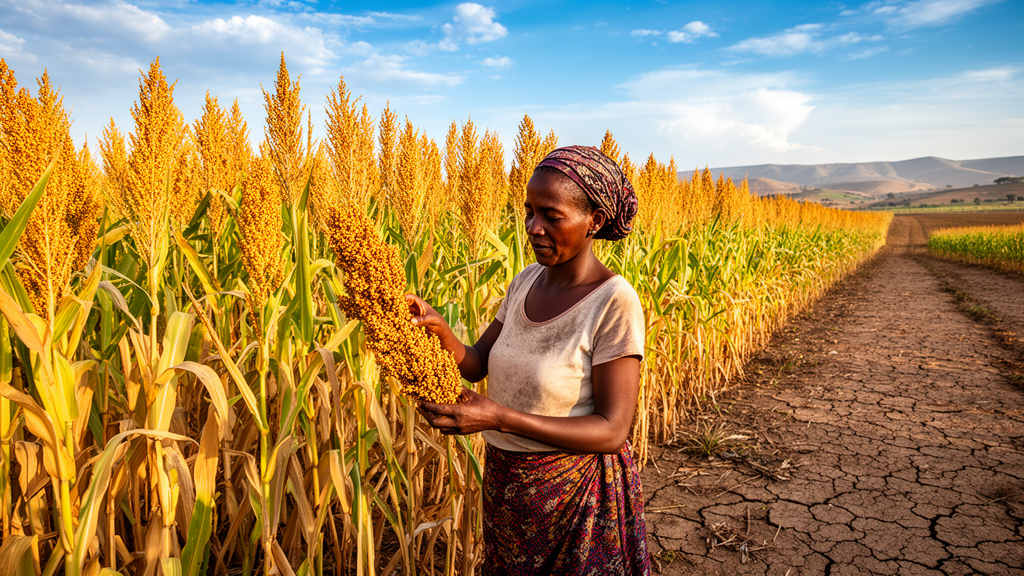
In the moisture-starved lowlands of eastern Amhara, Ethiopia, where the rainy season often arrives late and departs early, a quiet agricultural experiment has produced results that could reshape food security for thousands of farming households. A pre-scaling-up initiative led by Ethiopian agricultural researchers tested two improved early-maturing sorghum varieties, Girana-1 and Melkam, across four drought-prone districts, and the numbers are striking. Under real farmer-managed conditions, the improved varieties outperformed local landraces by margins ranging from roughly 27 percent to nearly 89 percent, demonstrating that scientifically bred, climate-adapted crops can thrive precisely where conventional varieties increasingly fail.
Sorghum is the fifth most important cereal crop globally, after maize, rice, wheat, and barley, and it occupies a special position in sub-Saharan Africa as a food-security anchor in semi-arid environments. Thanks to its genetic makeup, biochemical profile, and photosynthetic efficiency, sorghum tolerates drought better than most staples, which is why researchers describe it as a climate-smart crop. In Ethiopia it is the second most important staple after maize, cultivated on approximately 1.8 million hectares. In the Amhara region, sorghum covers about 14 percent of the four million hectares planted with field crops, some 650,000 hectares contributing roughly 16 percent of regional cereal production.
Yet productivity has lagged far behind potential. National average yields were only 1.3 tons per hectare in the late 1990s, and although they have since risen to around 2.3 tons per hectare, eastern Amhara’s sorghum fields remain dominated by local landraces grown with few recommended agronomic practices. The region’s lowlands, including the Yeju-Kewet sorghum cluster stretching from the Kobo-Alamata plain to Kewet, are chronically food insecure; 77 percent of the Amhara region’s safety-net users come from these eastern areas. Recurrent drought, low soil fertility, Striga infestation, pests, and erratic rainfall marked by late onset and early termination all conspire against farmers, and late-maturing local varieties that need seven to eight months in the field are becoming untenable as the climate shifts.
Recognizing these constraints, regional and federal research institutes had already released improved early-maturing varieties, and on-farm demonstrations suggested yield advantages of 70 to 90 percent over farmers’ practices. But adoption stalled. Improved seed was scarce, extension linkages were weak, awareness was limited, and gender-related barriers restricted access to new technologies. The new study, published in Innovations in Agriculture, set out to break that logjam by pre-scaling Girana-1 and Melkam with their full agronomic packages, aiming to create demand, stimulate seed multiplication, and strengthen the web of stakeholders who must cooperate for technology to spread.
The intervention covered Kobo, Habru, Kalu, and Dawa Chefa districts in the North Wollo, South Wollo, and Oromia Special Zones, each characterized by lowland agro-ecologies where the rains rarely last more than three months from late June to early September. Using a multi-stage purposive selection, the researchers enrolled 273 farmers, including 50 female-headed households, who cultivated a total of 80 hectares of adjacent, clustered farms across seven kebeles. Clustering was a deliberate design choice: contiguous plots made monitoring easier, improved weed and pest management, reduced damage from wild animals, and helped build market linkages within the production areas.
The technology package was agronomically precise. Farmers planted at a seed rate of 12 kilograms per hectare, applied 100 kilograms per hectare of NPS fertilizer and 50 kilograms per hectare of urea, with 39 kilograms of that urea side-dressed at the knee-height stage, spaced rows 75 centimeters apart and plants 15 centimeters apart, thinned 20 days after planting, and constructed tie-ridges to conserve moisture. Dissemination followed a structured sequence: a launch workshop and memorandum of understanding among stakeholders, two-day training combining theory and practice for farmers and extension agents, printed materials in Amharic and English, field days, and joint monitoring at key crop growth stages. Field days alone drew 338 participants, 78 of them women, who evaluated earliness, seed color and size, uniformity, threshability, and suitability for intercropping.
The yield results provide the strongest evidence yet for scaling. Girana-1 delivered mean grain yields of 4.57, 3.50, and 3.65 tons per hectare at Raya Kobo, Habru, and Dawa Chefa respectively, corresponding to advantages of 43.45, 27.27, and 73.8 percent over local varieties. Melkam performed even more dramatically, averaging 3.98 tons per hectare at Kobo, 4.80 at Habru, 4.15 at Kalu, and 3.80 at Dawa Chefa, with yield advantages of 59.2, 74.54, 88.63, and 73.37 percent. The exceptional result in Kalu suggests the variety is particularly well matched to that district’s soil moisture and management conditions, consistent with earlier findings identifying Melkam as a high-yielding, stable, widely adaptable option for drylands.
One trade-off emerged: Melkam’s shorter stalks reduce total biomass compared with local varieties, although farmers found its stalks more palatable as livestock feed. Because sorghum grain feeds people while stalks feed animals and fuel household fires, this dual-purpose dimension matters greatly to farmer preference. Farmers reported that Melkam’s shorter height actually improves tolerance to wind damage, and that both varieties thresh easily and are free from a local health concern known as qinqn, simplifying post-harvest handling. Many participants said they intend to intercrop the new varieties with mung bean, haricot bean, and forage species to offset any feed shortfall.
Farmers’ preferences, measured with a Relative Importance Index, revealed complementary strengths. Melkam topped nearly every trait evaluated, with a uniform crop stand, early maturity, and intercropping suitability, though its white seed and short stalk make it more vulnerable to bird damage. Girana-1 scored well on grain color and size, stalk palatability, marketability, and livestock feed value. Sensory evaluations of food quality added another layer of nuance: Melkam was preferred for porridge, injera taste, and injera color, while Girana-1 excelled in fermentation-related traits such as local beer quality, injera baking quality, lusciousness, and flour water-holding capacity. The two varieties thus serve complementary roles in Ethiopian kitchens as well as fields.
A total of 1,230 kilograms of seed, 825 kilograms of Girana-1 and 405 kilograms of Melkam, was distributed, with initial seed revolving to reach additional farmers through a farmer-to-farmer exchange mechanism designed to keep seed affordable, high in quality, and locally available. The researchers conclude that a coordinated multi-stakeholder approach, spanning research centers, agricultural offices, cooperatives, unions, seed enterprises, NGOs, and the Bureau of Agriculture, is essential to sustain community-based seed systems and market linkages. They also call for further research into fall armyworm, stalk borer, and emerging pests, along with food-science assessments along the value chain. If the momentum holds, the humble early-maturing sorghum plant may become one of eastern Africa’s most powerful tools against climate-driven hunger.
Subject of Research: Pre-scaling up of improved early-maturing sorghum varieties in moisture-deficient eastern Amhara, Ethiopia
Article Title: Pre-scaling up of early maturing sorghum ( Sorghum bicolor L.) technologies in moisture-deficient areas of eastern Amhara, Ethiopia
Article References: Haile, A., Siyum, N., Bahta, M., & Assefa, M. (2026). Pre-scaling up of early maturing sorghum (Sorghum bicolor L.) technologies in moisture-deficient areas of eastern Amhara, Ethiopia. Innovations in Agriculture, 9, Article e180604. https://doi.org/10.3897/ia.2026.180604
Image Credits: AI Generated
Keywords: sorghum, Ethiopia, drought tolerance, early maturity, food security, yield advantage, seed systems, agricultural extension, climate-smart agriculture, Girana-1, Melkam, Amhara region
Cite Scienmag News
Alan Morgan. (October 15, 2026). Early-Maturing Sorghum Delivers Big Yield Gains in Drought-Hit Ethiopia. Scienmag. https://scienmag.com/early-maturing-sorghum-delivers-big-yield-gains-in-drought-hit-ethiopia/
Alan Morgan. "Early-Maturing Sorghum Delivers Big Yield Gains in Drought-Hit Ethiopia." Scienmag, 15 October 2026, https://scienmag.com/early-maturing-sorghum-delivers-big-yield-gains-in-drought-hit-ethiopia/. Accessed 15 October 2026.
Alan Morgan. "Early-Maturing Sorghum Delivers Big Yield Gains in Drought-Hit Ethiopia." Scienmag. October 15, 2026. https://scienmag.com/early-maturing-sorghum-delivers-big-yield-gains-in-drought-hit-ethiopia/


