


In the quest for sustainable energy solutions, lithium has emerged as a critical element underpinning the global shift toward electrification and renewable technologies. However, the escalating demand for lithium, coupled with finite reserves, has spotlighted an urgent need for more efficient and environmentally friendly extraction methods. Traditional sources like mineral ores are increasingly constrained, prompting researchers to explore unconventional reservoirs such as salt-lake brines and geothermal waters. These sources, though abundant, present formidable challenges — chiefly, the difficulty in separating lithium ions from chemically similar and far more concentrated sodium and potassium ions. This hurdle has stymied scalable extraction efforts and kept lithium recovery technologies from realizing their full potential.
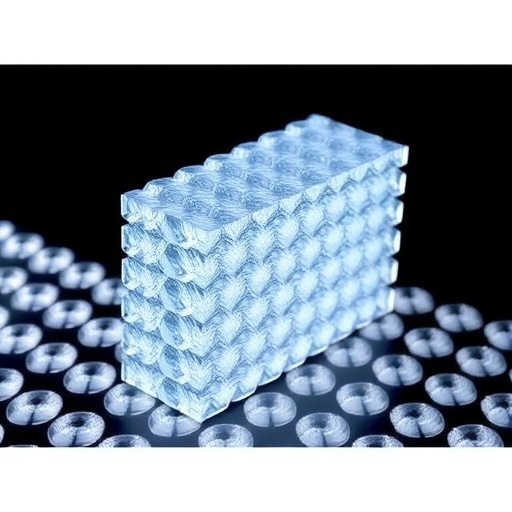
A groundbreaking study led by Wang et al. ushers in a new paradigm for lithium extraction by leveraging the unique properties of metal-organic frameworks (MOFs) integrated into a glass composite membrane. This novel membrane design draws inspiration from biological systems, particularly the sodium-potassium cotransporter proteins whose intricate, selective ion channels mediate and regulate ion transport in living cells. Drawing a parallel between biology and materials science, the research team engineered an ion-selective glass composite (ISGC) membrane by combining glassable zeolitic imidazolate framework 62 (ZIF-62) with thermally robust ZIF-8 through a melt-quenching process. This fusion forms a membrane embedded with sub-nanometer pores, which mimic the selective ion-filtering prowess of natural proteins.
At the heart of this innovation lies the membrane’s ability to distinguish between monovalent cations — lithium, sodium, and potassium — despite their close chemical and physical properties. This is achieved through complex coupled dehydration-rehydration mechanisms within the confined nanochannels, coupled with discrete yet subtle interactions between the ions and the MOF’s organic-inorganic framework. Molecular dynamics simulations substantiate these mechanistic insights, revealing how the delicate interplay restrains the passage of larger sodium and potassium ions, while favoring lithium transport. The result is a highly selective membrane that challenges the conventional trade-offs seen in ion separation technologies.
Performance testing of the membrane in binary ion mixtures revealed remarkable selectivity metrics. When exposed to equal concentrations of ions, the composite membrane attained a potassium-to-lithium (K^+/Li^+) selectivity factor of 185, while maintaining a sodium-to-lithium (Na^+/Li^+) selectivity of 53.3. These figures underscore the membrane’s unprecedented discrimination between lithium and its abundant alkali counterparts. Intriguingly, even when potassium concentration was increased tenfold relative to lithium, the membrane sustained a K^+/Li^+ selectivity of approximately 10, demonstrating extraordinary resilience and specificity under challenging feed scenarios.
The real promise of this technology unfolds in multi-ion brine environments, which more closely resemble real-world conditions found in salt lakes and geothermal reservoirs. Here, the membrane’s selective capability is further amplified, achieving selectivity levels as high as 410 for K^+/Li^+ and 80 for Na^+/Li^+. Such performance metrics position this MOF-based ISGC membrane as a game-changer for lithium enrichment technologies, transcending longstanding limitations imposed by competing ions in complex saline matrices.
Taking a significant stride from lab-scale proof-of-concept to practical applicability, the researchers successfully scaled their membranes into robust disc-tube modules that are compatible with crossflow filtration systems. This engineering leap enables the treatment of vast volumes of lithium-bearing brines, a critical step toward industrial implementation. The modules demonstrated capability in enriching lithium concentrations from synthetic salt-lake brines to as high as 64.6 grams per liter, surpassing thresholds necessary for economically viable recovery processes.
Perhaps most striking from an operational standpoint is the membrane’s energy efficiency. Using the disc-tube modules, the researchers managed to directly precipitate battery-grade lithium carbonate (Li_2CO_3), a vital precursor for lithium-ion battery manufacturing, at an energy cost of just 1.02 kilowatt-hours per kilogram. This energy input marks a significant reduction compared to existing commercial technologies, underscoring the sustainability of the approach and its alignment with green energy goals.
This multidisciplinary advancement seamlessly merges molecular-level ion transport engineering with scalable process design, bridging a gap that has so far limited lithium extraction innovations from moving beyond the laboratory. The use of MOF materials, conventionally celebrated for their tunable porosity and chemical functionality, within a glass composite matrix, ensures mechanical robustness and long-term operational stability — both essential for tackling real-world industrial demands.
Moreover, the study’s implications go beyond lithium extraction alone. The membrane platform’s outstanding ion selectivity hints at broader applications in water purification, resource recovery, and energy systems where selective ion separations are critical. By harnessing subtle ion dehydration dynamics and selective framework interactions, this technology offers an elegant, biomimetic solution to a pervasive scientific and industrial challenge.
The research vividly demonstrates the power of bioinspired materials science in addressing urgent environmental issues. By mimicking nature’s precision in ion discrimination, the team has crafted a new class of membranes capable of meeting escalating global lithium demands without compromising sustainability. This represents a milestone not only for battery materials supply chains but also for the broader transition towards circular economy models in critical materials management.
In conclusion, the development of MOF-based ion-selective glass composite membranes heralds a transformative advance in the sustainable extraction of lithium from complex brine mixtures. The combination of high selectivity, scalability, energy efficiency, and operational robustness positions this platform at the forefront of next-generation separation technologies. As the world races to electrify transportation and deploy renewable energy at scale, innovations like these will be vital to ensuring that essential materials like lithium can be sourced responsibly and economically.
The study by Wang and colleagues exemplifies how the convergence of biomimicry, materials chemistry, and process engineering can solve pressing resource challenges. Their scalable glass composite membranes pave the way toward a future where lithium is not only abundant but also extracted through environmentally conscious technologies, transforming energy storage and water purification fields alike. This research sets a new benchmark, inspiring further exploration into tailored MOF structures and composite materials to unlock even more selective, robust, and energy-efficient ion separations in diverse applications.
Cite Scienmag News
Faith Mcneil. (April 14, 2026). Scalable Glass Composite Membranes Boost Lithium Selectivity. Scienmag. https://scienmag.com/scalable-glass-composite-membranes-boost-lithium-selectivity/
Faith Mcneil. "Scalable Glass Composite Membranes Boost Lithium Selectivity." Scienmag, 14 April 2026, https://scienmag.com/scalable-glass-composite-membranes-boost-lithium-selectivity/. Accessed 4 September 2026.
Faith Mcneil. "Scalable Glass Composite Membranes Boost Lithium Selectivity." Scienmag. April 14, 2026. https://scienmag.com/scalable-glass-composite-membranes-boost-lithium-selectivity/


