


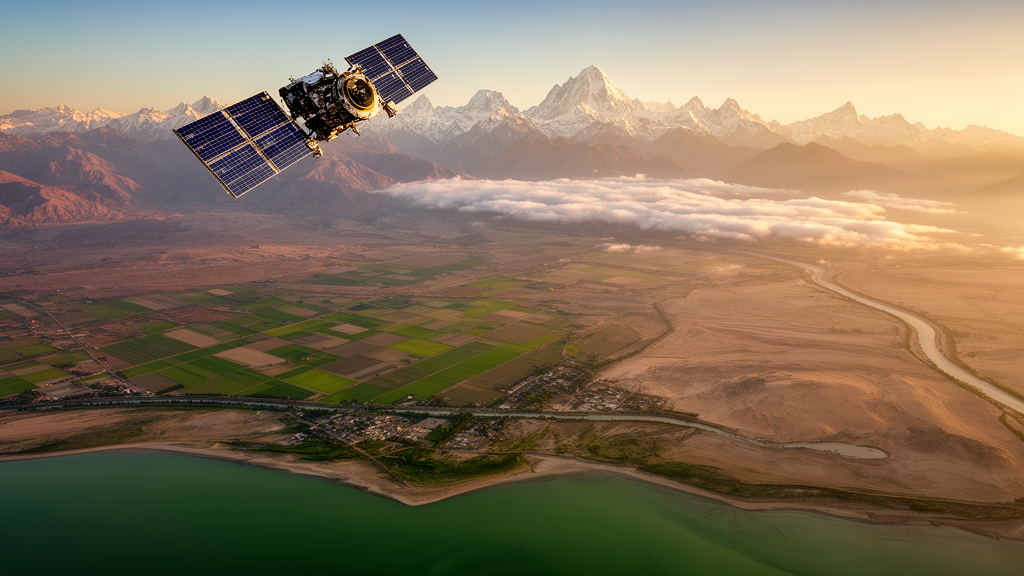
From the mangrove-fringed deltas of the Arabian Sea to the glacier-crowned peaks of the Karakoram, Pakistan compresses one of the steepest environmental gradients on Earth into a single national territory. That extraordinary range of climates and elevations has now been put to work as a natural laboratory for one of the most fundamental questions in climate science: how does vegetation respond, season by season, to a warming world? A new study published in Regional Environmental Change delivers the first national-scale assessment of vegetation phenology across Pakistan, and its findings reveal a landscape split between ecosystems that march in tight lockstep with the climate and those that have been largely decoupled from it by human management.
Phenology, the study of recurring biological events such as leaf-out, greening, and senescence, is far more than a botanical curiosity. The timing of when plants green up and shut down governs how much carbon ecosystems absorb, how productive rangelands and croplands are, and how vegetation feeds back into the climate system itself. Shifts in growing season length can alter regional water cycles, change surface reflectivity, and disrupt the synchrony between plants and the pollinators, herbivores, and microbes that depend on them. Tracking these shifts at scale, however, has long been a challenge in regions like South Asia, where ground-based phenological observations are sparse and terrain is formidable.
The research team, led by Zulqarnain Satti of Central South University in China together with colleagues from institutions in China, Pakistan, and Germany, tackled this problem from orbit. They drew on more than two decades of satellite observations from the MODIS instrument, using the MOD13Q1 product, which provides 16-day composites of the Normalized Difference Vegetation Index, or NDVI, at 250-meter resolution from 2001 to 2024. NDVI exploits the fact that healthy, chlorophyll-rich vegetation reflects near-infrared light strongly while absorbing red light, allowing satellites to track the green-up and browning-down of the land surface. To these vegetation records the researchers paired ERA5-Land reanalysis data from the European Centre for Medium-Range Weather Forecasts, offering hourly temperature and radiation estimates at roughly 9-kilometer resolution, along with elevation information from the Shuttle Radar Topography Mission. All data were processed through Google Earth Engine, the cloud-computing platform that has become indispensable for planetary-scale environmental analysis.
The spatial patterns that emerged are striking. The start of the growing season arrives earliest in the southern lowlands, between roughly day 20 and day 110 of the year, and latest in the northern highlands, where vegetation does not awaken until day 170 to 230. The length of the growing season spans an equally dramatic range, from about 150 days in high-altitude and arid regions to more than 300 days in the intensively irrigated agricultural zones of the Indus plains. The end of the season behaves differently in different regions: in the forested ecosystems of the north, senescence comes later and vegetation activity stretches longer, while in the hotter, drier south the season closes earlier, cut short by heat and moisture stress.
When the researchers examined which environmental factors best explained this variability, temperature emerged as the dominant and most spatially coherent driver, but with a crucial asymmetry. Minimum temperature, the warmth of nights and winters, was most strongly associated with an earlier start of season and a longer growing season, particularly in the cooler mountain ecosystems where thermal thresholds constrain when plants can begin growth. Maximum temperature told the opposite story: in arid and semi-arid regions, hotter daytime conditions were linked to an earlier end of season, consistent with heat accelerating senescence and drying out vegetation. Precipitation played a supporting role, associated with delayed season endings and longer growing seasons in environments where moisture is scarce. In other words, cold nights set the clock at the top of the mountains, while hot days pull the plug in the deserts.
Elevation itself proved to be a powerful predictor. Across the country, higher elevations corresponded to later starts of season, with a correlation coefficient of 0.61, and shorter growing seasons, with a coefficient of negative 0.55. These elevation-phenology relationships were strongest in Gilgit Baltistan and Khyber Pakhtunkhwa, the provinces that host the Hindu Kush, Karakoram, and western Himalaya. This makes physical sense: temperature declines predictably with altitude, snowmelt timing shifts upward with elevation, and the length of the frost-free window shrinks as terrain rises. The finding aligns with a broader international literature showing that mountain phenology is organized along elevational gradients, and that warming can compress those gradients by allowing high-elevation plants to green up earlier than they once did.
The long-term trends, however, came with an important statistical caveat. Over the 24-year record, directional changes were generally modest, and after the researchers applied false discovery rate correction, a standard safeguard against spurious significance when testing many locations simultaneously, the trends were not statistically significant. Yet the direction of change was far from random. In 82.5 percent of vegetated areas, the end of the growing season showed advancement, arriving earlier in the year, and in 62.3 percent of areas the growing season contracted. These patterns were concentrated in central Punjab and Khyber Pakhtunkhwa, suggesting that even where statistical confidence is limited, a consistent signal of shortening vegetation activity is emerging across the country’s agricultural heartlands.
Perhaps the most thought-provoking result concerns the contrast between wild and managed landscapes. Interannual analysis revealed that climate-phenology synchrony is stronger in high-elevation ecosystems than in the intensively managed lowland agricultural systems, where the associations were weaker or more variable. The interpretation is straightforward: alpine grasslands and forests have no choice but to follow the weather, while Punjab’s irrigated croplands are buffered by canal water, planting decisions, crop breeding, and fertilizer regimes. Farmers effectively rewrite the phenological calendar, sowing wheat when schedules and water deliveries permit rather than when temperatures alone would dictate. This decoupling has a silver lining for food security, since managed systems can adapt faster than nature, but it also means that satellite-based climate signals in agricultural zones reflect human choices as much as climatic ones, complicating the detection of genuine climate change impacts.
The study’s implications reach well beyond academic interest. Pakistan is among the countries most vulnerable to climate change, facing recurrent heatwaves, glacial lake outburst floods, and severe water stress in the Indus Basin. A national phenological baseline of the kind this research establishes provides a reference against which future shifts can be measured, an early-warning framework for rangeland degradation, and a foundation for climate-smart agricultural planning. If minimum temperatures continue to rise, mountain ecosystems may see further lengthening of their brief growing windows, with consequences for high-altitude carbon storage and the pastoral communities that time their livestock movements around alpine greening. If maximum temperatures keep climbing in the arid south, earlier season endings could shorten forage availability and increase irrigation demand precisely when water is scarcest.
There are also methodological lessons here for the global phenology community. The Pakistani case demonstrates that national-scale phenological assessments must account for the profound influence of irrigation and land management, which can mask or distort climate signals in satellite records. It also underscores the value of separating minimum from maximum temperature effects, since the two exert opposite influences depending on the moisture regime. As the MODIS record extends and newer sensors such as VIIRS continue the time series, the baseline built by Satti and colleagues will allow scientists to detect when the modest directional changes of the past two decades harden into statistically robust transformations. For a country whose rivers, fields, and forests hang on the timing of the seasons, knowing exactly how those seasons are shifting, and where vegetation still answers to the climate rather than the canal, is knowledge that could not come at a more urgent moment.
Subject of Research: Climate-driven vegetation phenology and growing season dynamics across elevational gradients in Pakistan
Article Title: Climate warming reveals contrasting phenological sensitivities across elevational gradients in Pakistan
Article References: Climate warming reveals contrasting phenological sensitivities across elevational gradients in Pakistan. (n.d.). https://doi.org/10.1007/s10113-026-02702-y
Image Credits: AI Generated
DOI: 10.1007/s10113-026-02702-y
Keywords: phenology, climate change, remote sensing, MODIS NDVI, growing season, elevation gradient, Pakistan, Hindu Kush Karakoram Himalaya, temperature sensitivity, irrigated agriculture, ERA5-Land, Regional Environmental Change
Cite Scienmag News
Sloane Callahan. (October 8, 2026). Satellites Reveal How Warming Reshapes Pakistan’s Growing Seasons From Coast to Karakoram. Scienmag. https://scienmag.com/satellites-reveal-how-warming-reshapes-pakistans-growing-seasons-from-coast-to-karakoram/
Sloane Callahan. "Satellites Reveal How Warming Reshapes Pakistan’s Growing Seasons From Coast to Karakoram." Scienmag, 8 October 2026, https://scienmag.com/satellites-reveal-how-warming-reshapes-pakistans-growing-seasons-from-coast-to-karakoram/. Accessed 8 October 2026.
Sloane Callahan. "Satellites Reveal How Warming Reshapes Pakistan’s Growing Seasons From Coast to Karakoram." Scienmag. October 8, 2026. https://scienmag.com/satellites-reveal-how-warming-reshapes-pakistans-growing-seasons-from-coast-to-karakoram/


