


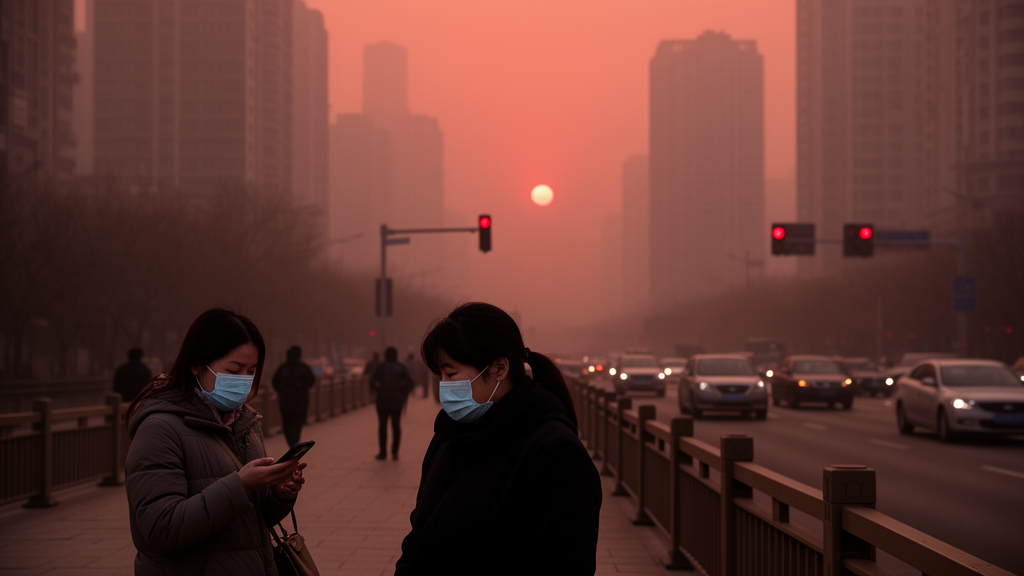
When Beijing issued its first-ever red-level haze alerts in December 2015, the city was not merely telling its residents that the air had turned dangerous. According to a new study published in the journal Air Quality, Atmosphere & Health, those alarms also acted as powerful reference signals that recalibrated how ordinary people estimated the pollution around them, pulling subjective judgments measurably closer to the hard numbers produced by official monitoring stations. The finding offers a rare, quasi-experimental window into a question that has long frustrated environmental psychologists and risk communicators alike: can a high-severity official warning actually correct the persistent gap between what people think they are breathing and what the sensors record?
The research team, led by Wei Wang and Boyuan Lu of the University of Wisconsin-Madison and Peking University, together with colleagues at the University of Maryland and Peking University’s Department of Sociology, exploited a natural experiment embedded in the timing of the December 2015 alerts. Beijing’s red haze alerts, the most severe tier in the city’s emergency response system, were triggered by forecasts of sustained heavy pollution and came bundled with dramatic countermeasures, including restrictions on vehicle use, suspension of industrial production, and closures of schools and construction sites. Because the alerts arrived suddenly and applied citywide, the researchers could compare the pollution estimates of people surveyed before the alerts with those of people surveyed after, treating the intervention much like a randomized treatment in a laboratory setting.
The study combined two sources of data. The first was official air-quality monitoring information from the Beijing Municipal Ecological and Environmental Monitoring Center, which provided objective benchmarks for fine particulate matter concentrations, known as PM2.5, and for the frequency of yellow-level haze days, a milder pollution category. The second was a survey experiment involving 947 university students who were randomly assigned to report their perceptions of pollution conditions either before or after the red alerts. By asking participants to estimate pollution levels and then comparing those estimates against monitored values, the researchers could quantify the estimation gap with unusual precision for a social science study of environmental perception.
The headline result is striking. Among students who reported being aware of the red alert, mean overestimation of PM2.5 concentrations fell from 49.90 percent above monitored values to 30.53 percent. The correction was even more dramatic for yellow-level haze days, a category that most residents would find harder to judge from memory: overestimation collapsed from 178.89 percent to 87.43 percent. In other words, before the alerts, students believed mild haze days were nearly three times more common than the monitoring record showed; afterward, their estimates were less than twice the true figure. Multivariate statistical models that controlled for individual characteristics confirmed these reductions, estimating that the red alert cut PM2.5 overestimation by 19 to 27 percent and yellow-level haze-day overestimation by 92 to 147 percent.
These numbers speak to a well-documented puzzle in the literature on environmental risk perception. Decades of research, stretching back to foundational work on judgment under uncertainty by Amos Tversky and Daniel Kahneman, have shown that people rely on heuristics and salient memories rather than statistical records when assessing hazards. Air pollution is a particularly tricky case because its severity varies across space and time, is often invisible at low concentrations, and is filtered through media coverage, personal symptoms, and social conversations. Previous studies in China and elsewhere have found that self-reported pollution levels routinely diverge from station data, sometimes wildly, and that these mismatches can distort protective behavior, undermine trust in government statistics, and complicate emergency management. The Beijing study suggests that a single, highly salient official alarm can serve as an anchoring event that resets the reference point people use when making subsequent judgments.
The mechanism the authors propose is consistent with salience theory in behavioral economics. A red alert is not just information; it is a dramatic, citywide signal that makes pollution cognitively available and provides a concrete benchmark against which past and present conditions can be evaluated. Once residents know that a red alert corresponds to a specific, severe pollution state, they apparently recalibrate their internal scale, becoming more accurate not only about extreme episodes but also about milder yellow-level conditions. This spillover from high-severity signals to lower-severity judgments is one of the study’s most interesting technical contributions, because it implies that extreme warnings do more than communicate the immediate emergency; they teach the public where the whole pollution distribution sits.
Yet the alert’s effects were strikingly selective when it came to evaluations of government mitigation efforts. The researchers examined whether the red alerts changed how students assessed specific policy responses, including vehicle restrictions, factory shutdowns, urban greening programs, and restaurant regulations. Only the vehicle restriction policy showed a significant increase in recognition and evaluation. The authors attribute this asymmetry to measure visibility: odd-even license plate rules remove half the cars from the streets, an effect that any commuter can directly observe, whereas factory closures, tree planting, and restaurant oversight happen largely out of public view. Assessments of those less visible measures did not shift at all in response to the alert. For policymakers, this is a sobering result, because the measures that are hardest for citizens to see are precisely the ones whose public support may depend on deliberate communication rather than ambient visibility.
The study also probed whether the alerts changed self-reported protective behavior, such as wearing masks or limiting outdoor activity, and whether gender shaped the accuracy of pollution estimates. On both fronts the results were more muted. Changes in protective behavior were modest and statistically insignificant, and gender had no significant effect on overestimation, a finding that runs counter to some earlier literature reporting systematic gender differences in environmental risk perception and pro-environmental behavior. The authors are careful not to overclaim here; a survey of university students, however well designed, captures a specific population at a specific moment, and self-reported behavior is vulnerable to recall and social desirability biases that the study’s own framing acknowledges.
Those limitations are worth taking seriously, but they do not erase the central contribution. By pairing a randomized survey design with objective monitoring data and a genuine policy shock, the study moves the field beyond the correlational snapshots that have dominated perception research. It demonstrates causally, not just associatively, that high-severity environmental alarms function as reference signals that narrow the perception gap. It also identifies the boundary conditions of that effect: the correction applies to pollution estimates but not automatically to policy evaluations, and it operates through visibility, meaning that invisible mitigation work remains invisible even during a crisis. The practical implication is that warnings and transparency must travel together. An alert can teach the public what severe pollution looks like, but only visible, well-communicated policy action can convert that heightened attention into durable trust in the institutions managing the air.
As cities worldwide grapple with wildfire smoke, dust storms, and industrial smog in a warming climate, the Beijing red alert experiment offers a template for evidence-based risk communication. Emergency warnings are often evaluated solely by whether they prompt immediate protective action, a metric on which this study found only weak effects. But the research suggests a second, subtler function that has been largely overlooked: alarms as calibration devices that align public perception with scientific measurement. If subsequent studies replicate these findings in other cities and populations, environmental agencies may come to see their most severe alert tiers not just as sirens but as teaching moments, brief windows in which the public is unusually receptive to learning what the numbers on the monitor actually mean for the air in their lungs.
Subject of Research: The effect of high-severity air pollution alerts on public perception accuracy and policy evaluation during Beijing's 2015 red haze alerts
Article Title: High-severity environmental alarms as reference signals: Evidence from Beijing’s first red haze alerts
Article References: Wang, W., Lu, B., Zhang, X., Fan, X., & Zhang, W. (2026). High-severity environmental alarms as reference signals: Evidence from Beijing’s first red haze alerts. Air Quality, Atmosphere & Health, 19(10), Article 228. https://doi.org/10.1007/s11869-026-02117-y
Image Credits: AI Generated
DOI: 10.1007/s11869-026-02117-y
Keywords: air pollution, PM2.5, red haze alert, risk perception, Beijing, environmental communication, survey experiment, public trust, protective behavior, salience theory, emergency response, environmental monitoring
Cite Scienmag News
Russell Cooper. (October 8, 2026). Beijing’s First Red Haze Alerts Sharpened How Residents Judge Air Pollution. Scienmag. https://scienmag.com/beijings-first-red-haze-alerts-sharpened-how-residents-judge-air-pollution/
Russell Cooper. "Beijing’s First Red Haze Alerts Sharpened How Residents Judge Air Pollution." Scienmag, 8 October 2026, https://scienmag.com/beijings-first-red-haze-alerts-sharpened-how-residents-judge-air-pollution/. Accessed 8 October 2026.
Russell Cooper. "Beijing’s First Red Haze Alerts Sharpened How Residents Judge Air Pollution." Scienmag. October 8, 2026. https://scienmag.com/beijings-first-red-haze-alerts-sharpened-how-residents-judge-air-pollution/


