


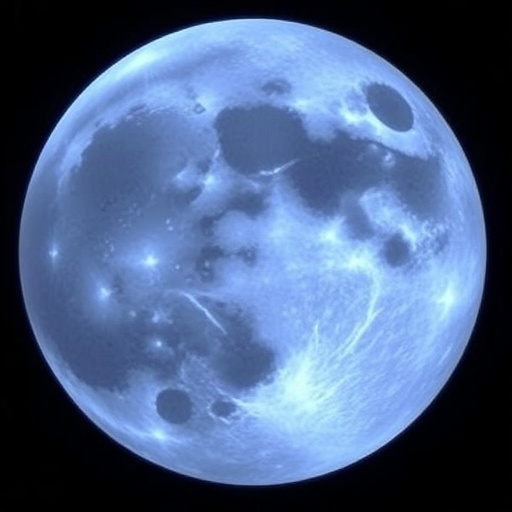
In a groundbreaking advancement poised to revolutionize lunar science, researchers at Tokyo Metropolitan University have unveiled a pioneering compact X-ray fluorescence (XRF) imaging spectrometer designed to map the entire surface of the Moon with unprecedented precision. This innovative approach utilizes a lightweight, high-resolution X-ray telescope integrated into a lunar-orbiting satellite, promising to unlock detailed geochemical insights that have remained elusive since the Apollo missions first glimpsed lunar composition data decades ago.
Understanding the Moon’s geological history has long challenged planetary scientists, largely due to the limitations of remote sensing technology and the logistical constraints of sample collection across its vast and varied surface. The Moon’s elemental makeup serves as a fundamental key to deciphering its evolutionary story, revealing processes from its formation to the present-day surface dynamics. However, previous attempts to generate comprehensive geochemical maps have fallen short, hindered by technical obstacles such as limited exposure to solar X-ray illumination and the rapid deterioration of detectors under harsh lunar orbital conditions.
The principle behind X-ray fluorescence imaging relies on detecting characteristic X-rays emitted by lunar surface elements when energized by solar X-rays. This methodology captures fingerprints of essential elements like oxygen, silicon, magnesium, aluminum, and iron, but dependence on solar activity has traditionally restricted data acquisition windows and spatial coverage. Moreover, the weak solar X-ray flux in the polar areas compounds these challenges, leaving key regions inadequately surveyed and their compositional secrets untapped.
Addressing these formidable barriers, Airi Toida and Professor Yuichiro Ezoe have spearheaded the development of a compact X-ray telescope weighing less than ten kilograms, a dramatic reduction compared to conventional bulky spaceborne X-ray instruments. Originally engineered for Earth magnetospheric studies, this lightweight design marries robustness with sensitive imaging capabilities tailored for the demanding lunar environment. Its enhanced radiation tolerance ensures sustained operation despite exposure to intense cosmic radiation and solar particle events encountered in lunar orbit.
The team rigorously modeled the instrument’s performance through sophisticated numerical simulations, embedding realistic parameters such as solar flare frequency and satellite orbital mechanics. Their simulation framework incorporated an assumed annual flux of 300 solar flares, which significantly amplify solar X-ray output and thus the emitted fluorescence signal, optimizing detection conditions. These calculations revealed that a single compact telescope orbiting the Moon could generate a complete elemental map at a 70 by 70-kilometer resolution grid within just two years.
To elevate the spatial resolution and accelerate data collection, the researchers proposed deploying an array of 25 identical telescopes configured in a five-by-five grid aboard a single satellite. This multi-detector system would not only sharpen the mapping resolution to 30 by 30 kilometers but also reduce mission duration to approximately one year for key elements and two years for broader elemental coverage including sodium. Such rapid and detailed mapping capabilities mark a quantum leap over previous missions, which struggled to deliver partial maps or single-element analyses with limited coverage.
Beyond technical innovations, the compact telescope’s operational paradigm leverages intermittent yet potent solar flares to illuminate vast portions of the lunar surface intensively, ensuring sufficient X-ray fluorescence emission for detection. This approach counteracts the pervasive challenge of weak solar excitation during normal conditions and systematically addresses the data voids in polar regions, offering the first hope of a truly comprehensive elemental survey of the Moon.
A successful full-coverage geochemical map generated by this technology would have profound scientific implications. It would provide crucial constraints on lunar differentiation processes, crust and mantle composition variations, and the distribution of volatile and refractory elements critical for understanding lunar resource potential and planetary formation theories. Furthermore, such a dataset would drastically refine models of lunar surface weathering and regolith formation driven by micrometeorite impacts and solar wind interactions.
This research underpins a new era in planetary remote sensing, where miniaturized yet highly capable instruments can be rapidly integrated into satellite constellations for long-term, wide-area observation campaigns. The compact XRF imaging spectrometer exemplifies the ethos of modern space instrumentation: maximizing scientific output while minimizing payload mass, power consumption, and cost. This paradigm shift is particularly crucial for small satellite platforms poised to democratize space exploration in the coming decades.
The study, published in the journal Earth Planets and Space, was supported by the Japan Society for the Promotion of Science (JSPS) under Grant Number 21H04972. Its significance extends beyond lunar science, offering a blueprint for future X-ray fluorescence mapping of other celestial bodies where direct sampling remains challenging, such as asteroids and the Martian moons. The versatility and agility of the compact telescope design hold promise for a broader family of planetary spectroscopy missions.
Collaborators emphasize that the next steps involve experimental validation of the compact telescope in relevant space-like conditions, refinement of detector calibration under lunar radiation environments, and the design of mission architectures optimized for simultaneous multi-element mapping. Long-term, the deployment of such instruments could coincide with upcoming Moon missions from international agencies, integrating geochemical mapping as a core objective for unlocking planetary evolution narratives.
In conclusion, this innovative X-ray fluorescence imaging spectrometer marks a pivotal breakthrough in lunar exploration technology. By enabling high-resolution, comprehensive elemental mapping of the Moon’s surface within manageable mission timelines, it opens a new window into the Moon’s geological past and future potential. This technological leap promises to bridge long-standing gaps in our understanding of Earth’s solitary satellite, fueling a renaissance in planetary science fueled by sophisticated, compact instrumentation.
Cite Scienmag News
Bethany Barker. (June 6, 2026). Satellite X-ray Telescopes Set to Map Lunar Surface Chemistry Within Years. Scienmag. https://scienmag.com/satellite-x-ray-telescopes-set-to-map-lunar-surface-chemistry-within-years/
Bethany Barker. "Satellite X-ray Telescopes Set to Map Lunar Surface Chemistry Within Years." Scienmag, 6 June 2026, https://scienmag.com/satellite-x-ray-telescopes-set-to-map-lunar-surface-chemistry-within-years/. Accessed 4 September 2026.
Bethany Barker. "Satellite X-ray Telescopes Set to Map Lunar Surface Chemistry Within Years." Scienmag. June 6, 2026. https://scienmag.com/satellite-x-ray-telescopes-set-to-map-lunar-surface-chemistry-within-years/


