

Wednesday, October 21, 2026
Science
No Result
View All Result
  • Login
  • HOME
  • SCIENCE NEWS
  • CONTACT US
  • HOME
  • SCIENCE NEWS
  • CONTACT US
No Result
View All Result
Scienmag
No Result
View All Result
Home Science News Earth Science

Satellite study maps Hurricane Erick impacts and projects Oaxaca shoreline change through 2045

October 21, 2026
in Earth Science
Violet Maxwell
By Violet Maxwell Scienmag Editorial Profile - Natural Hazards
Reading Time: 2 mins read
0
Satellite study maps Hurricane Erick impacts and projects Oaxaca shoreline change through 2045

Satellite study maps Hurricane Erick impacts and projects Oaxaca shoreline change through 2045

65
SHARES
587
VIEWS
Share on FacebookShare on Twitter
ADVERTISEMENT

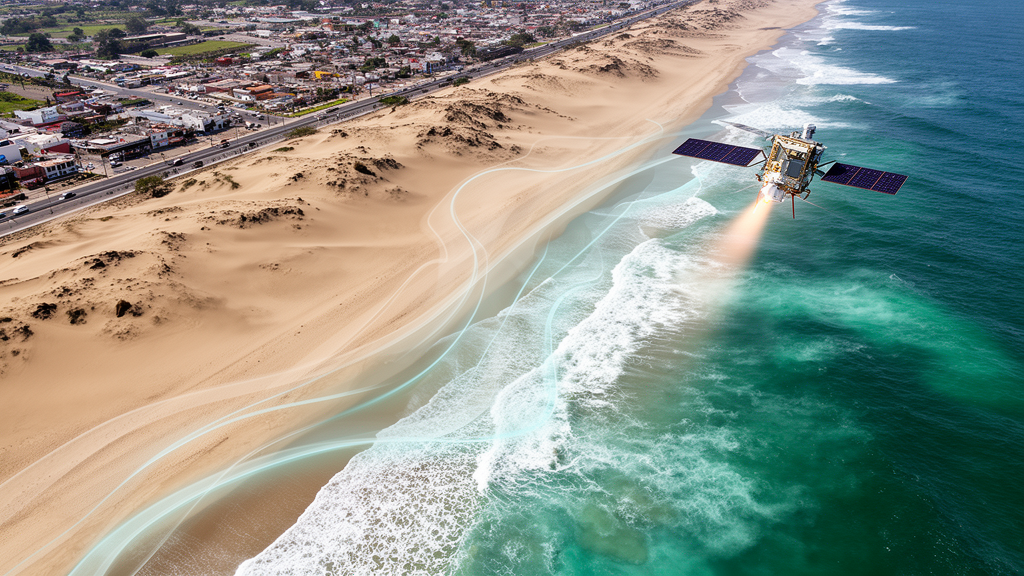
A multidecadal satellite study of Mexico’s Oaxaca coast found that Hurricane Erick in June 2025 coincided with marked shoreline displacement: erosion hotspots retreated by as much as 289 metres, while some sheltered or sediment-rich areas advanced by as much as 825 metres. The research also projected further erosion in historically unstable coastal segments for 2035 and 2045, and identified some stable areas that may face high erosion risk. Its scope was the coastal region of Oaxaca State rather than the hurricane alone.

Researchers used multi-temporal satellite imagery from 1995, 2005, 2015 and 2025 to examine long-term shoreline movement in Oaxaca. They combined remote sensing, geographic information systems and machine learning with three established shoreline-change techniques: end point rate, linear regression rate and net shoreline movement. In the pre- and post-hurricane analysis, net shoreline movement captured the maximum observed changes. River mouths and exposed sections of beach were common erosion hotspots, whereas accretion occurred in some areas described as sheltered or rich in sediment.

The findings show that the coastline did not respond uniformly to Erick. The before-and-after comparison detected both erosional and depositional trends associated with the event, including shoreline displacement of up to minus 289 metres in some hotspots and as much as 825 metres in accretion zones. The spatial pattern was consistent with a complex interplay among natural forcing mechanisms, sediment transport and anthropogenic influences such as coastal infrastructure development. However, the reported results do not assign a measured share of the changes to any one of these factors or provide a controlled estimate of the counterfactual shoreline without the hurricane.

Machine-learning projections based on the historical shoreline record indicate that the area’s historically unstable segments will continue to erode through 2035 and 2045. The models further suggest that some currently stable segments may move into a high-erosion-risk category. Gains in accretionary areas are also forecast to vary, with natural conditions and possible coastal-protection interventions identified as influences on those outcomes. These are model-based projections rather than observed changes, and the available study summary does not provide a separate quantitative assessment of forecast uncertainty.

The study demonstrates the value of examining event-scale shoreline disturbance together with multidecadal movement. Hurricanes can produce abrupt local changes along coastlines already shaped by long-term processes, while erosion and accretion remain unevenly distributed among river mouths, exposed beaches, sheltered locations and sediment-rich zones. The authors advocate incorporating hurricane-related variability into erosion-hazard mapping and policy planning, with the aim of supporting adaptive, data-driven management of at-risk communities, infrastructure and coastal ecosystems. The specific forecasts remain tied to the Oaxaca study area and should not be treated as direct measurements of future shoreline positions.

Subject of Research: Multidecadal shoreline change and Hurricane Erick impacts along Oaxaca’s coast

Article Title: Assessment of Multidecadal Shoreline Dynamics and Short-Term Impact of Hurricane Erick (2025)

Article References: Obayya, M., Alshammeri, M., Althobaiti, T., Britto, A. S. F., Kavitha, M., Begum, A. S., Sivakumar, V., & Jayasankar, T. (2026). Assessment of Multidecadal Shoreline Dynamics and Short-Term Impact of Hurricane Erick (2025). Earth Science Informatics, 19(12), Article 222. https://doi.org/10.1007/s12145-026-02272-x

Image Credits: AI Generated

DOI: 10.1007/s12145-026-02272-x

Keywords: Hurricane Erick, Oaxaca coast, shoreline erosion, coastal accretion, satellite imagery, remote sensing, machine learning, shoreline projection, coastal hazards, Mexico, Assessment, Multidecadal

Cite Scienmag News

Violet Maxwell. (October 21, 2026). Satellite study maps Hurricane Erick impacts and projects Oaxaca shoreline change through 2045. Scienmag. https://scienmag.com/satellite-study-maps-hurricane-erick-impacts-and-projects-oaxaca-shoreline-change-through-2045/


Violet Maxwell. "Satellite study maps Hurricane Erick impacts and projects Oaxaca shoreline change through 2045." Scienmag, 21 October 2026, https://scienmag.com/satellite-study-maps-hurricane-erick-impacts-and-projects-oaxaca-shoreline-change-through-2045/. Accessed 21 October 2026.

Violet Maxwell. "Satellite study maps Hurricane Erick impacts and projects Oaxaca shoreline change through 2045." Scienmag. October 21, 2026. https://scienmag.com/satellite-study-maps-hurricane-erick-impacts-and-projects-oaxaca-shoreline-change-through-2045/

Tags: assessmentclimate change effects on Mexican coastcoastal accretioncoastal erosion hotspots and sediment depositioncoastal hazardsGIS and machine learning in shoreline studiesHurricane ErickHurricane Erick shoreline erosion Oaxaca coasthurricane impact on sediment-rich beacheshurricane-induced shoreline retreat and advancelong-term shoreline displacement projection Oaxaca 2045Machine learningMexicoMultidecadalmultidecadal satellite imagery coastal monitoringOaxaca coastremote sensingremote sensing for coastal erosion predictionsatellite imagerysatellite-based coastal change analysis Mexicoshoreline change techniques and methodsshoreline erosionshoreline projectionshoreline stability assessment Oaxaca
Share26Tweet16
Previous Post

Elite badminton players show altered lower-limb coordination during backhand footwork

Next Post

Elite Kendo athletes differ in movement sharpness and premature reactions, study finds

Related Posts

Lab fracture model reproduces limestone dissolution under variable flow
Earth Science

Lab fracture model reproduces limestone dissolution under variable flow

October 21, 2026
Cross-domain risk governance of transboundary marine policies for blue carbon ecosystem protection: a fuzzy AHP evaluation framework applied to the nuclear wastewater discharge case
Earth Science

Cross-domain risk governance of transboundary marine policies for blue carbon ecosystem protection: a fuzzy AHP evaluation framework applied to the nuclear wastewater discharge case

October 21, 2026
One Weather Pattern Linked to Higher Wildfire Danger in Western Macedonia
Earth Science

One Weather Pattern Linked to Higher Wildfire Danger in Western Macedonia

October 21, 2026
Chengdu and Chongqing emissions shaped by growth, energy use and efficiency
Earth Science

Chengdu and Chongqing emissions shaped by growth, energy use and efficiency

October 21, 2026
Green Hydrogen Deployment Depends on More Than Electrolyzer Efficiency
Earth Science

Green Hydrogen Deployment Depends on More Than Electrolyzer Efficiency

October 21, 2026
Compostable plastic residues preserve compost quality and support lettuce growth
Earth Science

Compostable plastic residues preserve compost quality and support lettuce growth

October 21, 2026
Next Post
Elite Kendo athletes differ in movement sharpness and premature reactions, study finds

Elite Kendo athletes differ in movement sharpness and premature reactions, study finds

  • Mothers who receive childcare support from maternal grandparents show more optimized

    Mothers who receive childcare support from maternal grandparents show more parental warmth, finds NTU Singapore study

    27656 shares
    Share 11059 Tweet 6912
  • University of Seville Breaks 120-Year-Old Mystery, Revises a Key Einstein Concept

    1061 shares
    Share 424 Tweet 265
  • Bee body mass, pathogens and local climate influence heat tolerance

    682 shares
    Share 273 Tweet 171
  • Researchers record first-ever images and data of a shark experiencing a boat strike

    546 shares
    Share 218 Tweet 137
  • Groundbreaking Clinical Trial Reveals Lubiprostone Enhances Kidney Function

    531 shares
    Share 212 Tweet 133
Science

Embark on a thrilling journey of discovery with Scienmag.com—your ultimate source for cutting-edge breakthroughs. Immerse yourself in a world where curiosity knows no limits and tomorrow’s possibilities become today’s reality!

RECENT NEWS

  • Elite Kendo athletes differ in movement sharpness and premature reactions, study finds
  • Satellite study maps Hurricane Erick impacts and projects Oaxaca shoreline change through 2045
  • Elite badminton players show altered lower-limb coordination during backhand footwork
  • Lab fracture model reproduces limestone dissolution under variable flow

Categories

  • Agriculture
  • Anthropology
  • Archaeology
  • Athmospheric
  • Biology
  • Biotechnology
  • Blog
  • Bussines
  • Cancer
  • Chemistry
  • Climate
  • Earth Science
  • Editorial Policy
  • Marine
  • Mathematics
  • Medicine
  • Pediatry
  • Policy
  • Psychology & Psychiatry
  • Science Education
  • Science News
  • Social Science
  • Space
  • Technology and Engineering

Subscribe to Blog via Email

Enter your email address to subscribe to this blog and receive notifications of new posts by email.

Join 5,150 other subscribers

© 2025 Scienmag - Science Magazine

Welcome Back!

Login to your account below

Forgotten Password?

Retrieve your password

Please enter your username or email address to reset your password.

Log In
No Result
View All Result
  • HOME
  • SCIENCE NEWS
  • CONTACT US

© 2025 Scienmag - Science Magazine

Discover more from Science

Subscribe now to keep reading and get access to the full archive.

Continue reading