

Wednesday, October 21, 2026
Science
No Result
View All Result
  • Login
  • HOME
  • SCIENCE NEWS
  • CONTACT US
  • HOME
  • SCIENCE NEWS
  • CONTACT US
No Result
View All Result
Scienmag
No Result
View All Result
Home Science News Earth Science

One Weather Pattern Linked to Higher Wildfire Danger in Western Macedonia

October 21, 2026
in Earth Science
Violet Maxwell
By Violet Maxwell Scienmag Editorial Profile - Natural Hazards
Reading Time: 3 mins read
0
One Weather Pattern Linked to Higher Wildfire Danger in Western Macedonia

One Weather Pattern Linked to Higher Wildfire Danger in Western Macedonia

65
SHARES
587
VIEWS
Share on FacebookShare on Twitter
ADVERTISEMENT

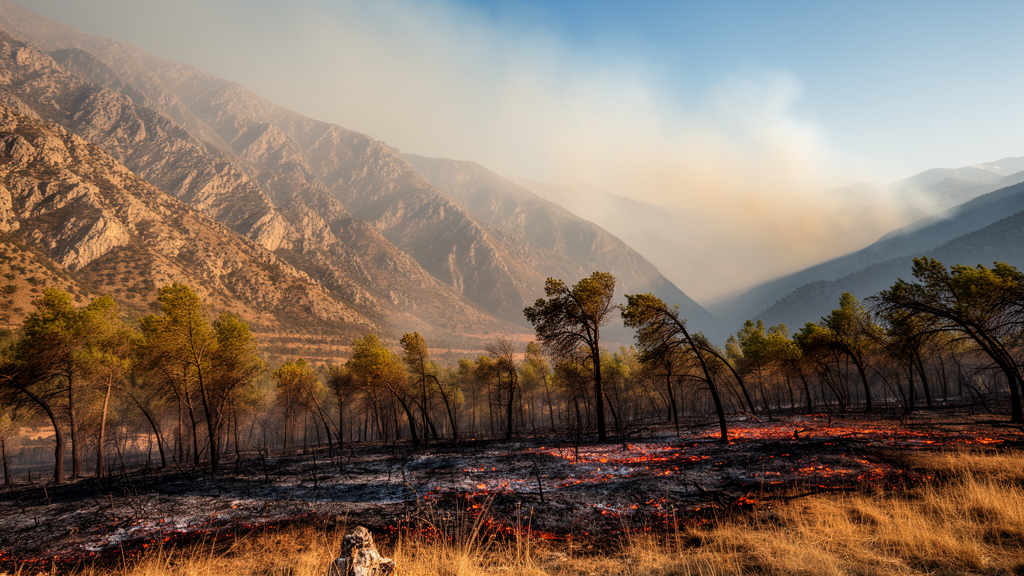
Wildfires recorded in the cross-border region of Western Macedonia in Greece and North Macedonia were associated with hot, dry conditions, and every analyzed fire event occurred under High, Very High or Extreme Fire Weather Index classifications, according to a statistical study covering May through October from 2008 to 2021. The analysis also identified a weather pattern that became more frequent during the study period and was linked to the highest wildfire danger among the patterns examined. Researchers working within the Cross Border Complex Floods and Forest Fires Prevention and Management, known as the SOLVE project, combined historical fire records with hourly meteorological observations.

The weather variables included air temperature, relative humidity, wind speed, atmospheric boundary-layer height, total cloud cover, precipitation and pressure. Fire and weather information was retrieved from the European Forest Fire Information System and the ERA5 Copernicus database. This observational study assessed the meteorological conditions associated with recorded fires in the two-country region rather than experimentally testing whether any single weather variable caused them.

The initial statistical analysis focused on daily noon observations on fire-event days. Across the analyzed events, mean air temperature was 29.2 °C and mean relative humidity was 25.4%. Precipitation averaged 0.06 mm per day, while winds were predominantly northerly or westerly and had an average speed of 2.3 m/s.

The reported averages do not quantify the difference between fire days and days without recorded fires, so they should not be interpreted as evidence that the conditions were unusual relative to the entire study period. The researchers next applied a weather-clustering method to the complete dataset to identify dominant weather patterns. They interpreted those patterns with the daily Fire Weather Index developed by the Canadian Forest Service.

One cluster, designated Cluster 4, showed the strongest association with fire danger: its average Fire Weather Index was 32, and Extreme conditions predominated within it. The number of occurrences of this pattern increased over the study period. That result describes the observed frequency of the weather pattern; it is not a projection of future fires and does not by itself demonstrate an increase in total burned area or in the number of fire events.

All analyzed fire events fell within the High, Very High or Extreme Fire Weather Index categories, while Cluster 4 combined the highest average index value with a predominance of Extreme classifications. The findings can support the development of coordinated wildfire-prevention and operational strategies by civil-protection agencies in both countries, which is an aim of the SOLVE project. The evidence is specific to the regional fire-event dataset and its dominant weather patterns.

It does not directly measure the effectiveness of any prevention measure or establish how emergency responses were coordinated across the border.

Subject of Research: Meteorological conditions associated with wildfires in Western Macedonia and North Macedonia

Article Title: Statistical analysis of weather factors influencing wildfire behaviour in the cross-border area of Western-Macedonia, Greece and North Macedonia. The SOLVE-Project

Article References: Sakellaris, I., Bartzis, J., Sfetsos, A., Maggos, T., Siarga, M., & Bakouros, I. (2026). Statistical analysis of weather factors influencing wildfire behaviour in the cross-border area of Western-Macedonia, Greece and North Macedonia. The SOLVE-Project. Theoretical and Applied Climatology, 157(11), Article 732. https://doi.org/10.1007/s00704-026-06664-3

Image Credits: AI Generated

DOI: 10.1007/s00704-026-06664-3

Keywords: wildfire weather, Western Macedonia, North Macedonia, Greece, Fire Weather Index, weather clustering, cross-border fires, SOLVE project, Statistical, analysis, weather, factors

Cite Scienmag News

Violet Maxwell. (October 21, 2026). One Weather Pattern Linked to Higher Wildfire Danger in Western Macedonia. Scienmag. https://scienmag.com/one-weather-pattern-linked-to-higher-wildfire-danger-in-western-macedonia/

Violet Maxwell. "One Weather Pattern Linked to Higher Wildfire Danger in Western Macedonia." Scienmag, 21 October 2026, https://scienmag.com/one-weather-pattern-linked-to-higher-wildfire-danger-in-western-macedonia/. Accessed 21 October 2026.

Violet Maxwell. "One Weather Pattern Linked to Higher Wildfire Danger in Western Macedonia." Scienmag. October 21, 2026. https://scienmag.com/one-weather-pattern-linked-to-higher-wildfire-danger-in-western-macedonia/


Tags: analysisclimate variability and wildfire frequencycross-border firescross-border wildfire analysis Greece North MacedoniaERA5 Copernicus meteorological observationsEuropean Forest Fire Information System datafactorsFire Weather IndexGreecehigh fire weather index classificationimpact of hot and dry conditions on wildfiresinfluence of temperature and humidity on wildfire riskmeteorological factors and wildfire occurrenceNorth MacedoniaSOLVE projectstatisticalstatistical study of fire weather patternsweatherweather clusteringweather pattern and wildfire dangerWestern Macedoniawildfire prevention and management in Western Macedoniawildfire risk in Western Macedoniawildfire weather
Share26Tweet16
Previous Post

Ferrocene-Derived Carbon Nanotubes Inhibit E. coli in Laboratory Assays

Next Post

Retrospective study links infections and outcome risks in Good syndrome

Related Posts

Cross-domain risk governance of transboundary marine policies for blue carbon ecosystem protection: a fuzzy AHP evaluation framework applied to the nuclear wastewater discharge case
Earth Science

Cross-domain risk governance of transboundary marine policies for blue carbon ecosystem protection: a fuzzy AHP evaluation framework applied to the nuclear wastewater discharge case

October 21, 2026
Chengdu and Chongqing emissions shaped by growth, energy use and efficiency
Earth Science

Chengdu and Chongqing emissions shaped by growth, energy use and efficiency

October 21, 2026
Green Hydrogen Deployment Depends on More Than Electrolyzer Efficiency
Earth Science

Green Hydrogen Deployment Depends on More Than Electrolyzer Efficiency

October 21, 2026
Compostable plastic residues preserve compost quality and support lettuce growth
Earth Science

Compostable plastic residues preserve compost quality and support lettuce growth

October 21, 2026
Mangrove crabs reveal trace element pollution in Amazonian estuaries
Earth Science

Mangrove crabs reveal trace element pollution in Amazonian estuaries

October 21, 2026
Experimental study finds highest hydrogen yield at D2 and pH 8
Earth Science

Experimental study finds highest hydrogen yield at D2 and pH 8

October 21, 2026
Next Post
Retrospective study links infections and outcome risks in Good syndrome

Retrospective study links infections and outcome risks in Good syndrome

  • Mothers who receive childcare support from maternal grandparents show more optimized

    Mothers who receive childcare support from maternal grandparents show more parental warmth, finds NTU Singapore study

    27656 shares
    Share 11059 Tweet 6912
  • University of Seville Breaks 120-Year-Old Mystery, Revises a Key Einstein Concept

    1061 shares
    Share 424 Tweet 265
  • Bee body mass, pathogens and local climate influence heat tolerance

    682 shares
    Share 273 Tweet 171
  • Researchers record first-ever images and data of a shark experiencing a boat strike

    546 shares
    Share 218 Tweet 137
  • Groundbreaking Clinical Trial Reveals Lubiprostone Enhances Kidney Function

    531 shares
    Share 212 Tweet 133
Science

Embark on a thrilling journey of discovery with Scienmag.com—your ultimate source for cutting-edge breakthroughs. Immerse yourself in a world where curiosity knows no limits and tomorrow’s possibilities become today’s reality!

RECENT NEWS

  • LLMs underperform specialized platform in 475-variant clinical classification
  • Plasma metabolite shows similar performance to CA19-9 in 60-person pancreatic cancer study
  • Cross-domain risk governance of transboundary marine policies for blue carbon ecosystem protection: a fuzzy AHP evaluation framework applied to the nuclear wastewater discharge case
  • Research report: The new constructionism. Papert after Peirce: indexicality, navigational thinking, and learning in the age of generative AI

Categories

  • Agriculture
  • Anthropology
  • Archaeology
  • Athmospheric
  • Biology
  • Biotechnology
  • Blog
  • Bussines
  • Cancer
  • Chemistry
  • Climate
  • Earth Science
  • Editorial Policy
  • Marine
  • Mathematics
  • Medicine
  • Pediatry
  • Policy
  • Psychology & Psychiatry
  • Science Education
  • Science News
  • Social Science
  • Space
  • Technology and Engineering

Subscribe to Blog via Email

Enter your email address to subscribe to this blog and receive notifications of new posts by email.

Join 5,150 other subscribers

© 2025 Scienmag - Science Magazine

Welcome Back!

Login to your account below

Forgotten Password?

Retrieve your password

Please enter your username or email address to reset your password.

Log In
No Result
View All Result
  • HOME
  • SCIENCE NEWS
  • CONTACT US

© 2025 Scienmag - Science Magazine

Discover more from Science

Subscribe now to keep reading and get access to the full archive.

Continue reading