


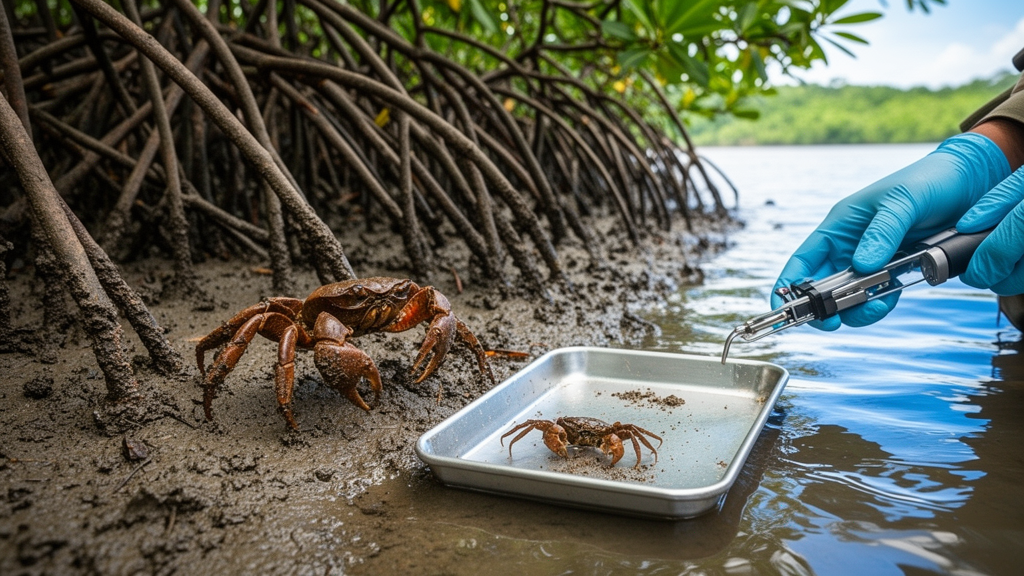
Crabs collected near a busy port on Brazil’s Amazon coast were smaller, lighter and more damaged at the cellular and genetic levels than crabs from a comparatively minimally affected mangrove, according to a field study that combined chemical measurements with biological markers. The study focused on the mangrove crab Ucides cordatus in São José Bay, designated a low-impact site, and São Marcos Bay, where the sampling area is influenced by residential, industrial and port activities. Water at the port-influenced site contained higher concentrations of zinc, iron, aluminum and manganese, while sediment concentrations of several metals were elevated there even though all measured sediment values remained within Brazilian regulatory limits. The crabs collected from that area were significantly smaller and lighter and showed more severe gill injury, hepatopancreatic lesions and nuclear abnormalities, providing a convergent biological signal of environmental stress.
The researchers sampled two locations in the state of Maranhão during 2021: Facão Island in São José Bay, near Raposa, and the Coqueiro Community in São Marcos Bay, near São Luís. The latter lies close to the Ponta da Madeira Port Complex, the Port of Itaqui and the Alumar/ALCOA port, where domestic and international cargo traffic operates continuously. Physicochemical conditions were measured twice in the rainy season and twice in the dry season, including pH, temperature, salinity and dissolved oxygen. Water and sediment were also sampled for trace elements, while 40 crabs underwent biometric examination, tissue histology and hemolymph analysis. This design allowed the investigators to ask whether chemical conditions around the crabs corresponded with differences in their growth, tissue architecture and nuclear integrity.
Most of the measured water-quality conditions were broadly comparable between the bays, although dissolved oxygen was significantly lower in the port-influenced area during the rainy season and failed to meet the Brazilian regulatory criterion for Class III brackish water. Temperature, pH and salinity were otherwise similar, with salinity consistently higher at the low-impact site. Chemical analysis detected the clearest site difference in the water: zinc, iron, aluminum and manganese concentrations were higher at São Marcos Bay, in some cases exceeding the limits established under Brazil’s CONAMA Resolution No. 357/2005. The authors noted that several of these elements are biologically essential at ordinary levels but can become toxic when concentrations rise, potentially increasing an organism’s susceptibility to disease and producing molecular, cellular and physiological changes.
Sediment results added a more nuanced picture. Copper, chromium and zinc concentrations were elevated at the port-affected site, a pattern consistent with previous surveys of the region, but every element measured in sediments from both locations remained within the limits set by CONAMA Resolution No. 454/2012. Fine silts and clays can retain metals in sediment, where their persistence and bioavailability may create continuing exposure routes for bottom-dwelling animals. Unlike the water measurements, however, the sediment findings did not show regulatory exceedances in the samples collected. The contrast demonstrates why a chemical assessment based on only one environmental compartment can provide an incomplete picture of contamination in a dynamic mangrove estuary.
Biometric analysis produced one of the clearest differences between the crab populations. Researchers measured carapace length and width, cheliped propodus length and width, movable-finger length and width, and total body weight. Every morphometric value was lower in U. cordatus from São Marcos Bay, and crabs from that area were significantly smaller and lighter than those from São José Bay at a threshold of p less than 0.05. The pattern was observed in both rainy- and dry-season samples. The study authors said the difference was consistent with earlier findings in areas affected by residential and port activity and suggested that crabs may divert energy from growth toward physiological processes associated with contaminant exposure, although the field comparison cannot establish that mechanism directly.
Microscopic examination of the gills showed injury at both sites but a greater prevalence and more destructive forms of damage in crabs from the port region. Animals from São José Bay more often displayed cuticle detachment and hemocytic nodules associated with parasitic infection. In São Marcos Bay, the gills showed marginal canal deformation, lamellar collapse, pillar-cell rupture and necrosis, indicating loss of normal tissue architecture. Gills are especially important to crustaceans because they participate in osmoregulation, ion balance, excretion and the filtering of xenobiotics from water. As a result, gill lesions can serve as indicators of both direct environmental exposure and disruption of normal physiological function. Their presence at both locations means the crabs were not entirely free from stress, but the more extensive structural injury in the port-influenced population distinguished the two sites.
The hepatopancreas, the principal organ involved in detoxifying and processing contaminants in crustaceans, also displayed more severe abnormalities in São Marcos Bay crabs. At the low-impact site, common findings included vacuolated B cells, pyknotic nuclei and abnormalities within the organ’s lumens. Port-region crabs showed epithelial delamination and necrosis during the rainy season, followed by distorted lumens, pyknotic nuclei and damage to the myoepithelial layer in the dry season. The hepatopancreas contains several cell types, including absorptive R cells, digestive-enzyme-secreting F cells and B cells involved in intracellular digestion and excretion. Abnormal lumens and vacuolated B cells can reflect physiological stress in these pathways, while necrosis and delamination indicate more serious tissue degeneration. The authors therefore treated the hepatopancreas as a marker of chronic contamination, in contrast to the gills, where they considered lesions more closely associated with acute exposure.
Hemolymph testing supplied a genotoxic dimension to the comparison. The investigators prepared two blood smears from each crab, stained them with Giemsa and examined 1,000 cells per slide for micronuclei and other nuclear abnormalities. Mean micronucleus frequency and nuclear alterations, especially pyknotic cells, were greatest in crabs from São Marcos Bay. Micronuclei are small nuclear structures that can form when whole chromosomes or chromosome fragments fail to move normally during cell division, providing a measure of chromosomal damage that may be associated with exposure to xenobiotic compounds. Pyknotic cells showed condensed nuclei and chromatin, changes that can precede fragmentation and non-programmed cell death. These cellular responses complement the tissue lesions by showing that the port-region crabs experienced damage below the level visible in gill and hepatopancreas architecture.
Taken together, the results support U. cordatus as a potential sentinel for estuarine contamination, but they do not prove that trace elements alone caused every observed effect. The investigation was a two-site comparison based on one water sample and one sediment sample from each location, together with 40 crabs, so its chemical dataset was limited and cannot fully represent seasonal or spatial variation. The two bays also differ in their surrounding human activities and environmental histories, meaning salinity patterns, dissolved oxygen, port traffic, residential pressures and other stressors could have influenced crab condition. The higher sediment values in São Marcos Bay remained within regulatory limits, and the study did not directly measure contaminant accumulation in the crabs. Nevertheless, the convergence of chemical concentrations, smaller body size, more severe tissue injury and more frequent nuclear abnormalities provides stronger evidence than any single measurement alone. The authors propose broader monitoring programs that pair systematic chemical analysis with multiple biological markers, comparisons among sentinel species and longer-term sampling capable of resolving how contamination and biological responses vary through time.
Subject of Research: Trace element contamination and biological effects in Amazonian estuaries assessed using mangrove crabs
Article Title: An integrated chemical and biomarker approach using Ucides cordatus (Crustacea; Decapoda) to assess trace element contamination and its biological impacts across two Amazonian estuaries
Article References: Oliveira, L. B., Gayoso e Almendra Ibiapina Moreno, L. C., de Oliveira, S. R. S., dos Anjos Benjamin, L., Pinheiro-Sousa, D. B., dos Santos Protázio, G., de Sousa, A. L., Andrade, T. P., Ribeiro, E. B., da Silva Castro, J., Rodrigues Vale de Macedo, G. H., da Silva Ferreira, L. J., Oliveira, V. M., Martins Silva Santos, D., Loureiro de Castro Nunes, S. F., & Fortes Carvalho Neta, R. N. (2026). An integrated chemical and biomarker approach using Ucides cordatus (Crustacea; Decapoda) to assess trace element contamination and its biological impacts across two Amazonian estuaries. Environmental Monitoring and Assessment, 198(11), Article 1237. https://doi.org/10.1007/s10661-026-16077-4
Image Credits: AI Generated
DOI: 10.1007/s10661-026-16077-4
Keywords: trace element pollution, mangrove crab, Amazon estuary, genotoxicity, histopathology, environmental biomonitoring, micronucleus test, port pollution, integrated, chemical, biomarker, approach
Cite Scienmag News
Violet Maxwell. (October 21, 2026). Mangrove crabs reveal trace element pollution in Amazonian estuaries. Scienmag. https://scienmag.com/mangrove-crabs-reveal-trace-element-pollution-in-amazonian-estuaries/
Violet Maxwell. "Mangrove crabs reveal trace element pollution in Amazonian estuaries." Scienmag, 21 October 2026, https://scienmag.com/mangrove-crabs-reveal-trace-element-pollution-in-amazonian-estuaries/. Accessed 21 October 2026.
Violet Maxwell. "Mangrove crabs reveal trace element pollution in Amazonian estuaries." Scienmag. October 21, 2026. https://scienmag.com/mangrove-crabs-reveal-trace-element-pollution-in-amazonian-estuaries/


