


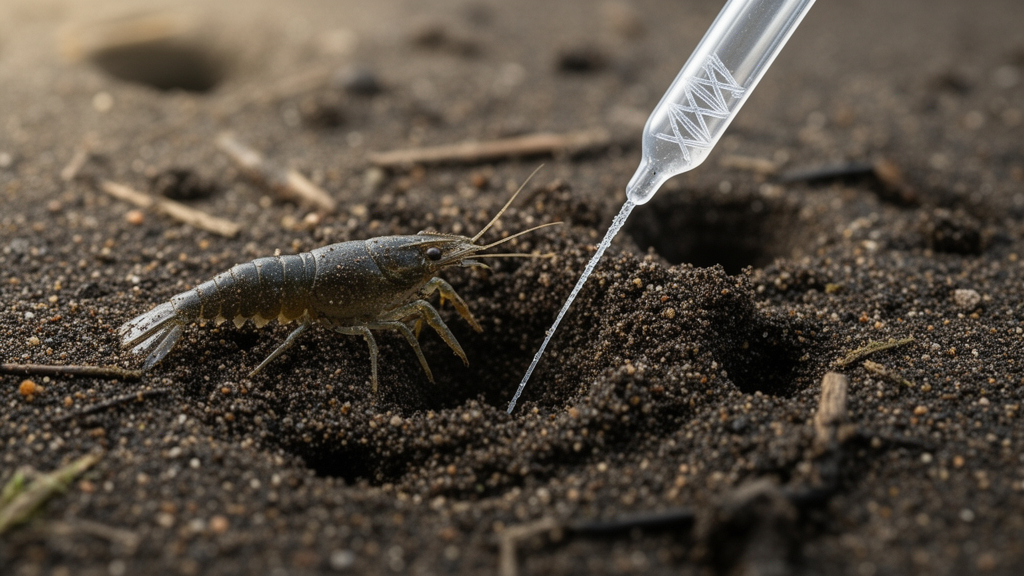
A tank experiment found that DNA from the mud shrimp Upogebia major could remain detectable in marine sediment for at least 30 days and for as long as 50 days after the animals were removed, without a significant decline in concentration. The result suggests that sedimentary DNA, or sedDNA, can outlive the organism that produced it and must be considered carefully when scientists use genetic traces to map the presence of burrowing coastal animals.
Researchers reared three adult mud shrimps individually in sediment-filled aquaria for 30 days, removed the animals and then measured shrimp-specific DNA in surface sediment over the following 50 days. The work used a species-specific droplet digital PCR assay to detect and quantify the DNA. Negative-control tanks contained sediment and artificial seawater but no shrimp, and no target DNA was detected in those controls. The findings indicate a persistence window that could complicate inference from a single sediment sample, particularly when a positive result is interpreted as evidence that an animal is currently present.
Upogebia major is a decapod crustacean that inhabits tidal flats around the East Asian coast, the Russian shore of the Sea of Japan and parts of the western coast of North America. It constructs deep, Y-shaped burrows that can extend more than 2 metres below the sediment surface. Those burrows make the species difficult to observe and collect directly, while burrow openings can be buried or change shape seasonally. Sediment DNA therefore offers an alternative way to detect the shrimp, but the study shows that a genetic signal may reflect a much longer history of the animal’s presence than a survey of living individuals would suggest.
Each experimental aquarium held about 115 centimetres of natural tidal-flat sediment collected from the Shiizu River estuary in Chiba Prefecture, where U. major does not occur. Approximately 10 centimetres of artificial seawater was added above the sediment, and the water was replaced daily to imitate low tide. The temperature was maintained near 20 degrees Celsius, within the 16–22 degree range recorded at the collection site, while blackout curtains prevented direct sunlight from reaching the tanks. Sediment was sampled from six locations at 10-centimetre intervals around two burrow openings on days 0, 7, 10, 15, 20, 25, 30 and 50 after removal. Tank A was sampled on day 5 rather than day 7.
All three shrimp began burrowing immediately. They reinforced the burrow walls with sediment and mucus, formed two openings within three days and produced frequent sand-volcano events during the first 10 days, apparently completing the most demanding phase of excavation. From day 10 onward, seawater spouting through the openings coincided with feeding activity, and fragments of shrimp setae were observed in the expelled water. These processes could transport DNA-bearing mucus, tissue and other biological material from inside the burrows onto the sediment surface. The animal in Tank A molted on day 17, leaving its cast skin near a burrow opening; another individual died in Tank C and decomposed inside the burrow, where the surrounding sediment blackened under reducing conditions.
The DNA detection patterns differed markedly among the three aquariums. Tank A produced the strongest signal: all six samples collected on day 50 contained shrimp DNA, and the overall detection frequency was 71.4 per cent at one sampling location, 85.7 per cent at another and 42.9 per cent at the remaining four. Concentrations generally ranged from about 100 to 1,000 copies per gram of sediment, and statistical tests found no significant differences among sampling days. In Tanks B and C, detections were less frequent and concentrations showed no significant time trend. DNA was detected through day 30 in Tank B and through day 50 in Tank C, but only seven and six samples, respectively, were positive.
The researchers proposed three possible explanations for the unexpectedly stable concentrations, while emphasizing that the experiment could not determine which mechanism was most important. First, the shrimp may have produced more DNA than was degraded during the observation period. Molting, mucus secretion, feeding, burrow construction and sand volcanoes could all have supplied new genetic material. The molting event in Tank A was especially notable because discarded exoskeletons can release epidermal cells, tissue fragments, mucus and other biological materials into the environment. Mucus used to line the burrows could also have reached the sediment surface during sand-volcano events, while material associated with feeding may have been expelled through the burrow openings.
Second, degradation may have proceeded slowly in the tanks. Direct ultraviolet exposure was limited, waves and tidal disturbances were absent, and the low level of bioturbation probably reduced oxygen movement into the sediment. This may have suppressed bacterial activity, one of the main drivers of DNA breakdown. The source article also notes that sediment-bound DNA can be less susceptible to bacterial degradation after adsorption onto clay minerals, which are abundant in muddy sediments. Differences in mud content may therefore affect degradation rates and persistence, although the study did not directly test the relative contribution of sediment composition.
A third possibility is that the empty burrows continued to act as reservoirs. Remnants of feces, mucus and other material could have remained in mucus-lined burrow walls and been intermittently moved onto the surface by the weak currents generated during water replacement. This possibility is especially relevant for burrowing animals because it differs from most previous environmental DNA experiments involving free-living organisms, for which concentrations generally declined after the animals were removed. The persistent signal in Tank C may have had a different origin: the carcass left behind by the shrimp that died there. However, rapid anaerobic decomposition may also have destroyed that remains quickly, and the consistently low detection frequency suggests that the carcass was not a major source of long-term DNA.
Spatial and temporal variability showed that persistence did not mean uniform distribution. In Tank A, DNA detection at one location alternated between positive and negative samples, and only two to four of the six samples were positive on days 0–30, compared with all six on day 50. Some points roughly 10–20 centimetres from burrow openings had higher detection frequencies than points immediately adjacent to them, although the small number of positive samples in the other tanks limited interpretation. Expelled sediment often settled locally rather than spreading uniformly, and differences among mucus, feces and tissue fragments could also have altered the amount of DNA entering each patch. Limited sediment mixing was probably important: unlike DNA in the water column, DNA bound to sediment particles was not readily redistributed under the gentle tank conditions.
The experiment used three adult shrimps, each in a separate aquarium, and observed a maximum of 50 days after removal. The animals were collected during their growth period in spring tides in May, June and October, so persistence could differ among juveniles, spawning periods or dormant seasonal stages. The tanks also lacked waves, strong tidal currents, natural bioturbation and other disturbances that could change sediment mixing in the field. The results therefore do not establish a universal half-life or a standard detection window for mud shrimp DNA. Instead, they show that, under the tested conditions, a positive sedDNA signal may persist for weeks and that concentration data alone cannot readily distinguish current occurrence from older traces left in sediment or released from burrows.
Subject of Research: Persistence and spatial variability of adult mud shrimp sedimentary DNA in a tank experiment
Article Title: Persistence of sedimentary DNA in burrowing marine benthos: evidence from the decapod Upogebia major
Article References: Kitabatake, K., Kitajima, H., Izumi, K., & Okoshi, K. (2026). Persistence of sedimentary DNA in burrowing marine benthos: evidence from the decapod Upogebia major. Frontiers in Marine Science, 13, 1964335. https://doi.org/10.3389/fmars.2026.1964335
Image Credits: AI Generated
DOI: 10.3389/fmars.2026.1964335
Keywords: sedimentary DNA, environmental DNA, mud shrimp, Upogebia major, marine benthos, tank experiment, DNA persistence, tidal flats, digital PCR, burrow ecology, Persistence, sedimentary
Cite Scienmag News
Violet Maxwell. (October 21, 2026). Mud shrimp DNA persists for weeks in sediment. Scienmag. https://scienmag.com/mud-shrimp-dna-persists-for-weeks-in-sediment/
Violet Maxwell. "Mud shrimp DNA persists for weeks in sediment." Scienmag, 21 October 2026, https://scienmag.com/mud-shrimp-dna-persists-for-weeks-in-sediment/. Accessed 21 October 2026.
Violet Maxwell. "Mud shrimp DNA persists for weeks in sediment." Scienmag. October 21, 2026. https://scienmag.com/mud-shrimp-dna-persists-for-weeks-in-sediment/


