


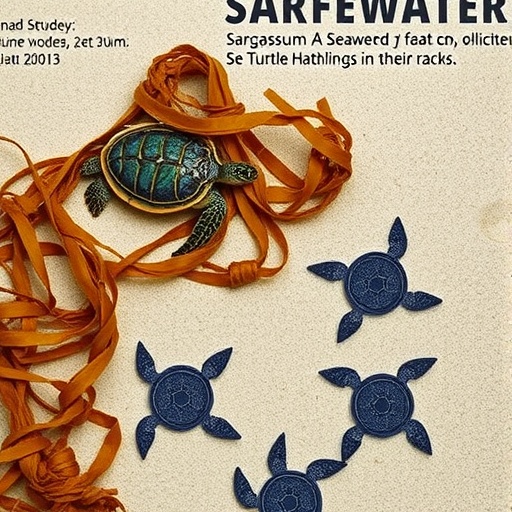
As the sun rises over Florida’s coastline, an ancient and perilous journey unfolds on its sandy beaches. Every year, thousands of sea turtle hatchlings emerge from their nests and scramble toward the ocean, their survival hinging on successfully navigating a gauntlet of natural and human-made obstacles. While threats like bright artificial lights, beach litter, and ravenous predators have long been recognized, a new and insidious hazard has recently surfaced: burgeoning mats of sargassum seaweed that carpet the shorelines in unprecedented volumes. Recent research spearheaded by Florida Atlantic University (FAU) shines a critical light on how this marine algae accumulation poses a growing physical and ecological challenge to vulnerable sea turtle hatchlings during this vital first crawl to the sea.
The researchers, based in FAU’s Charles E. Schmidt College of Science, undertook a rigorous experimental study probing the biomechanical and physiological impact of sargassum coverage on three prominent sea turtle species native to Florida: leatherbacks (Dermochelys coriacea), loggerheads (Caretta caretta), and green turtles (Chelonia mydas). Conducted on beaches including Juno Beach, Jupiter, and Boca Raton, the study employed controlled crawlways mimicking natural hatchling pathways intermixed with prostrate mats of sargassum seaweed, reaching heights of up to 19 centimeters. This height scale represents realistic but challenging conditions akin to what hatchlings face on sargassum-laden shores during seasonal blooms. A subtle, dim light placed seaward simulated the nocturnal bioluminescent cues that guide the hatchlings to the open water.
By quantitatively measuring crawl speeds and behaviors across these engineered habitats, the study revealed striking delays when hatchlings encountered the tangled seaweed. Across the board, individuals took significantly longer to traverse stretches of sargassum; the slowdowns were most acute during the physically demanding task of climbing over dense seaweed mounds. Surprisingly, even moderate patch heights between 7 and 9 centimeters resulted in some turtles failing to complete their traverses within the allotted observation window. Leatherbacks faced the most pronounced delays, crawling 54% slower through light sargassum and an alarming 158% slower through heavier mats. Loggerheads’ crawl times were hindered by 91% and 175% respectively, while green turtles showed increases of 75% and 159% in crawl duration.
This marked deceleration in transit time is not just a statistical curiosity but carries profound ecological consequences. Hatchlings’ prolonged presence on the beach dramatically elevates their vulnerability to a suite of predators, including crab species and avian hunters. Moreover, the thermal environment of the beach itself becomes increasingly hostile with dawn; hatchlings trapped in the entanglement face escalating risks of overheating and dehydration. The research team observed that the sargassum substrate often caused hatchlings to flip onto their backs — termed “inversions” — compounding their peril as recovery in this position drains precious time and energy. Remarkably, some individuals exhibited more than twenty inversions in a single trial, underscoring the physical challenge presented by these thick algae mats.
Beyond behavioral hindrance, the study probed the physiological impacts by assessing blood glucose concentrations post-crawl, a critical biomarker for energy expenditure. Contrary to expectations, there were no significant differences in glucose levels between hatchlings that endured sargassum obstacles and those traversing clear sand, across all species tested. Interestingly, hatchlings in a no-crawl control condition exhibited higher glucose concentrations, suggesting the physical act of crawling — irrespective of substrate complexity — exerts the primary metabolic demand. These findings imply that while sargassum dramatically slows hatchlings and increases lethal risks, it may not immediately deplete short-term energy reserves detectably.
Senior author Dr. Sarah Milton, a distinguished biological sciences professor at FAU, emphasizes the broader implications of these findings. “Our coastline is witnessing unprecedented sargassum blooms; some mats reach over a meter in height and extend across hundreds of meters of beach,” she notes. “For hatchlings already battling to survive, these seaweed accumulations present an increasingly formidable barrier. Each added obstacle intensifies their odds of succumbing to predation, thermal stress, or energy exhaustion.” Such pervasive sargassum coverage could even physically block hatchling access to the ocean in extreme cases, potentially undermining entire cohorts annually.
The ramifications of sargassum proliferation go beyond hatchling locomotion. Accumulated seaweed layers may also impinge upon nesting beaches by displacing suitable nesting sites and altering sand temperatures — critical variables influencing incubation success and hatchling sex ratios. These cascading effects underscore the urgent need for dynamic coastal management strategies that address this evolving threat without compromising the delicate beach ecosystems. Given the sea turtles’ critical role in marine biodiversity and their status as endangered species, safeguarding the success of hatchlings is paramount for long-term conservation.
This study’s methodology, blending meticulously controlled field experiments with physiological assays, provides a robust framework for future investigations into interaction effects between environmental stressors and wildlife. The integration of behavioral time metrics with biochemical indicators offers a nuanced perspective on how physical impediments translate into survival outcomes. Further research could elucidate longer-term energy dynamics and potential compensatory mechanisms hatchlings might employ when faced with successive sargassum barriers or under differing thermal conditions.
The work of Abbey M. Appelt, a sea turtle nesting specialist and FAU graduate, was instrumental in advancing this investigation. Supported by FAU’s commitment to impactful marine biology research, the project exemplifies the intersection of academia and conservation practice—leveraging empirical insights to shape informed policy and pragmatic interventions. As coastal ecosystems worldwide confront shifting oceanographic patterns promoting sargassum blooms, the lessons gleaned here may inform broader regional and global conservation paradigms.
This expanding challenge posed by sargassum mats on Florida’s shorelines symbolizes a complex environmental nexus where ocean currents, climate change, and human activity converge to threaten vulnerable marine species. Through rigorous scientific inquiry and attentive stewardship, there remains hope that these ancient creatures will continue their timeless march from sand to sea, fueling resilience not only in the turtles but in the ecosystems they help sustain.
News Publication Date: 20-Jun-2025
Web References:
- Florida Atlantic University
- Charles E. Schmidt College of Science
- Journal of Coastal Research DOI Link
References:
- Milton, S., Appelt, A. M., et al. (2025). Physiological Effects of Sargassum Beach Coverage on Three Species of Sea Turtle Hatchlings. Journal of Coastal Research. DOI: 10.2112/JCOASTRES-D-24-00092.1
Cite Scienmag News
Margaret Porter. (September 8, 2025). Sargassum Seaweed Snare: How Floating Algae Halt Sea Turtle Hatchlings in Their Tracks. Scienmag. https://scienmag.com/sargassum-seaweed-snare-how-floating-algae-halt-sea-turtle-hatchlings-in-their-tracks/
Margaret Porter. "Sargassum Seaweed Snare: How Floating Algae Halt Sea Turtle Hatchlings in Their Tracks." Scienmag, 8 September 2025, https://scienmag.com/sargassum-seaweed-snare-how-floating-algae-halt-sea-turtle-hatchlings-in-their-tracks/. Accessed 3 September 2026.
Margaret Porter. "Sargassum Seaweed Snare: How Floating Algae Halt Sea Turtle Hatchlings in Their Tracks." Scienmag. September 8, 2025. https://scienmag.com/sargassum-seaweed-snare-how-floating-algae-halt-sea-turtle-hatchlings-in-their-tracks/


