


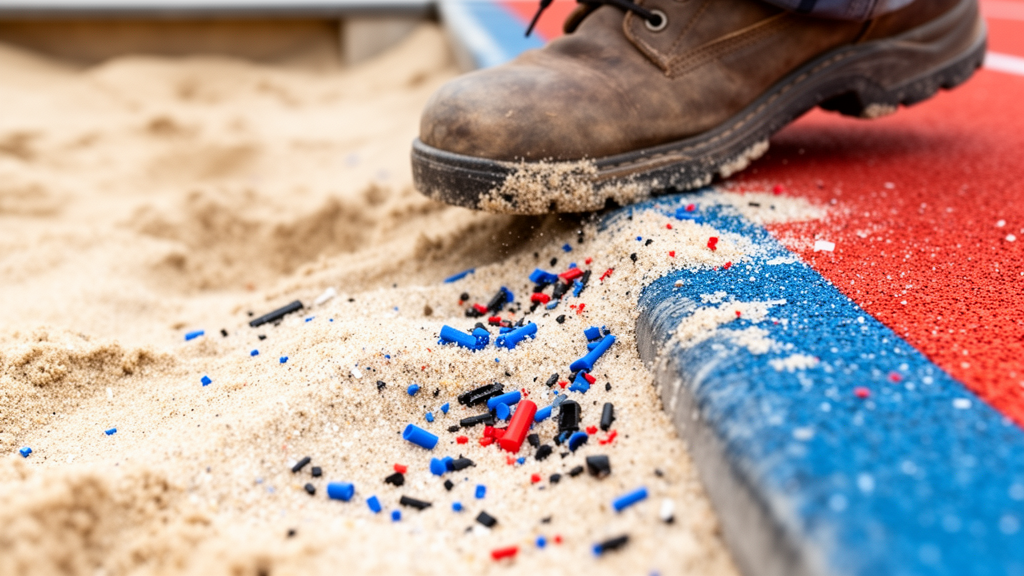
Microplastic particles accumulated in the sand of nine long-jump pits at Polish schools and a university stadium, offering a practical way to monitor shedding from nearby synthetic running tracks, football fields and other sports surfaces. In the case study, sand collected on 7 July 2025 contained between 3 and 104 microplastic particles per 10 g, with a mean of 24 ± 17 particles per 10 g. Most of the 1,921 particles counted across 81 subsamples were red, consistent with nearby colored track surfaces, while black particles resembling rubber infill from artificial football fields formed the second-largest group.
The study, which focused on facilities within Kielce in south-central Poland, examined six sandpits at elementary schools and three at the Kielce University of Technology. The school facilities ranged from 626 to 4,867 square metres and had sandpits constructed or restored at different times between 1966 and 1989. The university complex, built from 2019 to 2021, covered 30,000 square metres and included a full-size artificial-turf football pitch, a 400-metre polyurethane running track, an additional 130-metre track and several throwing and jumping facilities. The institution has about 4,500 students, most of whom participate in sporting activities.
About 1.5 kg of sand was collected from each pit. Each bulk sample was divided into three increments taken near the long-jump beam, in the central area and at the landing point, producing 27 samples in total. Following air-drying for approximately a week, each sample was manually mixed and divided into three 10 g portions. Investigators counted particles across the entire portion under a stereoscopic microscope, using polarized and unpolarized light to distinguish colored plastics from quartz and other mineral or organic material. The detectable size range was 0.01 to 5 mm, with 5 mm adopted as the upper limit for practical reasons.
The observed particles ranged from about 0.1 to 5 mm and averaged 2.7 mm in size. Red accounted for 70% of all identified particles, black for 25%, and green, blue, orange, pink, violet and other colors for the remaining 5%. Many fragments had irregular shapes and a porous texture, features consistent with material abraded from an upper track layer. The researchers identified these particles by visual appearance and selected representative groups for chemical verification with attenuated total reflection Fourier-transform infrared spectroscopy, or ATR-FTIR.
Spectral analysis confirmed polyether urethane in selected red particles from six sampling sites and selected black particles from four sites. Two red particles were identified as ethylene propylene diene monomer, a polymer used in some synthetic surfaces. Polyether urethane showed characteristic absorption bands associated with N–H, C=O and C–O–C stretching, while the ethylene propylene diene monomer particles produced the expected carbon-hydrogen bands. Spectral similarity with reference-library spectra exceeded 70% for the analyzed material. The study nevertheless noted an important limitation: only a small number of selected particles underwent FTIR analysis, so visual identification supplied much of the broader count.
The highest overall particle concentrations occurred in the university stadium sandpits, and a one-way analysis of variance found statistically significant differences among sites at p = 0.01. By contrast, particle numbers did not differ significantly among the three portions taken from the same sandpit. Facility size alone did not explain the pattern: there was no statistically significant correlation between the area of a sports complex and the number of particles recovered. The lowest and least variable counts occurred at a school pit far from the running track and football field and at another where a newly installed synthetic surface was used only occasionally.
These results suggest that the amount of microplastic in a sandpit may depend on local conditions such as the extent of synthetic surfacing, maintenance practices and the intensity of use, although the study did not establish which factor was responsible for the differences between facilities. The site conditions were broadly similar on the sampling day, with no rain or strong winds in the preceding days and temperatures reaching 24 °C. The investigators therefore considered local weather unlikely to account for the observed spatial pattern. The single sampling date, however, prevented the researchers from separating persistent differences among sites from seasonal or short-term effects.
The authors contend that long-jump sand can serve as a simple sampling medium for source-focused microplastic monitoring. Unlike stormwater or wash water collected from cleaning equipment, pit sand is not directly affected by the weather at the moment of collection, and it is less likely than a cleaning-machine sample to be biased by additional abrasion produced during washing. The university stadium was cleaned weekly with an industrial vacuum and intensively machine-cleaned twice a year, whereas school facilities were maintained with brooms or leaf blowers. Sand itself is already widely used for microplastic studies in beaches, dunes, playgrounds and laboratory experiments, which gives researchers an opportunity to build comparable protocols around a familiar matrix.
The study also highlights a possible pathway from sports facilities to surrounding environments. Sandpits are not necessarily permanent sinks for deposited microplastics: particles can be lifted by wind or carried in rainwater. Outdoor facilities commonly drain into municipal storm sewers, potentially delivering abraded material to river systems. The findings do not directly measure that downstream transport, nor do they establish the toxicity of the particles for people or wildlife. Instead, they identify the sandpit as a practical early-warning sampling point close to the synthetic surfaces from which the material is likely to originate.
Several limitations constrain the findings: only 10 g portions were examined, particles were identified visually before limited chemical confirmation, and nine pits were sampled on one day. The researchers call for future work addressing seasonal variability, maintenance regimes, intensity of use and the factors governing particle distribution. They also propose validating standardized sand traps filled with laboratory-cleaned sand as deposition collectors in agricultural areas, roadside soils and urban environments. Meanwhile, their results support careful management of sand removed from long-jump pits so that accumulated microplastics are not inadvertently redistributed. The case study provides a baseline for such monitoring while showing that even visibly simple sports facilities can serve as sampling points for a widespread environmental contaminant.
Subject of Research: Microplastic accumulation in long-jump sandpits near synthetic surfaces at Polish sports facilities
Article Title: Running tracks abrasion as a source of microplastics pollution: a long jump sandpit case study
Article References: Gałuszka, A., Migaszewski, Z. M., Migaszewski, A., Krzciuk, K., & Strójwąs, A. (2026). Running tracks abrasion as a source of microplastics pollution: a long jump sandpit case study. Environmental Science and Pollution Research. https://doi.org/10.1007/s11356-026-38323-5
Image Credits: AI Generated
DOI: 10.1007/s11356-026-38323-5
Keywords: microplastics, sports surfaces, running tracks, long-jump sandpits, polyurethane, environmental monitoring, plastic pollution, Poland, ATR-FTIR, synthetic turf, Running, tracks
Cite Scienmag News
Violet Maxwell. (October 21, 2026). Sandpits reveal microplastics shed from sports surfaces in Polish case study. Scienmag. https://scienmag.com/sandpits-reveal-microplastics-shed-from-sports-surfaces-in-polish-case-study/
Violet Maxwell. "Sandpits reveal microplastics shed from sports surfaces in Polish case study." Scienmag, 21 October 2026, https://scienmag.com/sandpits-reveal-microplastics-shed-from-sports-surfaces-in-polish-case-study/. Accessed 21 October 2026.
Violet Maxwell. "Sandpits reveal microplastics shed from sports surfaces in Polish case study." Scienmag. October 21, 2026. https://scienmag.com/sandpits-reveal-microplastics-shed-from-sports-surfaces-in-polish-case-study/


