


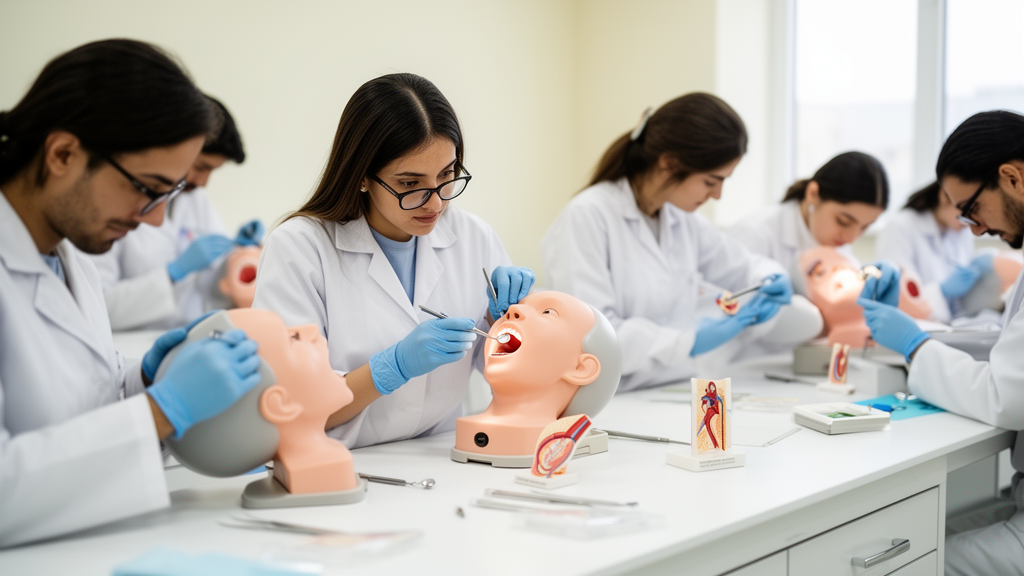
A multicenter cross-sectional study of 456 health professional students in Riyadh found marked variation in knowledge, awareness, attitudes and reported practices concerning oral potentially malignant disorders and oral cancer. Dental students recorded the most favorable results across the four domains, but the researchers warned that the estimate is exploratory because only 23 dental students participated. More broadly, the survey identified gaps in recognizing potentially malignant lesions, understanding risk factors and translating knowledge into clinical behavior, raising questions about how well future practitioners across several disciplines are being prepared to detect oral cancer early.
The survey was conducted between February and May 2026 among undergraduates in medicine, dentistry, nursing and applied medical sciences at five universities in Riyadh. Participants had a mean age of 21.78 ± 3.73 years; 352, or 77.1%, were female and 104, or 22.9%, were male. Medicine was the largest professional group, contributing 280 participants, followed by applied medical sciences with 100, nursing with 53 and dentistry with 23. Recruitment into the university groups was also uneven: University A supplied 201 respondents, University B 90, University C 74, University D 63 and University E 28. The final dataset contained no missing observations, and all 456 students were included in the analyses.
Researchers used a 32-item questionnaire adapted from a previously validated instrument for health workers. A panel of five specialists in oral medicine, oral pathology and dental public health reviewed the questions for relevance, clarity and cultural appropriateness in Saudi Arabia. The panel removed 22 of the original 54 items, including questions about alcohol use, betel-quid or areca-nut chewing and practices not routinely performed by Saudi healthcare students. The adapted questionnaire achieved a scale-level content validity index of 0.94. A pilot study with 40 students, excluded from the main analysis, produced an intraclass correlation coefficient of 0.82, while internal consistency was 0.74 for awareness, 0.72 for attitudes and 0.77 for practice.
Because eight of the 12 knowledge questions allowed multiple answers, the researchers did not construct a conventional total knowledge score. Instead, they used two-step cluster analysis on 27 categorical variables covering risk factors, oral changes, lesion recognition and treatment-related responses. This method separated 195 students into a higher-knowledge cluster and 261 into a lower-knowledge cluster. The higher cluster was much more likely to identify leukoplakia, tobacco use and non-healing ulcers: 82.1% recognized leukoplakia, 94.4% identified tobacco use and 67.2% recognized non-healing ulcers. In the lower cluster, the corresponding proportions were 13.0%, 58.2% and 30.3%.
Dental students had substantially stronger results: 18 of 23, or 78.3%, fell into the higher-knowledge cluster, compared with 143 of 280 medical students, or 51.1%; 21 of 100 applied medical sciences students, or 21.0%; and 13 of 53 nursing students, or 24.5%. In multivariable binary logistic regression, dental students had 12.67 times the odds of belonging to the higher-knowledge cluster than applied medical sciences students, with a 95% confidence interval of 4.17 to 38.40 and p < 0.001. The wide interval signals considerable imprecision, however, and medical students also had higher odds than applied sciences students, at 3.77 with a 95% confidence interval of 2.19 to 6.49 and p < 0.001. Nursing did not differ significantly from applied sciences, and age was not a significant independent predictor.
Awareness also varied by professional stream, with a p-value of 0.006. Fifteen dental students, or 65.2%, were classified as having high awareness, compared with 29.3% of medical students, 32.0% of applied sciences students and 32.1% of nursing students. In regression analysis, however, the dental difference from applied sciences narrowly missed the conventional threshold for statistical significance, producing an odds ratio of 2.68, a 95% confidence interval of 0.99 to 7.23 and p = 0.052. Knowledge was more clearly associated with awareness: students in the higher-knowledge cluster had 2.07 times the odds of high awareness than those in the lower cluster, with a 95% confidence interval of 1.35 to 3.19 and p = 0.001.
Attitudes and reported practices showed parallel variation. Positive attitudes toward oral cancer examination, screening and education were recorded for 52.2% of dental students, 24.5% of nursing students, 17.0% of applied sciences students and 13.6% of medical students; the association with professional stream was significant at p < 0.001. Dental students also had 3.54 times the odds of a positive attitude than applied sciences students, with a 95% confidence interval of 1.23 to 10.17 and p = 0.019. University D had higher odds of a positive attitude than University E, although the study did not model possible within-university correlation fully. The knowledge cluster itself was not independently associated with positive attitude after adjustment, with an odds ratio of 1.66, a 95% confidence interval of 0.96 to 2.87 and p = 0.070.
Good clinical practice was reported by 65.2% of dental students, 26.4% of nursing students, 19.0% of applied sciences students and 16.4% of medical students. High awareness was associated with 3.53 times the odds of good practice, while a positive attitude was associated with 5.10 times the odds; both confidence intervals excluded 1 and both p-values were below 0.001. Dental students also had 4.40 times the odds of good practice compared with applied sciences students, with a 95% confidence interval of 1.44 to 13.43 and p = 0.009. Medical and nursing students did not differ significantly from applied sciences in the adjusted model. Notably, the higher-knowledge cluster itself was not independently associated with good practice, with p = 0.374, indicating that greater factual knowledge alone was not fully aligned with reported clinical behavior.
Knowledge did not differ significantly among the five universities, with p = 0.057. That borderline result should not be read as evidence that the institutions were equivalent, particularly because institutional sample sizes ranged from 28 to 201 and potential clustering within universities was not formally modeled. Differences in curriculum, academic stage, prior training and clinical exposure were also not measured, so the study cannot establish that professional discipline itself caused the observed variations. Its cross-sectional design, voluntary online convenience sampling and self-reported answers further limit causal interpretation and generalizability. Without a complete sampling frame or denominator of eligible students, the researchers could not calculate a reliable response rate or assess nonresponse bias. Selection of students with greater interest in oral health may also have produced more favorable results than those found in the wider Riyadh student population.
The results point toward interdisciplinary education that combines recognition of oral potentially malignant disorders with practical examination, counseling and referral training. Students across medicine, nursing and applied medical sciences may encounter oral lesions during routine care, yet the survey indicates that knowledge alone does not reliably predict favorable attitudes or practices. The authors therefore recommend clinically oriented oral cancer instruction, interprofessional collaboration and opportunities to apply knowledge in realistic settings. They also call for larger, representative multicenter studies using probability-based recruitment, balanced participation across professions and institutions, objective assessments of clinical performance and statistical methods that account for institutional clustering. Until such evidence is available, the dental advantage and the size of the broader educational gaps should be treated as preliminary rather than definitive.
Subject of Research: Knowledge and clinical readiness concerning oral potentially malignant disorders and oral cancer among health professional students in Riyadh
Article Title: Knowledge, awareness, attitudes and practice regarding oral potentially malignant disorders and oral cancer among health professional students in Riyadh, Saudi Arabia: a multicenter cross-sectional study
Article References: Khanagar, S. B., Alofi, A., Alzaaqi, L. A., Alsubaie, J. M., Alayed, D., Abothnin, S. M., Almuammar, A. A., Alfaifi, A., & Iyer, K. (2026). Knowledge, awareness, attitudes and practice regarding oral potentially malignant disorders and oral cancer among health professional students in Riyadh, Saudi Arabia: a multicenter cross-sectional study. Frontiers in Oral Health, 7, Article 1942387. https://doi.org/10.3389/froh.2026.1942387
Image Credits: AI Generated
DOI: 10.3389/froh.2026.1942387
Keywords: oral cancer, oral potentially malignant disorders, health professional education, Riyadh, Saudi Arabia, dental students, medical students, early detection, cross-sectional study, Knowledge, awareness, attitudes
Cite Scienmag News
Nathaniel Bowman. (October 21, 2026). Riyadh health students show uneven oral cancer readiness. Scienmag. https://scienmag.com/riyadh-health-students-show-uneven-oral-cancer-readiness/
Nathaniel Bowman. "Riyadh health students show uneven oral cancer readiness." Scienmag, 21 October 2026, https://scienmag.com/riyadh-health-students-show-uneven-oral-cancer-readiness/. Accessed 21 October 2026.
Nathaniel Bowman. "Riyadh health students show uneven oral cancer readiness." Scienmag. October 21, 2026. https://scienmag.com/riyadh-health-students-show-uneven-oral-cancer-readiness/


