


Climate change, and specifically rising temperatures, will place a great strain on plant growth and will almost certainly impact plant production. One obvious consequence of a warmer climate is that plants in the field will require more irrigation. With more watering, however, also comes more salinity as in this way nutrient salts accumulate in agricultural soils. Climate change will also affect plant health through what it does to the communities composed of numerous microorganisms that live in intimate association with plant hosts. These communities make plants hardier in the face of stressful conditions and more resistant to pathogenic microbes. Thus, inoculation with defined bacterial communities as probiotics is an attractive strategy for safeguarding plant health. However, to ensure that these inocula are effective it is necessary to understand how bacteria and plants interact under different conditions.

Credit: Stéphane Haquard
Climate change, and specifically rising temperatures, will place a great strain on plant growth and will almost certainly impact plant production. One obvious consequence of a warmer climate is that plants in the field will require more irrigation. With more watering, however, also comes more salinity as in this way nutrient salts accumulate in agricultural soils. Climate change will also affect plant health through what it does to the communities composed of numerous microorganisms that live in intimate association with plant hosts. These communities make plants hardier in the face of stressful conditions and more resistant to pathogenic microbes. Thus, inoculation with defined bacterial communities as probiotics is an attractive strategy for safeguarding plant health. However, to ensure that these inocula are effective it is necessary to understand how bacteria and plants interact under different conditions.
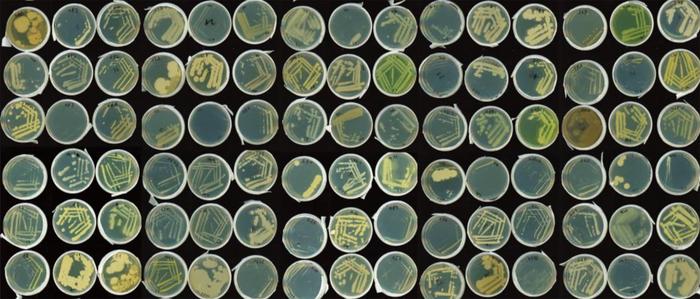
From previous experiments, co-corresponding author Hacquard who is based at the Max Planck Institute for Plant Breeding Research in Cologne, Germany, and his colleagues knew that approx. 95% of the bacteria found in plant microbiota are either neutral or beneficial in one-on-one interactions with thale cress plants. A small number, however, are detrimental when grown together with plants under laboratory conditions, among them Pseudomonas brassicacearum R401, a Gram-negative bacterium found in soil that is a dominant member of the plant microbiota. Surprisingly, though, when this bacterium was grown together with plants under natural soil conditions, no disease was observed. This suggests that the bacterium requires specific conditions to cause disease on soil-grown plants.
Some previous reports had shown that salt stress can facilitate bacterial infection of plants. Indeed, when the scientists applied salt, they found that plant growth was negatively affected in the presence of the R401 strain. Many Gram-negative bacteria cause virulence by injecting disease-causing proteins directly into the host cell cytoplasm. However, inspection of the R401 genome failed to reveal any genes encoding this injection apparatus. Further, many pathogenic bacteria overgrow on their plant host and deploy strategies to dampen plant immune responses. Again, R401 was doing neither of these things.
To understand how the R401 strain causes disease on soil-grown plants facing salt stress, Hacquard and his group teamed up with the natural product group of Till Schäberle at the Justus-Liebig-University and the Fraunhofer Institute for Molecular Biology and Applied Ecology in Giessen. Together the researchers identified genes that showed similarity to genes from related bacteria that encode phytotoxic metabolites. They isolated the predicted metabolite, which they termed brassicapeptin, and mutated one of the core genes required for its synthesis. This mutation was sufficient to turn R401 into a plant-beneficial bacterium.
Strikingly, once they had the compound in hand, the scientists could show that brassicapeptin is by itself enough to cause plant disease in concert with high salt conditions. Further, brassicapeptin was not only toxic for thale cress plants but also for tomato plants experiencing salt stress, as well as for other microbes. The researchers could show that the molecule, which is composed of a fatty acid tail linked to amino acids, can form pores in plant membranes. This could explain why the molecules toxicity becomes apparent when plants are facing salt stress.
Till Schäberle is excited by the possibilities this study throws up for improving crop health: “It is important that we learn more about how the natural products produced by microbes influence plant physiology. This will allow us to design effective biologics for crop protection.”
Stéphane Hacquard found remarkable that “a single bacterial molecule can at the same time sensitize plants to osmotic stress, promote bacterial capability to colonize roots and impede growth of bacterial and fungal competitors.”
Journal
Nature Communications
Method of Research
Experimental study
Subject of Research
Cells
Article Title
Physiochemical interaction between osmotic stress and a bacterial exometabolite promotes plant disease
Article Publication Date
28-May-2024
Cite Scienmag News
Drew Townsend. (May 28, 2024). Salty soil sensitizes plants to an unconventional mode of bacterial toxicity. Scienmag. https://scienmag.com/salty-soil-sensitizes-plants-to-an-unconventional-mode-of-bacterial-toxicity/
Drew Townsend. "Salty soil sensitizes plants to an unconventional mode of bacterial toxicity." Scienmag, 28 May 2024, https://scienmag.com/salty-soil-sensitizes-plants-to-an-unconventional-mode-of-bacterial-toxicity/. Accessed 4 September 2026.
Drew Townsend. "Salty soil sensitizes plants to an unconventional mode of bacterial toxicity." Scienmag. May 28, 2024. https://scienmag.com/salty-soil-sensitizes-plants-to-an-unconventional-mode-of-bacterial-toxicity/

