


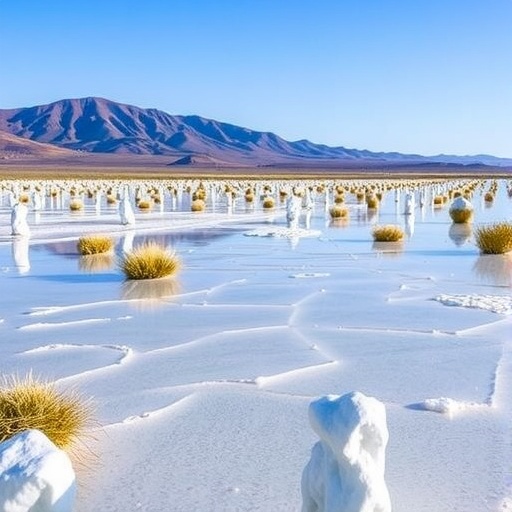
In an era where environmental challenges loom larger than ever, researchers are increasingly looking toward nature for solutions that can foster sustainability. A pivotal study titled “Mechanism of salt tolerance ability of novel Desertifilum salkalinema SSAU 7 for sustainable development” has emerged, showcasing the remarkable adaptive strategies of a newly identified bacterial species. Scientists are beginning to unravel how this microorganism can thrive in some of the most saline environments on Earth, and what implications these adaptations might have for agriculture and ecological stability.
Salt stress is a significant factor that diminishes the agricultural potential of vast areas of the planet. According to recent studies, salinity affects over 20% of the world’s irrigated land, leading to reductions in crop yields and threatening food security. Understanding how organisms like Desertifilum salkalinema SSAU 7 navigate these challenges could provide critical insight into developing salt-resistant crops, crucial for maintaining agricultural productivity in saline conditions.
Desertifilum salkalinema SSAU 7 was isolated from extreme saline environments where few life forms can survive. The name itself is a testament to its extraordinary adaptation to salt-laden soils. Researchers have conducted extensive studies, emphasizing the bacterium’s unique physiological and molecular mechanisms that confer its resilience against toxic salt concentrations. These adaptations are not merely incidental; they reflect a complex evolutionary history shaped by the demands of life in harsh conditions.
One of the most fascinating findings from the research is the identification of specific genes within Desertifilum salkalinema SSAU 7 that play a critical role in its salt tolerance. These genes code for proteins responsible for ion transport and osmotic regulation, enabling the bacterium to maintain cellular integrity in hyper-saline environments. By understanding the genetic underpinnings of salt tolerance, scientists can explore potential applications in biotechnology, particularly in engineering crops that can withstand salt stress.
Notably, the bacterium employs a range of biochemical pathways to counteract the detrimental effects of salinity. The production of compatible solutes, such as osmoprotectants, allows it to stabilize proteins and cellular structures. These solutes effectively balance the osmotic pressure without disrupting cellular functions. Exploring these pathways could pave the way for agricultural innovations, especially in regions afflicted by saline soils.
The environmental implications of this research extend beyond agriculture. Desertifilum salkalinema SSAU 7 could play a role in bioremediation strategies aimed at restoring saline-affected lands. By harnessing its natural salt tolerance and metabolic processes, researchers envision the possibility of employing this bacterium in reclaiming degraded ecosystems. From a sustainability perspective, this could contribute to biodiversity conservation and the restoration of ecological stability.
The findings regarding Desertifilum salkalinema SSAU 7 also hold promise for developing novel anti-salinity biotechnologies. By integrating the insights gained from this research into agricultural practices, farmers could potentially cultivate more resilient crops, thereby enhancing food security in the face of climate change. These insights challenge traditional notions of crop productivity and encourage a reevaluation of how we assess agricultural viability under changing environmental conditions.
Furthermore, as researchers delve deeper into the mechanisms of salt tolerance, they are likely to uncover additional applications in medicine and pharmaceuticals. The unique adaptations of Desertifilum salkalinema SSAU 7 might inspire biomimetic approaches, leading to the development of new materials or drug delivery systems that can withstand extreme conditions. The interdisciplinary nature of this research exemplifies how studies focused on fundamental biological questions can yield insights with far-reaching implications.
In light of these exciting developments, collaborative efforts among microbiologists, agronomists, and environmental scientists will be crucial. By pooling together their expertise, these researchers can expedite the translation of laboratory findings into practical applications that foster sustainable agricultural practices. This collaboration may also lead to broader initiatives aimed at combating the salinization of arable land across the globe.
The study conducted by Maurya, Sharma, and Jaiswal serves as a clarion call to the scientific community. It underscores the importance of investigating extremophiles like Desertifilum salkalinema SSAU 7, which thrive in conditions that challenge conventional life forms. Understanding these organisms not only contributes to fundamental biological knowledge but also provides a roadmap for innovation in addressing current and future environmental crises.
In summary, the research detailing Desertifilum salkalinema SSAU 7’s salt tolerance mechanisms is a compelling narrative of resilience and adaptation in nature. As we face escalating environmental challenges, studies like this offer hope and practical solutions for sustainable development. They remind us of the ingenious ways life evolves in response to adversity and the potential we have to learn from these processes to foster a more sustainable and secure future.
This work is essential, not only for its immediate applications in agriculture and ecology but also for its broader implications in our understanding of life’s adaptability. The journey of Desertifilum salkalinema SSAU 7 serves as a reminder that nature often holds the keys to solving some of our most pressing problems.
By continuing to explore the genetic and physiological traits of such extremophiles, we stand at the cusp of a new frontier in biotechnology, where the knowledge gleaned from these organisms could be pivotal in creating solutions for a rapidly changing world.
The remarkable story of Desertifilum salkalinema SSAU 7 encapsulates the essence of scientific inquiry: a relentless search for understanding that continues to unravel the complexities of life on Earth, presenting us with innovative possibilities for the future.
Maurya, N., Sharma, A., Jaiswal, S. et al. Mechanism of salt tolerance ability of novel Desertifilum salkalinema SSAU 7 for sustainable development.
Int Microbiol (2025). https://doi.org/10.1007/s10123-025-00731-x
Cite Scienmag News
Alan Morgan. (October 7, 2025). Salt Tolerance Mechanism of Desertifilum salkalinema Unveiled. Scienmag. https://scienmag.com/salt-tolerance-mechanism-of-desertifilum-salkalinema-unveiled/
Alan Morgan. "Salt Tolerance Mechanism of Desertifilum salkalinema Unveiled." Scienmag, 7 October 2025, https://scienmag.com/salt-tolerance-mechanism-of-desertifilum-salkalinema-unveiled/. Accessed 3 September 2026.
Alan Morgan. "Salt Tolerance Mechanism of Desertifilum salkalinema Unveiled." Scienmag. October 7, 2025. https://scienmag.com/salt-tolerance-mechanism-of-desertifilum-salkalinema-unveiled/


