


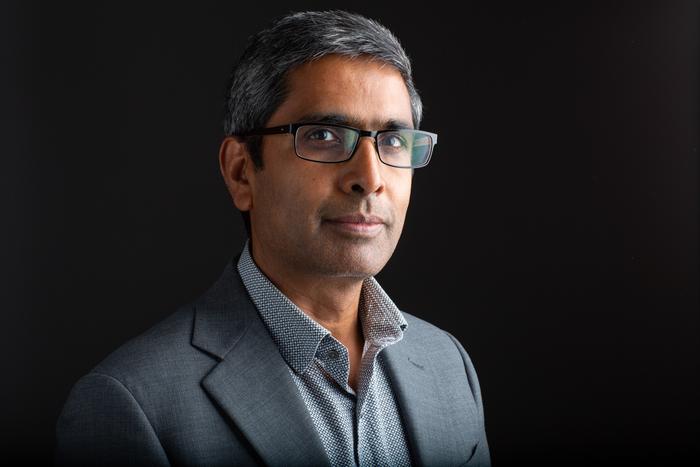
LA JOLLA (April 18, 2024)—Salk Institute Professor Satchidananda Panda has been named a 2023 Fellow of the American Association for the Advancement of Science (AAAS), the world’s largest general scientific society and publisher of the journal Science. Panda is among 502 new AAAS Fellows spanning 24 scientific disciplines who were nominated by their peers for their distinguished efforts to advance science. The election recognizes his contributions to the field of chronobiology, particularly for applications to obesity and human health.

Credit: Salk Institute
LA JOLLA (April 18, 2024)—Salk Institute Professor Satchidananda Panda has been named a 2023 Fellow of the American Association for the Advancement of Science (AAAS), the world’s largest general scientific society and publisher of the journal Science. Panda is among 502 new AAAS Fellows spanning 24 scientific disciplines who were nominated by their peers for their distinguished efforts to advance science. The election recognizes his contributions to the field of chronobiology, particularly for applications to obesity and human health.
“The Salk community congratulates Satchin on his well-deserved election as an AAAS Fellow,” says Salk President Gerald Joyce. “His pioneering work in circadian biology has illuminated the intricacies of our body’s internal clock and opened new avenues for understanding human health and preventing and managing chronic diseases. We are delighted to celebrate this prestigious recognition with him.”
Panda is a professor in the Regulatory Biology Laboratory and holder of the Rita and Richard Atkinson Chair at Salk. He is consistently named among the best and most highly cited researchers in the world by Clarivate. His research explores the genes, molecules, and cells that keep the whole body on the same circadian clock, and how they are linked to health and disease. He has made significant advancements in understanding how light sensors in the eyes measure ambient light levels to regulate the body’s sleep and wake times. These discoveries have fueled a new lighting revolution to reduce blue light exposure at night to improve mood, alertness, and sleep.
In further exploring these daily cycles in the body, his lab’s work has extended into the field of time-restricted eating and its impact on metabolism and immunity. Panda found that mice that eat within a set amount of time (8–12 hours) were slimmer and healthier than those who ate the same number of calories in a larger window of time, showing that when one eats may be as important as what one eats. Subsequent studies have explored whether these benefits of time-restricted eating hold true in humans, with pilot studies suggesting it could have profound impacts on treating high cholesterol, heart disease, diabetes, and obesity. A recent clinical trial in firefighters also showed promising results for improving cardiovascular health in shift workers.
Mice with dysregulated circadian rhythms also had higher levels of inflammation in their bodies than other mice, suggesting that genes and molecules involved in the circadian clock could be potential drug targets for conditions linked to inflammation, such as cancer. Panda’s lab continues to explore the ways that circadian regulation can be used to prevent and better manage these diseases and, in turn, promote healthy aging and extended life spans.
About the Salk Institute for Biological Studies:
Unlocking the secrets of life itself is the driving force behind the Salk Institute. Our team of world-class, award-winning scientists pushes the boundaries of knowledge in areas such as neuroscience, cancer research, aging, immunobiology, plant biology, computational biology, and more. Founded by Jonas Salk, developer of the first safe and effective polio vaccine, the Institute is an independent, nonprofit research organization and architectural landmark: small by choice, intimate by nature, and fearless in the face of any challenge. Learn more at www.salk.edu.
About the American Association for the Advancement of Science:
The American Association for the Advancement of Science (AAAS) was founded in 1848 and includes more than 250 affiliated societies and academies of science, serving 10 million individuals. The nonprofit AAAS is open to all and fulfills its mission to “advance science and serve society” through initiatives in science policy, international programs, science education, public engagement, and more. For additional information about AAAS, see www.aaas.org.
Cite Scienmag News
Drew Townsend. (April 18, 2024). Salk Professor Satchin Panda named 2023 AAAS fellow. Scienmag. https://scienmag.com/salk-professor-satchin-panda-named-2023-aaas-fellow/
Drew Townsend. "Salk Professor Satchin Panda named 2023 AAAS fellow." Scienmag, 18 April 2024, https://scienmag.com/salk-professor-satchin-panda-named-2023-aaas-fellow/. Accessed 4 September 2026.
Drew Townsend. "Salk Professor Satchin Panda named 2023 AAAS fellow." Scienmag. April 18, 2024. https://scienmag.com/salk-professor-satchin-panda-named-2023-aaas-fellow/

