Researchers in Iran have identified ten small molecules in saliva that appear to distinguish diabetic patients with periodontitis from diabetic patients without the gum disease, according to an exploratory pilot study published in Genomics & Informatics. Using nuclear magnetic resonance spectroscopy on unstimulated whole saliva, the team found that five of the ten candidate markers map onto a single biochemical route, pyrimidine metabolism, which emerged as the only significantly enriched pathway in their analysis. The authors stress that the findings come from a very small sample and require independent validation before any clinical use.
The study, led by Samaneh Vaziri-Amjad and colleagues with senior author Amir Taherkhani, recruited adults with confirmed diabetes mellitus from the School of Dentistry at Hamadan University of Medical Sciences between February 2025 and April 2026. Of 30 diabetic patients assessed for eligibility, four were excluded, two because of hyperthyroidism and two who declined to participate, leaving 26 participants who were split evenly: 13 with periodontitis and 13 without. Everyone enrolled provided saliva samples, and no participants were lost after enrollment. Diabetes was confirmed by HbA1c of at least 6.5 percent and fasting plasma glucose of at least 126 mg/dL, while periodontitis was diagnosed according to the 2017 World Workshop classification, requiring interdental clinical attachment loss at two non-adjacent teeth or buccal or oral attachment loss of at least 3 mm with pocket depth greater than 3 mm at two teeth, with radiographic bone loss assessed where available.
The two groups were statistically well matched on glycemic control. HbA1c values followed a normal distribution in both groups, and the mean was 7.53 percent in the periodontitis group versus 7.33 percent in the control group, a difference of 0.20 percentage points that was not statistically significant (95 percent confidence interval from −0.68 to 1.08; p = 0.642). Exclusion criteria removed pregnant women, anyone who had used antibiotics or anti-inflammatory agents within the previous three months, and people with other major systemic diseases. To reduce bias, the clinician performing periodontal examinations was blinded to the spectroscopy data, and the analyst processing the spectra did not know which group each sample came from.
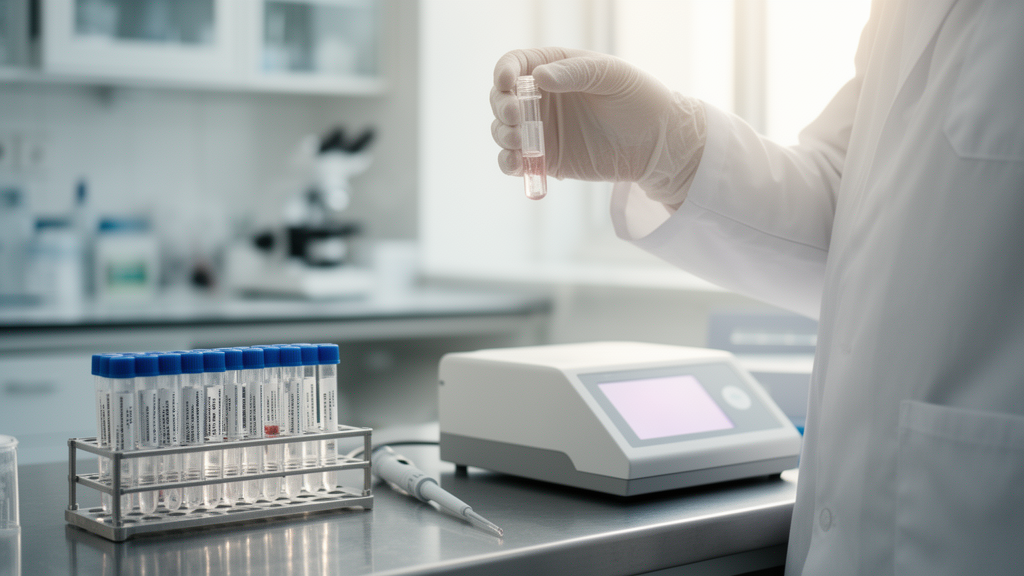
Saliva collection followed a tightly standardized protocol designed to limit confounding. All samples were taken in the morning between 9:00 and 11:00 to avoid circadian effects, and participants abstained from food, drink, caffeine, alcohol, nicotine, chewing gum, and oral hygiene for at least one hour beforehand. After a rinse with deionized water and a ten-minute rest, saliva was collected by passive drooling into ice-chilled tubes; the first minute of output was discarded and the following five minutes retained. Samples reached the laboratory on ice within 120 minutes, were treated with sodium azide to curb microbial growth, centrifuged at 10,000 times gravity for ten minutes at 4 degrees Celsius, and stored at −80 degrees Celsius until analysis.
For the metabolic profiling, 675 microliters of saliva were mixed with phosphate buffer in deuterated water and analyzed on a 400-MHz Bruker spectrometer at 25 degrees Celsius. The team used a Carr–Purcell–Meiboom–Gill pulse sequence to suppress signals from large macromolecules, then processed the spectra with binning, normalization, and chemical shift alignment in the ProMetab software, dividing the 0.2 to 10 ppm range into 0.05 ppm buckets and excluding the water resonance. A supervised multivariate model, partial least squares discriminant analysis, was then applied to separate the two groups, and spectral variables with a variable importance in projection score above 1 were carried forward for metabolite identification against the Biological Magnetic Resonance Data Bank and confirmation with Chenomx software.
The model separated the groups in this sample, yielding an apparent area under the receiver operating characteristic curve of 0.905, but the authors are explicit that this figure should not be read as diagnostic performance. The cross-validated predictive measure Q2 was only 0.031, and permutation testing with 500 label permutations and 7-fold cross-validation produced empirical p values of 0.324 for R2Y and 0.166 for Q2, neither reaching conventional significance thresholds. Because the area under the curve was computed from the training set in a cohort of only 26 people, the researchers describe it as an apparent, not validated, estimate that is likely optimistic and possibly a product of overfitting. In their framing, the model functioned mainly as a dimension-reduction and feature-filtering tool rather than a clinical classifier.
From the 78 discriminating spectral bins that passed the variable-importance threshold, the annotation pipeline assigned identities to ten metabolites: glycolic acid, thymidine, tyramine, deoxyguanosine, cytidine, uridine, NADPH, ADP, serotonin, and nicotinate. Identification relied on matching chemical shifts against the BMRB database and then verifying candidates by checking whether all expected peaks of a compound aligned with a reference spectrum, since individual metabolites typically produce multiple peaks across the spectral range. Metabolite set enrichment analysis run on the MetaboAnalyst 6.0 platform, with false discovery rate controlled by the Benjamini–Hochberg procedure at a threshold of 0.05, flagged pyrimidine metabolism as the single significantly enriched pathway, with a false discovery rate of 0.005. Five of the ten metabolites, thymidine, cytidine, uridine, NADPH, and ADP, belong to that pathway, and a set-membership heatmap showed ADP and NADPH participating in multiple routes while deoxyguanosine and tyramine each mapped to only one.
The authors interpret the pyrimidine signal in light of prior literature. They note that genes involved in pyrimidine degradation were previously reported to be enriched in diseased subgingival plaque, while genes for pyrimidine synthesis showed lower relative abundance than in healthy controls. They also discuss a Mendelian randomization analysis by Cai and colleagues, which used genetic instruments for 1,400 blood metabolites from 8,299 participants alongside chronic periodontitis data from the FinnGen cohort of 4,784 cases and 272,252 controls; that study highlighted 2′-deoxyuridine, another pyrimidine-metabolism product, as one of five blood metabolites most strongly associated with chronic periodontitis, possibly through effects on cell proliferation and inflammatory pathways. Comparisons with other salivary and tissue metabolomics studies, which reported changes in glucose, amino acid derivatives, purine metabolism, and fatty acid pathways, underscore that the salivary signature observed here arises specifically in the setting of diabetes, though the authors caution that such contrasts are between different study designs and populations rather than direct tests.
The limitations are substantial and the authors catalogue them in detail. The cohort came from a single academic dental center through convenience sampling, limiting generalizability across regions, health systems, and ethnicities. The sample of 13 per group limits statistical reliability, the study population comprised adults with established type 2 diabetes so results may not transfer to type 1 diabetes, prediabetes, or non-diabetic periodontitis patients, and no stratification by periodontitis severity or stage was performed. The 400-MHz spectrometer offers lower spectral dispersion and sensitivity than higher-field instruments, and NMR itself is less sensitive than mass spectrometry, so trace-level metabolites may have been missed. No multivariable adjustments were made for age, sex, smoking, HbA1c, body mass index, diabetes duration, or medication use, leaving residual confounding possible, and self-reported medical history was not independently verified. Crucially, because the comparison included only diabetic patients, it remains unknown whether the ten metabolites are specific to the diabetes–periodontitis interaction or are general markers of periodontitis that would appear in anyone with the disease.
Because the design was cross-sectional, the study cannot say whether the observed metabolic changes contribute to periodontitis in diabetes or simply accompany it, and longitudinal studies are needed to track how salivary metabolites vary over time. The authors conclude that the ten candidate markers, likely reflecting increased cellular turnover, tissue destruction, and inflammation in diabetes-associated periodontitis, should be treated as potential biomarkers until validated in independent cohorts. They call for large-scale, multicenter replication in ethnically diverse populations, ideally with multi-omics approaches and control groups including healthy individuals and periodontitis patients without diabetes, before these signatures could be considered clinically generalizable or adopted as non-invasive diagnostic tools for monitoring gum disease in people living with diabetes.
Subject of Research: Salivary metabolomic profiling to identify candidate biomarkers of periodontitis in patients with diabetes
Article Title: Salivary 1H NMR metabolic profiling of diabetic patients with and without periodontitis: an exploratory pilot study
Article References: Vaziri-Amjad, S., Zalei, B., Rabienejad, N., Golshaian, A., & Taherkhani, A. (2026). Salivary 1H NMR metabolic profiling of diabetic patients with and without periodontitis: an exploratory pilot study. Genomics & Informatics, 24(1), Article 23. https://doi.org/10.1186/s44342-026-00085-4
Image Credits: AI Generated
DOI: 10.1186/s44342-026-00085-4
Keywords: salivary metabolomics, 1H NMR spectroscopy, periodontitis, diabetes mellitus, pyrimidine metabolism, PLS-DA, biomarkers, pilot study, saliva, Hamadan, cross-sectional study, metabolite set enrichment analysis
Cite Scienmag News
Gregory Coleman. (October 27, 2026). Saliva Metabolites Flag Periodontitis in Diabetes in Small Pilot Study. Scienmag. https://scienmag.com/saliva-metabolites-flag-periodontitis-in-diabetes-in-small-pilot-study/
Gregory Coleman. "Saliva Metabolites Flag Periodontitis in Diabetes in Small Pilot Study." Scienmag, 27 October 2026, https://scienmag.com/saliva-metabolites-flag-periodontitis-in-diabetes-in-small-pilot-study/. Accessed 28 October 2026.
Gregory Coleman. "Saliva Metabolites Flag Periodontitis in Diabetes in Small Pilot Study." Scienmag. October 27, 2026. https://scienmag.com/saliva-metabolites-flag-periodontitis-in-diabetes-in-small-pilot-study/