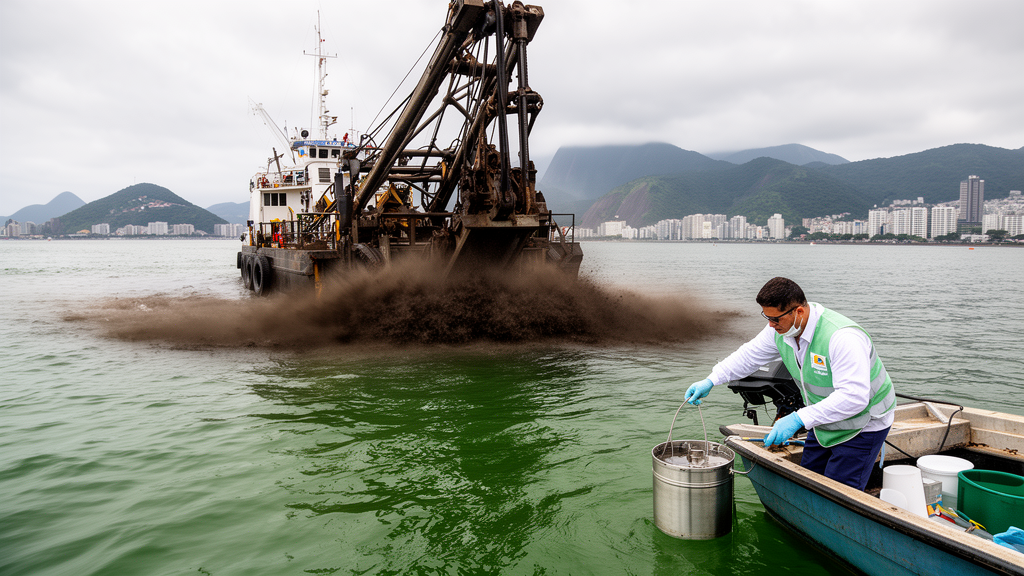
Dredged sediment from Brazil’s Guanabara Bay releases zinc into forms that aquatic organisms can absorb, and the amounts measured after laboratory resuspension exceeded the thresholds set by Brazil’s own dredging regulation in nearly every sample tested. The finding comes from a study published in the journal Anthropocene Coasts, which compared two chemical extraction methods designed to estimate how much of the metal in sediment is actually bioavailable rather than locked away in mineral lattices. The authors argue that the results expose a blind spot in the Brazilian dredging standard, CONAMA Resolution 454/12, which relies on total or pseudo-total metal measurements and does not require testing before and after sediment is stirred up.
Guanabara Bay, the 381-square-kilometer estuary that Rio de Janeiro sits beside, is described in the study as one of the most metal-polluted aquatic ecosystems in Brazil and worldwide. It receives the highest number of dredging operations of any bay in Brazil and South America, driven by intense silting of its drainage basin and the need to maintain navigation channels serving the port areas. Roughly 8.6 million people live in 22 municipalities within the bay’s 4,081-square-kilometer drainage basin, and an industrial hub surrounding the watershed accounts for 70 percent of the industries in the state of Rio de Janeiro, discharging much of the industrial sewage that reaches the ecosystem. Sanitary sewage contributes about 75 percent of the bay’s organic pollution load, with industrial discharges contributing the remaining 25 percent, and only about half of urban homes in the basin are connected to the sewage treatment network.
The research team sampled surface sediments from four areas of the bay: Rio de Janeiro Harbor, Niterói Harbor, the Iguaçu River estuary, and the Meriti River estuary. The two port areas are contaminated mainly by domestic sewage and metals associated with ships, while the Iguaçu River estuary lies near the largest oil refinery in the country and the former Gramacho landfill, once considered the largest in Latin America until its closure in 2012. The Meriti River drains a densely populated region and has long received sewage contaminated with mercury and other metals from a chlor-alkali industry on its banks. Sampling took place in September 2014, during the dry winter season, and in March 2015, during the wet summer season, with three collection points in each area.
To simulate what happens when dredging stirs bottom sediment into the water column, the researchers placed 20 grams of homogenized wet sediment in flasks with 100 milliliters of unfiltered water collected from the bay’s channel area. The flasks were agitated on a mechanical shaker at 200 revolutions per minute, open to the atmosphere, and tested at six time intervals: 30 minutes, 1 hour, 3 hours, 6 hours, 12 hours, and 24 hours. A baseline measurement, labeled T0, captured the sediment before any resuspension. The short intervals were chosen because previous work indicated that changes in bioavailability occur mainly during the first hour, while the 24-hour point was included to test whether contaminant shifts persist over longer events. All samplings were conducted in duplicates.
The core of the study is a comparison between two operationally defined bioavailability extractions. The first uses a 1 molar hydrochloric acid solution, agitated with dried sediment for 16 hours, which dissolves the reactive phase of the sediment: metals adsorbed to particle surfaces or associated with carbonates, monosulfides, iron and manganese oxides and hydroxides, and clay minerals. The second uses 0.11 molar acetic acid, corresponding to step 1 of the sequential extraction procedure developed by the Community Bureau of Reference in Europe, which targets exchangeable metals and those bound to carbonates, the fraction most susceptible to release when pH changes. Zinc concentrations in the extracts were measured by inductively coupled plasma optical emission spectrometry, with a certified reference material yielding recoveries between 96 and 103 percent.
The results showed that zinc concentrations exceeded the regulatory standard in all samples, in both extraction methods and in both seasons, after resuspension. In winter, three of the four areas showed concentrations exceeding both level 1 and level 2 of CONAMA Resolution 454/12, which is based on the Effect Range Low and Effect Range Medium values originally proposed for sediments in North America, both before and after resuspension. In the winter hydrochloric acid extraction, zinc was above the Effect Range Low at all resuspension intervals in Niterói Harbor and the Meriti River, while Rio de Janeiro Harbor showed all intervals after resuspension above the Effect Range Medium, indicating a high risk to biota. In summer, the pattern was patchier but still concerning: Niterói Harbor and the Iguaçu River exceeded the Effect Range Low at all intervals after resuspension, and the Meriti River showed three results above the low threshold and three above the medium threshold in one extraction, with four above the medium and two above the low in the other.
To quantify how much zinc shifted between forms, the team applied a Bioavailability Change index, which expresses the gain or loss of reactive-phase metal after resuspension as a percentage of the concentration before resuspension. Positive values indicate remobilization, meaning metal became more bioavailable, while negative values indicate a reduction. For the hydrochloric acid extraction, the index returned 24 positive results and 5 negative results, suggesting zinc was remobilized after resuspension at essentially all intervals. For the acetic acid extraction, 19 significant results appeared, 18 of them positive. The authors interpret this as evidence that zinc remobilization occurred after resuspension for all samples and in most resuspension intervals, pointing to an environmental risk tied directly to the resuspension that dredging causes.
Seasonal contrasts shaped the findings in ways the researchers did not fully anticipate. Metal concentrations were higher in the winter campaign, which the authors attribute to the dry season bringing less water input into the system, while the lower summer concentrations may reflect dilution as rainfall swells the rivers of the watershed. Grain size also shifted: in winter, Niterói Harbor and both river estuaries were composed entirely of fine silt and clay, a texture that favors metal retention because fine particles offer more surface area, higher surface charge, and more complexed organic matter. In summer, Rio de Janeiro Harbor became predominantly sandy, possibly because swell waves enter the region during that season. All samples in winter showed organic matter contents above 10 percent, and zinc correlated positively with manganese in both extractions, consistent with manganese acting as a carrier that adsorbs metals in estuarine waters before forming oxyhydroxides when oxygen-rich seawater arrives.
The study also weighed the two extraction methods against each other. All metals measured, including iron, manganese, and zinc, showed higher concentrations in the 1 molar hydrochloric acid extraction, which can dissolve carbonates, iron and manganese oxides, and part of the combined organic and sulfurous metal pool, though not the residual fraction. The authors note this contrasts with some prior findings in less polluted environments, where certain metals extracted more strongly with acetic acid, and they link the difference here to the heavily polluted character of the bay. They conclude that the hydrochloric acid method proved more efficient than acetic acid extraction and, because it is cheaper and simpler than the pseudo-total extractions used in most global dredging standards, could be adopted as a monitoring tool by regulatory agencies working with limited budgets.
The broader argument of the paper is regulatory. The chemical criteria in CONAMA Resolution 454/12 derive from ecotoxicological values adopted by environmental agencies in the United States and Canada, and the authors, citing prior work, contend that these imported benchmarks do not align with the environmental reality of tropical regions, where sediment chemistry and bacterial activity differ from temperate systems. Previous studies cited in the paper found that dredging resuspension affected the development of a benthic copepod and a sea urchin species in Guanabara Bay sediments, and that zinc concentrations measured with the hydrochloric acid method exceeded Brazilian legislative limits. The team recommends that Brazilian dredging legislation incorporate bioavailability-based extraction methods and laboratory resuspension tests, and that the Effect Range Low and Effect Range Medium limits be revised for tropical countries. As the authors put it, the use of pseudo-total extraction does not reflect the environmental reality of areas subjected to dredging, and future standards should be built on site-specific data rather than values replicated from the countries that conducted the original studies.
Subject of Research: Zinc bioavailability in dredged sediments of Guanabara Bay, Brazil, and the adequacy of national dredging standards
Article Title: Evaluating zinc bioavailability in dredged sediments of Guanabara bay (BRAZIL): implications for coastal management standards
Article References: do Nascimento Monte, C., de Castro Rodrigues, A. P., Cavalcante-Silva, M., Machado, G., de A. Novo, A., Santos, H. L. R., Lage, L. S. S., da Silva, L. I. D., Cordeiro, R. C., Souza, W. F., & Machado, W. (2026). Evaluating zinc bioavailability in dredged sediments of Guanabara bay (BRAZIL): implications for coastal management standards. Anthropocene Coasts, 9(1), Article 43. https://doi.org/10.1007/s44218-026-00149-6
Image Credits: AI Generated
DOI: 10.1007/s44218-026-00149-6
Keywords: Guanabara Bay, zinc, dredged sediment, bioavailability, sediment resuspension, heavy metals, CONAMA Resolution 454/12, coastal management, tropical estuaries, 1 M HCl extraction, BCR sequential extraction, Brazil
Cite Scienmag News
Violet Maxwell. (October 27, 2026). Zinc Surges When Guanabara Bay Sediments Are Stirred, Testing Brazil’s Dredging Rules. Scienmag. https://scienmag.com/zinc-surges-when-guanabara-bay-sediments-are-stirred-testing-brazils-dredging-rules/
Violet Maxwell. "Zinc Surges When Guanabara Bay Sediments Are Stirred, Testing Brazil’s Dredging Rules." Scienmag, 27 October 2026, https://scienmag.com/zinc-surges-when-guanabara-bay-sediments-are-stirred-testing-brazils-dredging-rules/. Accessed 28 October 2026.
Violet Maxwell. "Zinc Surges When Guanabara Bay Sediments Are Stirred, Testing Brazil’s Dredging Rules." Scienmag. October 27, 2026. https://scienmag.com/zinc-surges-when-guanabara-bay-sediments-are-stirred-testing-brazils-dredging-rules/