


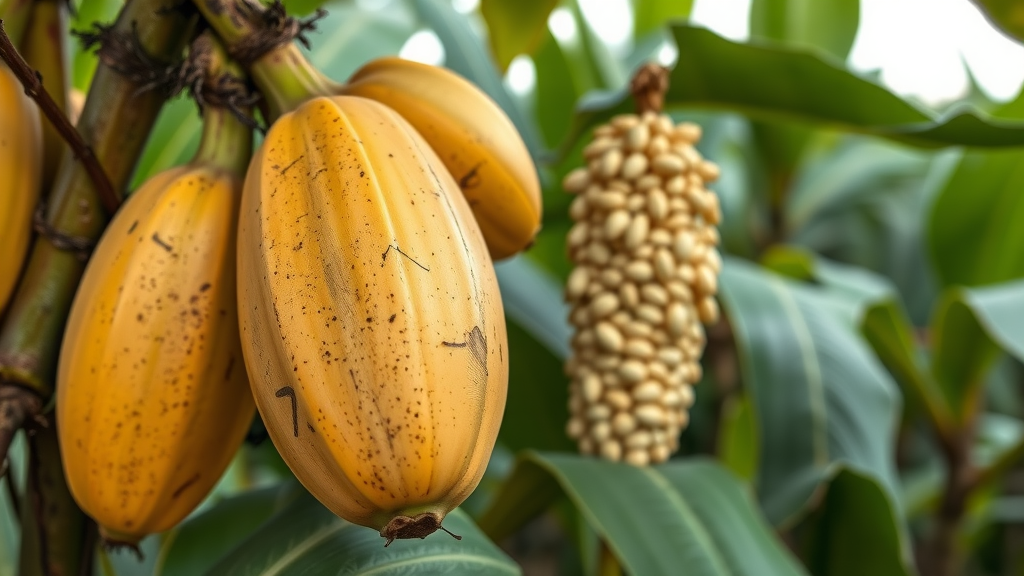
Every day, markets across East Africa discard mountains of overripe bananas, bruised papayas, shriveled lemons, and blemished pineapples—produce too far gone for the dinner table but, according to new research, potentially perfect for the farm. A study conducted at the University of Dodoma in Tanzania and published in Discover Plants shows that simple water extracts prepared from this fruit waste can dramatically improve the germination and early growth of two of the region’s most important staple crops, maize and common bean. The findings suggest that a cheap, locally available resource that usually ends up rotting in landfills could become a practical tool for smallholder farmers struggling with erratic rainfall and poor seedling establishment.
The research, carried out by Gerald Enos Shija of the University of Dodoma’s Chemistry Department, is the first systematic comparison of aqueous extracts from four commonly discarded fruits—papaya (Carica papaya), banana (Musa spp.), lemon (Citrus × limon), and pineapple (Ananas comosus)—applied as seed priming agents to both a cereal and a legume. Seed priming is a well-established technique in which seeds are soaked before planting to trigger the earliest stages of germination without allowing the radicle to emerge. When primed seeds are sown, they germinate faster and more uniformly, a decisive advantage in semi-arid environments where a single failed emergence window can devastate a season’s yield.
To prepare the biostimulants, overripe or decayed fruits unsuitable for human consumption were collected from local markets in Dodoma, washed, blended into pulp, and filtered through muslin cloth to produce fresh aqueous extracts. These were diluted one part extract to four parts water and used to soak certified maize and bean seeds for six and four hours respectively, durations selected from preliminary imbibition trials that respect the differing water-uptake kinetics of the two species. The extracts were then characterized for basic physicochemical properties: pH values ranged from 4.2 in lemon to 5.7 in banana, and total soluble solids fell between 4.6 and 7.0 degrees Brix. A gelatin hydrolysis assay confirmed strong proteolytic enzyme activity in the papaya and pineapple extracts—evidence of papain and bromelain—while banana and lemon showed no detectable proteolysis.
The experimental design was rigorous. Each of three independent experiments, repeated at least a week apart with freshly prepared extracts and new seed batches, used a completely randomized layout with four replicates of fifty seeds per treatment, giving 200 seeds per treatment per run. Two controls anchored the comparison: hydropriming with distilled water, which isolates the effect of water uptake alone, and a polyethylene glycol (PEG-6000) solution at −0.5 megapascals, which serves as an osmotic stress benchmark. Germination, defined as radicle protrusion of at least two millimeters, was recorded daily for seven days at a constant 25 ± 2 °C in the dark, and seedlings were measured on the final day for shoot length, root length, and a composite seedling vigour index.
The results were striking and remarkably consistent across all three experimental repeats, with coefficients of variation below twelve percent for every measured parameter. Papaya and banana extracts raised final germination percentage to between 90 and 94 percent in both crops, compared with just 74 percent in hydroprimed maize and 76 percent in hydroprimed beans. Even more impressive was the acceleration of germination speed: mean germination time fell by 48 to 61 percent, with papaya-primed bean seeds emerging in only 2.2 days versus 5.7 days in the control, and papaya- or banana-primed maize requiring 2.7 to 2.9 days instead of 5.3. Pineapple extract delivered intermediate results, while lemon extract produced only modest gains, likely because its low pH of 4.2 and high citric acid content imposed mild osmotic or membrane stress at the dilution tested.
Seedling growth told the same story. Banana-primed maize seedlings produced the longest shoots, at 14.1 centimeters, and roots of 7.9 centimeters, achieving a seedling vigour index of 2024—far above the hydroprimed maize control value of 1201. In common bean, papaya priming produced the best performance, with shoots reaching 13.4 centimeters and roots 8.2 centimeters, for a vigour index of 2030 against a control of 1191. The overall efficacy ranking across both crops was consistent: papaya and banana at the top, followed by pineapple, then lemon, with the controls trailing. All treatment differences were statistically significant in one-way analyses of variance followed by Tukey’s honestly significant difference test.
The mechanistic explanation lies in the distinctive biochemistry of ripening fruit. As fruits soften and sweeten, they accumulate phytohormones—gibberellins, auxins, and cytokinins—that normally orchestrate the final stages of fruit development but can also reawaken dormant seed metabolism when supplied externally. Papaya pulp is particularly rich in gibberellins and the cysteine protease papain, which can accelerate endosperm weakening and the mobilization of stored reserves. Banana extracts carry elevated auxins and cytokinins, hormones known to promote cell division and radicle elongation; auxins stimulate root initiation by upregulating cell-wall-loosening proteins called expansins, while gibberellins drive shoot elongation through the degradation of DELLA repressor proteins. Pineapple contributes bromelain along with residual sugars and organic acids, whereas lemon is dominated by citric acid and flavonoids, a profile that appears less favorable at the tested concentration.
The study situates these results within a growing literature on botanical biostimulants. Previous work has shown that moringa leaf extract, rich in zeatin, minerals, and antioxidants, can speed maize germination—but moringa must be deliberately cultivated. Red chicory and cauliflower waste extracts have enhanced drought tolerance in maize in a genotype-specific manner, and low-concentration papaya pulp extracts have improved common bean emergence even under fungal pathogen pressure. The Dodoma study extends this evidence in two important directions: it demonstrates that market-discarded overripe fruits, requiring no cultivation or processing beyond blending and dilution, can rival or exceed the germination-time reductions reported for chitosan osmo-priming and nutrient priming in maize, and it validates the approach simultaneously on a cereal and a legume under conditions representative of semi-arid East Africa.
The authors are careful to note the study’s limitations. All experiments were conducted under controlled laboratory conditions, so the benefits may be moderated—or possibly amplified—under the temperature swings, soil heterogeneity, and pest pressure of real fields. Only a single 1:4 dilution was tested, leaving open the question of optimal dosing, particularly for the more acidic lemon extract. Biochemical characterization was limited to pH, soluble solids, and qualitative enzyme assays, so future work should employ techniques such as high-performance liquid chromatography and liquid chromatography–tandem mass spectrometry to quantify individual phytohormones and establish structure–activity relationships. Long-term outcomes—field emergence, yield, nutrient uptake, and drought or salinity tolerance—remain untested, as do combination strategies such as papaya–banana blends or pairing fruit extracts with microbial inoculants.
Even so, the practical implications are compelling. Fruit waste that would otherwise decompose in landfills and release methane can be converted, with nothing more sophisticated than a blender, muslin cloth, and water, into an effective seed treatment. For smallholder farmers in resource-limited semi-arid systems, where synthetic priming chemicals are often unaffordable or unavailable, this represents a genuinely accessible technology aligned with circular bioeconomy principles. Faster, more synchronous germination translates into denser stands, quicker canopy closure, better early access to water and nutrients, and greater resilience when the rains falter. As climate variability intensifies across sub-Saharan Africa and beyond, the idea that yesterday’s spoiled pineapples and blackened bananas could help secure tomorrow’s harvest is an appealing one—and with field trials, dose optimization, and shelf-life studies on the agenda, this zero-waste seed technology may soon be ready to leave the laboratory for the farm.
Subject of Research: Fruit waste-derived aqueous extracts used as natural biostimulants for seed priming in maize and common bean
Article Title: Fruit waste-derived extracts as natural biostimulants for seed priming in maize and common beans
Article References: Shija, G. E. (2026). Fruit waste-derived extracts as natural biostimulants for seed priming in maize and common beans. Discover Plants, 3(1), Article 417. https://doi.org/10.1007/s44372-026-00885-6
Image Credits: AI Generated
DOI: 10.1007/s44372-026-00885-6
Keywords: seed priming, fruit waste, biostimulants, maize, common bean, papaya, banana, phytohormones, germination, seedling vigour, circular bioeconomy, semi-arid agriculture
Cite Scienmag News
Alan Morgan. (September 22, 2026). Rotten Papaya and Banana Turn Waste Into Powerful Seed Boosters for Maize and Beans. Scienmag. https://scienmag.com/rotten-papaya-and-banana-turn-waste-into-powerful-seed-boosters-for-maize-and-beans/
Alan Morgan. "Rotten Papaya and Banana Turn Waste Into Powerful Seed Boosters for Maize and Beans." Scienmag, 22 September 2026, https://scienmag.com/rotten-papaya-and-banana-turn-waste-into-powerful-seed-boosters-for-maize-and-beans/. Accessed 5 October 2026.
Alan Morgan. "Rotten Papaya and Banana Turn Waste Into Powerful Seed Boosters for Maize and Beans." Scienmag. September 22, 2026. https://scienmag.com/rotten-papaya-and-banana-turn-waste-into-powerful-seed-boosters-for-maize-and-beans/


