


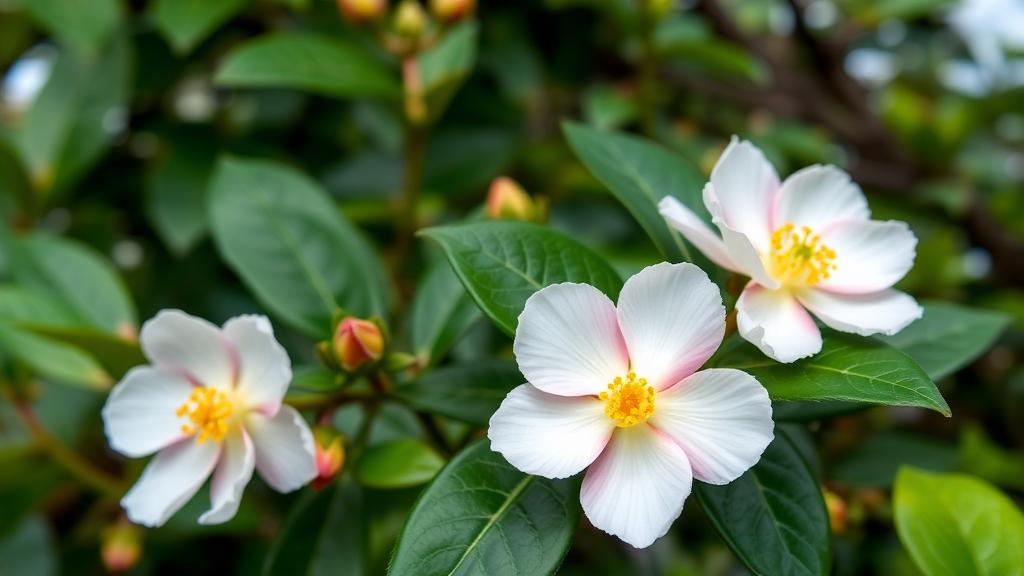
On the forested slopes of Fanjing Mountain in China’s Guizhou Province, a modest wild shrub has been quietly hiding a remarkable amount of biological variation. Camellia rosthorniana Hand.-Mazz., a wild relative of the ornamental and oil-producing camellias, has long been treated as a single, relatively uniform species across its range. A new morphological survey of germplasm accessions collected from the Fanjing Mountain region, published in BMC Plant Biology, now shows that this assumption understates the species’ true diversity. By combining classical floral measurements with scanning electron microscopy of pollen grains and a battery of multivariate statistical tools, a research team led by Bin Xu, Zhoujun Zhu, and Jianxin Li of Tongren University has documented significant intraspecific variation that could matter both for plant systematics and for future camellia breeding programs.
The study’s methodology was deliberately comprehensive. Floral traits were measured with a vernier caliper, allowing the team to quantify features such as corolla length, petal number, stamen number, pistil number, and ovule number across the collected accessions. Pollen morphology, a character set that has historically proven valuable in camellia systematics, was examined with scanning electron microscopy and then quantified using ImageJ software, yielding measurements of polar axis length, equatorial axis length, colpus length, and the ratio between the polar and equatorial dimensions. To evaluate how much variation existed and how it was structured, the researchers applied the coefficient of variation, correlation analysis, the Shannon-Wiener diversity index, principal component analysis, cluster analysis, and a supervised method known as orthogonal partial least squares-discriminant analysis, or OPLS-DA, which was used specifically to identify the traits that best separate groups of accessions from one another.
The results revealed striking variability in the flowers. The Shannon-Wiener diversity index for floral traits ranged from 0.22 to 2.76, with corolla length showing the highest diversity and pistil number the lowest. Coefficients of variation for floral characters spanned 7.21 percent to 23.80 percent, with pistil number again the most stable trait and stamen number the most variable. In practical terms, this means that within a single species growing in a single mountain region, individual plants differ dramatically in the size and composition of their blossoms. For breeders, such variation is raw material: corolla length and stamen number, the traits that vary most, are precisely the kinds of characters that ornamental horticulture prizes when selecting plants with showier or more unusual flowers.
The pollen data added a second, complementary layer of evidence. Under the scanning electron microscope, the pollen grains were oblong in equatorial view and trilobate-circular in polar view, and their exine ornamentation was granulate-foveolate, a surface texture of granules interspersed with small pits that the authors highlight as a distinct palynological signature of these accessions. Pollen traits were generally less diverse than floral traits, with Shannon-Wiener indices between 1.42 and 1.91, but the coefficients of variation ranged widely, from 4.76 percent up to 45.09 percent, indicating that certain pollen dimensions are far more labile than others. Because pollen morphology often reflects deep evolutionary constraints, the consistency of the granulate-foveolate pattern across accessions supports the placement of C. rosthorniana within the genus while the quantitative variation hints at local differentiation.
Correlation analysis exposed an interesting asymmetry in how the traits covary. Associations among floral traits were stronger than associations between floral and pollen traits, suggesting that the two character sets respond to partly independent developmental and evolutionary pressures. Two negative correlations stood out: ovule number was negatively correlated with colpus length, and petal number was negatively correlated with equatorial axis length. These relationships imply trade-offs within the reproductive system, where investment in one component of the flower or pollen grain appears to come at the expense of another. Such trade-offs are of interest to evolutionary biologists because they can reveal the functional architecture underlying reproductive strategies in wild populations.
Multivariate statistics then turned this sea of measurements into a coherent structure. Principal component analysis identified six principal components that together accounted for 72.973 percent of the total variance, a substantial share indicating that a handful of composite axes capture most of the morphological information in the dataset. Cluster analysis, using Euclidean distance with a linkage distance of L = 11, grouped the germplasm accessions into three major clusters. OPLS-DA, the supervised discriminant technique, pinpointed six key discriminatory variables that drive the separation between these groups: ovule number, equatorial axis length, corolla length, the polar-to-equatorial ratio, polar axis length, and petal number. Box plot analyses confirmed that the three clusters differ significantly across eight floral and pollen traits, meaning the groupings are not statistical artifacts but reflect genuine morphological divergence among accessions.
Perhaps the most intriguing finding concerns the stamens. Frequency distribution patterns of specific stamen traits revealed a numerical shift that the authors interpret as a potential phenotypic tendency toward stamen-to-petal transformation. This phenomenon, known as homeosis, is the developmental process by which one organ type assumes the identity of another, and it is famously responsible for the double flowers that make ornamental camellias so prized. A natural population showing a statistical tendency in this direction offers a rare window on how the raw variation for such transformations might arise in the wild, before any human selection has acted. If validated genetically, this tendency could make Fanjing Mountain germplasm especially valuable for breeding camellias with fuller, more petal-rich blooms.
The study also assessed the practical quality of the germplasm through in vitro germination tests. Clusters I and II both maintained high average germination rates exceeding 70 percent, with no significant difference between them, indicating vigorous, viable material across much of the collection. Cluster II, however, exhibited greater germination stability and a more consistent distribution than Clusters I and III, suggesting that accessions in that group may be more reliable candidates for propagation and conservation. Germination performance is a critical filter in germplasm utilization, because morphological novelty is of little use if the material cannot be propagated dependably in nurseries or breeding programs.
The systematic implications of the work are equally noteworthy. Pollen morphology has long served as a taxonomic marker in Theaceae, and the granulate-foveolate exine ornamentation documented here provides a palynological character that distinguishes these accessions and contributes to understanding their position within the genus Camellia. At the same time, the clear morphological differentiation among three clusters within a single species raises questions about how local populations of C. rosthorniana have diverged across the heterogeneous terrain of the Fanjing Mountain region, a UNESCO-recognized biodiversity hotspot in Guizhou. The authors are careful to frame their results as preliminary morphological evidence: the observed differentiation will require further genetic and field validation before it can be translated into formal varietal classification or taxonomic revisions.
For conservationists and breeders alike, the message is that this wild camellia deserves closer attention. C. rosthorniana is currently listed as Not Evaluated on the IUCN Red List and is not covered by CITES appendices, although Guizhou Province categorizes it as Least Concern owing to its stable local populations. That stable status, combined with the substantial phenotypic diversity now documented, makes the Fanjing Mountain region a potentially important reservoir of genetic resources for ornamental Camellia improvement. The study, conducted with specimens from the C. rosthorniana Germplasm Nursery at Tongren University within the Kaima Forest Farm and supported by provincial science and education funding programs, demonstrates how a rigorous morphological pipeline, from caliper and microscope to PCA and OPLS-DA, can transform a little-known wild shrub into a candidate resource for horticulture, while reminding researchers that the mountains of southern China still hold unexplored variation in even their most familiar plants.
Subject of Research: Floral and pollen morphological diversity of Camellia rosthorniana germplasm from the Fanjing Mountain region
Article Title: Floral and pollen diversity of Camellia rosthorniana germplasm accessions from Fanjing Mountain region: systematic significance and germplasm utilization
Article References: Xu, B., Zhao, J., Zhu, Z., Wu, J., Ming, Y., Yang, H., Yang, C., & Li, J. (2026). Floral and pollen diversity of Camellia rosthorniana germplasm accessions from Fanjing Mountain region: systematic significance and germplasm utilization. BMC Plant Biology. https://doi.org/10.1186/s12870-026-09994-6
Image Credits: AI Generated
DOI: 10.1186/s12870-026-09994-6
Keywords: Camellia rosthorniana, Fanjing Mountain, pollen morphology, floral traits, germplasm, phenotypic diversity, scanning electron microscopy, principal component analysis, OPLS-DA, cluster analysis, plant breeding, Guizhou
Cite Scienmag News
Alan Morgan. (October 5, 2026). Hidden Diversity in a Wild Camellia: Pollen and Flower Traits Reveal Three Distinct Germplasm Groups on Fanjing Mountain. Scienmag. https://scienmag.com/hidden-diversity-in-a-wild-camellia-pollen-and-flower-traits-reveal-three-distinct-germplasm-groups-on-fanjing-mountain/
Alan Morgan. "Hidden Diversity in a Wild Camellia: Pollen and Flower Traits Reveal Three Distinct Germplasm Groups on Fanjing Mountain." Scienmag, 5 October 2026, https://scienmag.com/hidden-diversity-in-a-wild-camellia-pollen-and-flower-traits-reveal-three-distinct-germplasm-groups-on-fanjing-mountain/. Accessed 5 October 2026.
Alan Morgan. "Hidden Diversity in a Wild Camellia: Pollen and Flower Traits Reveal Three Distinct Germplasm Groups on Fanjing Mountain." Scienmag. October 5, 2026. https://scienmag.com/hidden-diversity-in-a-wild-camellia-pollen-and-flower-traits-reveal-three-distinct-germplasm-groups-on-fanjing-mountain/


