


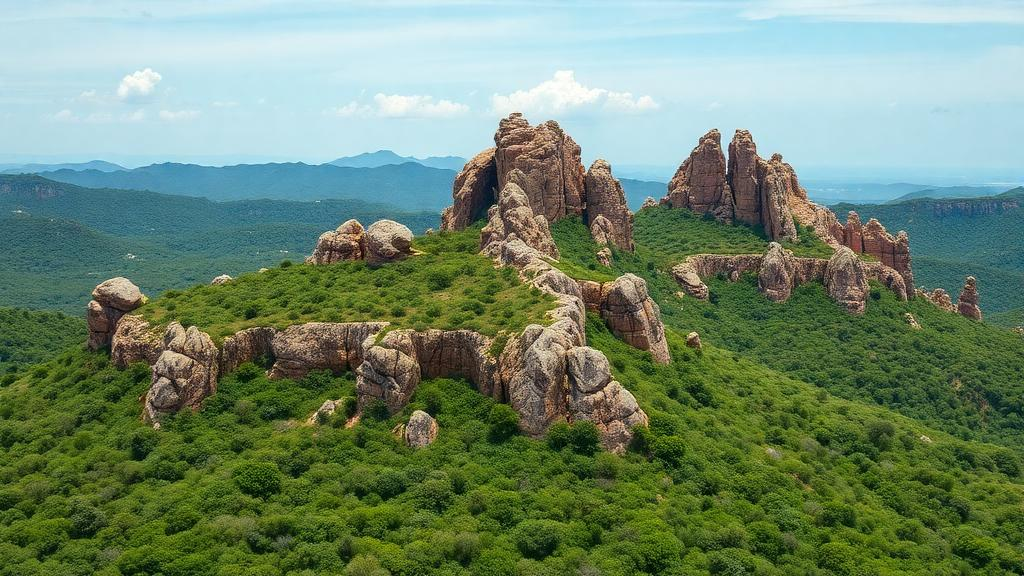
Scattered across the tropical lowlands of South America, far from the famous cloud forests and Andean peaks, lie thousands of rocky islands that most people never notice. Granite domes rise abruptly from rainforest, quartzite plateaus break the savannah horizon, rust-red ironstone mesas punctuate the Amazon, and pale limestone pavements crack open the dry Chaco. According to a new review published in Frontiers of Biogeography, these rock outcrops are far more than scenic geological curiosities. They harbour a distinctive and highly specialised flora, much of it still undocumented, and they are threatened by climate change, land-use change, invasive species and mining. The researchers argue that understanding the biogeography of these island-like systems is now an urgent scientific and conservation priority.
The review, led by Rosie Clegg of the Royal Botanic Gardens, Kew, together with colleagues from Brazil, Bolivia and Sweden, synthesised 213 publications on lowland rock outcrop vegetation published over the last four decades. The team found a striking imbalance in the literature. Most studies have focused on Brazil and on granitic inselbergs, while limestone outcrops have received the least attention. Entire countries, including Guyana, Suriname, Paraguay and Bolivia, remain poorly surveyed. Fewer than half of the reviewed studies covered more than one rock type, meaning that researchers have rarely compared floras across the full geological diversity of these systems. This fragmentation of effort, the authors suggest, has limited the generality of conclusions about what drives plant diversity on outcrops.
To unify the field, the researchers classified South American tropical lowland rock outcrops into four main groups based on geology and soil: granite and gneiss, quartzite and metamorphosed sandstone, limestone, and ironstone. Each lithology creates a fundamentally different growing environment. Granite inselbergs, dome-shaped formations associated with the ancient Precambrian Shield, have sparse, nutrient-poor, acidic soils and smooth surfaces where water runs off quickly. Quartzite outcrops, best known from the Brazilian campos rupestres, are fractured and fissured, with coarse sandy soils that are highly leached and rich in aluminium. Ironstone outcrops, known locally as cangas, are residual fragments of haematite and magnetite with soils rich in calcium, iron, zinc and lead, supporting characteristic metal-tolerant vegetation. Limestone pavements and karst systems, shaped by rapid carbonic acid weathering, have high soil pH and elevated magnesium and calcium concentrations.
The central hypothesis of the review is that lithology is the major determinant of floristic composition on rock outcrops, outweighing even climate in many cases. The reasoning is technical but compelling. Rock type controls pedogenesis, the process of soil formation, as well as surface morphology and water-holding capacity. On sandstone outcrops in the Amazon, rainwater immediately runs off the rock surface, generating dry soil conditions in one of the wettest regions on Earth. Rock surfaces also absorb and retain heat, so even outcrops situated within rainforest can experience microclimates more akin to arid habitats. Because different lithologies erode at different rates, quartzite and ironstone outcrops tend to reach higher elevations than fast-eroding granites, which rarely exceed 700 metres. Elevation, in turn, influences both microclimatic conditions and the degree of insularity from the surrounding vegetation matrix.
The harsh edaphic conditions on outcrops drive strong species turnover, meaning that outcrop floras often differ dramatically from the surrounding vegetation. Plants survive through specialist morphological and physiological adaptations. Poikilohydric species, which tolerate desiccation, persist in substrates shallower than two centimetres. Vellozioid roots can physically weather quartzite rock. Lithophytic plants divide into chasmophytes growing in crevices, psammophytes favouring sand, and petrophytes colonising bare rock surfaces. Lichens and cyanobacteria contribute to soil genesis by corroding the rock substratum, producing biofilms and fixing nitrogen. Yet the review highlights that little research exists on these microbial associations, particularly across different lithologies, representing a significant knowledge gap in understanding how outcrop ecosystems function.
The relationship between outcrop floras and surrounding biomes emerges as a mixed and fascinating picture. Granitic inselbergs in the Mata Atlântica represent classical examples of terrestrial habitat islands, ecologically separated from the surrounding rainforest by steep gradients in radiation, temperature, moisture and nutrient availability. Yet shared species have been documented between inselberg floras and the biomes they occur within, and even between inselbergs in different biomes. Long-distance floristic affinities have been recorded between Bolivian sandstone and granite outcrops and the seasonally dry tropical forests of the Brazilian Caatinga, with the tree Commiphora leptophloeos common in both regions. The authors suggest that herbaceous floras, which colonise cracks and shallow soils directly on the rock surface, are likely to show higher endemism on outcrops than woody floras, which grow where soils are deeper and less distinct from the surroundings.
To test these ideas, the researchers propose a genomic research framework grounded in island biogeography. Population genetic studies of bromeliads on inselbergs have already revealed long-term population persistence combined with low genetic connectivity between outcrops, suggesting that factors beyond inter-outcrop gene flow maintain these populations. In the bromeliad Pitcairnia flammea, introgression and hybridisation have been recorded, indicating a continuous speciation process. The review recommends studying species that occur both on outcrops and in surrounding vegetation, such as Pseudobombax longiflorum or Mandevilla tenuifolia, to quantify how insular these environments truly are and how often outcrop populations are recruited from surrounding ones.
Phylogenomic approaches offer a powerful lens on the evolutionary assembly of outcrop floras. If multiple species endemic to a given lithology form a monophyletic group, this suggests a single ancient colonisation event followed by speciation confined to the rocky environment, evidence of niche conservatism. If endemic species are scattered across the phylogeny, colonisation has occurred repeatedly from different source environments, indicating that the adaptive shift to outcrop life is evolutionarily easy to achieve. The pantropical genus Ipomoea, with roughly 17 South American species growing on outcrops, provides an ideal study system, as does the legume genus Mimosa, whose representatives occur across all four lithologies. Time-calibrated phylogenetic trees can even date when outcrops became available for colonisation, since endemic lineages cannot be older than the rocks they inhabit, and geological studies show that granite exhumation in northeast Brazil occurred as recently as the late Miocene.
The conservation implications are profound. If outcrops of a particular lithology house floras with distinctive species and lineage endemism, disproportionately threatened by mining, then losing those sites means erasing unique evolutionary history. The Carajás region of the Amazon holds the world’s largest known reserves of high-quality iron ore, directly overlapping ironstone outcrop ecosystems. Effective conservation of biological diversity on outcrops, the authors argue, requires conservation of geodiversity, and understanding floristic turnover within each lithology at continental scale is essential to determine how many protected areas are needed. The review concludes that South American rock outcrops constitute an exciting and understudied system whose scientific exploration will yield significant insights, but only if urgent conservation efforts prevent the biogeographic history contained in their peculiar flora from being erased.
Subject of Research: Plant biogeography and evolutionary assembly of rock outcrop floras in South American tropical lowlands
Article Title: Plant biogeography of rock outcrops in South American tropical lowlands
Article References: Clegg, R., Azevedo, L., Martinez-Ugarteche, M. T., Neves, D., Kidner, C., Hind, D. J. N., Antonelli, A., Rowland, L., & Pennington, R. T. (2025). Plant biogeography of rock outcrops in South American tropical lowlands. Frontiers of Biogeography, 18, Article e145659. https://doi.org/10.21425/fob.18.145659
Image Credits: AI Generated
Keywords: rock outcrops, inselbergs, biogeography, lithology, South America, tropical lowlands, campos rupestres, niche conservatism, phylogenomics, endemism, conservation, geodiversity
Cite Scienmag News
Gavin Prescott. (October 18, 2026). Rock outcrops act as evolutionary islands across South American tropical lowlands. Scienmag. https://scienmag.com/rock-outcrops-act-as-evolutionary-islands-across-south-american-tropical-lowlands/
Gavin Prescott. "Rock outcrops act as evolutionary islands across South American tropical lowlands." Scienmag, 18 October 2026, https://scienmag.com/rock-outcrops-act-as-evolutionary-islands-across-south-american-tropical-lowlands/. Accessed 18 October 2026.
Gavin Prescott. "Rock outcrops act as evolutionary islands across South American tropical lowlands." Scienmag. October 18, 2026. https://scienmag.com/rock-outcrops-act-as-evolutionary-islands-across-south-american-tropical-lowlands/


