


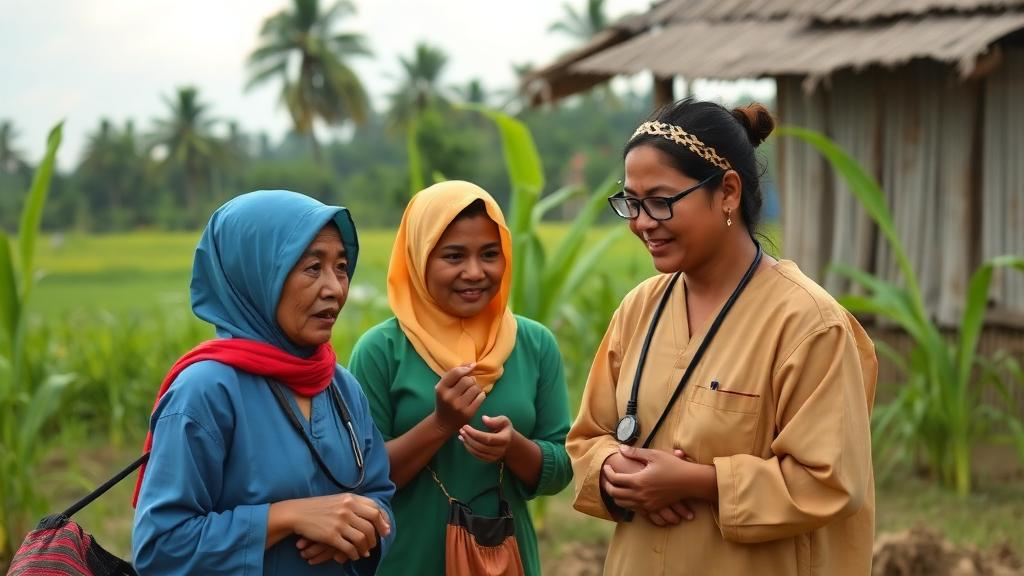
In the quiet villages of Pangandaran, on the southern coast of West Java, the success of a vaccination drive or a maternal health campaign often rests not on doctors or officials, but on a neighbor with a notebook. Community health workers, known locally as kader, are the connective tissue between Indonesia’s rural population and its formal health system. A new qualitative study published in BMC Public Health by researchers at Universitas Padjadjaran has now listened closely to these frontline communicators, deconstructing the barriers they face, the strategies they improvise, and the training they say they actually need. The findings challenge the standard top-down model of health communication training and argue for something far more grounded in village realities.
The research team, led by Kurniawan Kurniawan of the Department of Community and Mental Health Nursing, employed a descriptive qualitative design to capture the lived experiences of frontline health communicators. Data were collected through in-depth focus group discussions with 18 community health workers in Parakanmanggu Village, Pangandaran, Indonesia. Verbatim transcripts were then analyzed using thematic analysis, a method that systematically codes qualitative data to surface recurring patterns of meaning. The study received ethical approval from the Health Research Ethics Commission at Jenderal Achmad Yani University Cimahi and was conducted in accordance with the Declaration of Helsinki, with written informed consent obtained from all participants.
Thematic analysis revealed three interrelated themes that dictate communication effectiveness in rural settings. The first theme, communication barriers, encompasses knowledge deficits, experiential limitations, and interactional hurdles. Knowledge deficits refer to gaps in the health information itself, where workers may not fully understand the scientific content they are asked to convey. Experiential limitations capture the reality that many community health workers have never been taught how to translate clinical concepts into everyday language. Interactional hurdles describe the social friction of the encounter itself, including hesitation to challenge long-held beliefs, difficulty managing skeptical or older villagers, and the delicate dynamics of discussing sensitive topics within tight-knit communities.
The second theme, communication strategies, is perhaps the most striking. Rather than passively awaiting instruction, the workers independently developed practical exercises, message personalization, and feedback mechanisms to overcome the barriers they encountered. Message personalization means tailoring health advice to the specific circumstances of each household, framing information in terms of local routines, family structures, and economic realities. Practical exercises involve rehearsing conversations before home visits, testing different phrasings on colleagues, and refining delivery through repetition. Feedback mechanisms include checking comprehension by asking villagers to repeat key points in their own words, a technique that echoes established health communication models emphasizing two-way dialogue over one-way messaging.
The third theme, communicative needs and expectations, is driven by the workers’ desire for comprehensive informational support and continuous engagement rather than isolated training sessions. The participants made clear that a single workshop, however well-intentioned, does little to build durable communication capacity. What they want instead is an ongoing relationship with the health system: updated information as guidelines evolve, opportunities to discuss difficult cases with peers and supervisors, and iterative coaching that responds to the problems they meet in the field. This expectation reframes training as a continuous process embedded in daily practice, not an event on a calendar.
The technical implications of these themes are significant for public health systems in low- and middle-income countries. Community health workers are widely documented as promoters of behavior change, from immunization uptake to sanitation practices, yet the bottom-up perspectives of the workers themselves regarding the communication training they receive are rarely explored. By grounding training design in the actual barriers and strategies reported by workers, health programs can move beyond generic curricula and address the specific experiential and interactional obstacles that undermine message reception in rural contexts.
The study’s conclusions are direct. Being a proficient communicator, the authors argue, requires more than generic, top-down instruction. The findings underscore the critical need for culturally tailored, interactive communication curricula that address the specific experiential and interactional barriers faced by rural community health workers. By aligning training with the workers’ actual field strategies and expectations, health systems can significantly enhance public reception of health interventions. In practice, this means designing curricula that incorporate role-play, household-level case discussion, and feedback loops, rather than relying on lecture-based modules delivered by distant experts.
For Indonesia, where tens of thousands of village health volunteers form the backbone of primary care outreach, the study offers a template for reform. The researchers suggest that training programs should treat the workers’ improvised strategies as assets to be refined, not deficiencies to be corrected. Personalized messaging, rehearsal, and comprehension checks are already functioning in Parakanmanggu; the task of the health system is to formalize, support, and scale these practices through continuous engagement and comprehensive informational support.
The broader lesson reaches far beyond one village in West Java. Across rural Asia, Africa, and Latin America, community health workers occupy the same precarious position: trusted locally, undertrained formally, and expected to communicate complex health information under difficult conditions. This study demonstrates that the most valuable source of insight into communication effectiveness is the workers themselves. Listening to the rural frontline, the authors conclude, is not merely an academic exercise but a practical prerequisite for building health communication that actually works.
Subject of Research: Health Communication
Article Title: Voices from the rural frontline: deconstructing communication barriers, strategies, and training needs of indonesian community health workers
Article References: Kurniawan, K., Khoirunnisa, K., Masrina, D., Rahman, A., Parestorian, P. H., & Aliyah, I. N. (2026). Voices from the rural frontline: deconstructing communication barriers, strategies, and training needs of indonesian community health workers. BMC Public Health. https://doi.org/10.1186/s12889-026-29829-1
Image Credits: AI Generated
DOI: 10.1186/s12889-026-29829-1
Keywords: Voices, rural, frontline, deconstructing, communication, barriers, strategies, training, needs, indonesian, community, health
Cite Scienmag News
Ophelia Keating. (October 18, 2026). Rural Indonesian health workers reveal how they really talk communities into better health. Scienmag. https://scienmag.com/rural-indonesian-health-workers-reveal-how-they-really-talk-communities-into-better-health/
Ophelia Keating. "Rural Indonesian health workers reveal how they really talk communities into better health." Scienmag, 18 October 2026, https://scienmag.com/rural-indonesian-health-workers-reveal-how-they-really-talk-communities-into-better-health/. Accessed 18 October 2026.
Ophelia Keating. "Rural Indonesian health workers reveal how they really talk communities into better health." Scienmag. October 18, 2026. https://scienmag.com/rural-indonesian-health-workers-reveal-how-they-really-talk-communities-into-better-health/


