


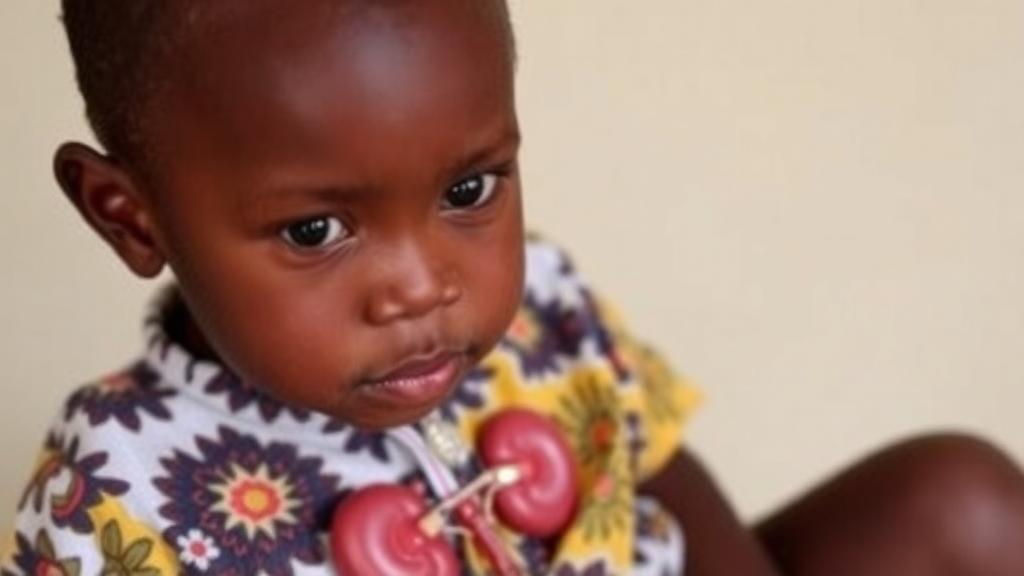
Congenital anomalies of the kidney and urinary tract, known collectively as CAKUT, are the most common cause of chronic kidney disease in children worldwide, and a new sixteen-year study from Senegal now offers one of the clearest pictures yet of how these birth defects unfold in a low-resource setting. The retrospective cohort study, published in BMC Pediatrics by a team of pediatric surgeons, nephrologists and urologists working across Dakar’s major referral hospitals, followed 194 children diagnosed with CAKUT between January 2008 and December 2023. Its central finding is stark: 19.1 percent of these children reached advanced chronic kidney disease, defined as stage 4 or 5 under the KDIGO classification, and 12.9 percent progressed all the way to end-stage kidney disease, the point at which the organs can no longer sustain life without dialysis or transplantation.
The numbers matter because CAKUT is not a single disease but an umbrella term covering a spectrum of malformations that arise during fetal development of the kidneys, ureters, bladder and urethra. In the Senegalese cohort, malformations of the kidney itself accounted for 59.3 percent of cases, while malformations of the urinary tract accounted for 38.7 percent. These structural defects can obstruct urine flow, allow urine to reflux backward toward the kidney, or leave the organs with too little functioning tissue to filter blood effectively. Over years, the resulting mechanical and inflammatory damage destroys nephrons, the microscopic filtering units of the kidney, and the surviving nephrons compensate by working harder, a process called hyperfiltration that paradoxically accelerates further loss of function.
Chronic kidney disease in children is staged according to estimated glomerular filtration rate, or eGFR, a measure of how well the kidneys clear waste from the blood. Stage 1 and 2 disease may be silent for years, detectable only through laboratory abnormalities or imaging. By stage 4, eGFR has fallen below 30 milliliters per minute per 1.73 square meters of body surface area, and stage 5, kidney failure, marks the threshold at which kidney replacement therapy becomes necessary. The Senegalese researchers classified their patients using the KDIGO guidelines, the international standard developed by the Kidney Disease: Improving Global Outcomes initiative, allowing their results to be compared directly with cohorts from high-income countries.
One of the most sobering findings concerns timing. Antenatal diagnosis, the detection of urinary tract malformations on prenatal ultrasound before birth, was documented in only 7.7 percent of patients. In well-resourced health systems, routine second-trimester ultrasound screening frequently identifies hydronephrosis, the swelling of the kidney caused by urine buildup, while the fetus is still in the womb. That early signal allows pediatric urologists to plan interventions, from prophylactic antibiotics to corrective surgery, in the first weeks of life, often before a single infection has occurred. In the Senegalese cohort, the overwhelming majority of children were identified only after birth, and in many cases presumably only after symptoms had already appeared, meaning the malformations had months or years to inflict cumulative damage on developing kidneys.
The study’s strongest statistical signal involved infection. Urinary tract infections occurred in 13.9 percent of the children, and after adjusting for other clinical variables using logistic regression, the presence of a urinary tract infection tripled the odds of progressing to advanced chronic kidney disease, with an adjusted odds ratio of 3.02 and a 95 percent confidence interval of 1.29 to 7.08. The biological explanation is well understood. In a urinary tract already distorted by malformation, bacteria can ascend and colonize the kidney, triggering pyelonephritis, an infection of the renal tissue itself. Each episode of pyelonephritis leaves scar tissue in its wake, and renal scarring permanently reduces filtering capacity. In children with obstructive or refluxing malformations, infection and structural damage form a vicious cycle in which each worsens the other.
Access to definitive treatment emerged as another critical theme. Among the 31 children in the cohort who had a surgical indication, meaning a malformation that could and should have been corrected operatively, only 16, or 51.6 percent, actually underwent operative management. The study does not detail the reasons for this gap, but the authors point to limited access to timely specialized management as a likely contributor to kidney deterioration. Corrective surgery for CAKUT, whether relieving an obstruction at the junction between kidney and ureter, reimplanting a refluxing ureter into the bladder, or repairing posterior urethral valves, is time-sensitive. Delay allows ongoing pressure injury and recurrent infection to erode renal function that surgery alone cannot restore.
The implications extend beyond Senegal. CAKUT accounts for roughly 40 to 50 percent of pediatric end-stage kidney disease in most registries worldwide, and the burden falls disproportionately on low- and middle-income countries, where diagnostic infrastructure, pediatric nephrology services and kidney replacement therapy are scarce. Dialysis for children is expensive, technically demanding and often unavailable outside capital cities, and pediatric transplantation rates in sub-Saharan Africa remain among the lowest in the world. A child who reaches end-stage kidney disease in a setting without sustainable access to kidney replacement therapy faces a grim prognosis, which makes preventing progression through early detection and infection control not merely desirable but potentially lifesaving.
The retrospective design of the study carries inherent limitations that the authors acknowledge. Because the analysis relied on medical records from a single tertiary referral center, it captures children who reached specialized care, potentially missing those who died or deteriorated before referral, which could mean the true burden of advanced disease is even higher. Missing data on antenatal screening, laboratory values and follow-up duration are common in retrospective cohorts drawn from resource-limited settings, and the logistic regression can adjust only for variables that were reliably recorded. Still, the sixteen-year span and the size of the cohort make this one of the most substantial datasets on pediatric CAKUT from the region, and the consistency of the infection signal with findings from other settings strengthens its credibility.
The authors’ conclusion is a call for structural change rather than a single clinical fix. They argue that strengthening early detection, through wider antenatal ultrasound coverage and postnatal screening of at-risk infants, combined with structured follow-up strategies, is essential to mitigate progression in resource-limited settings. In practical terms, that means training more sonographers to recognize fetal urinary tract dilatation, ensuring that newborns with identified malformations receive timely postnatal imaging and antibiotic prophylaxis where indicated, building referral pathways so that infants reach pediatric surgical services before infections accumulate, and establishing long-term surveillance of kidney function so that progression is caught at reversible stages. Each of these steps is far cheaper than a lifetime of dialysis, and each addresses a point in the disease trajectory where the Senegalese data show the system currently losing children.
For the global nephrology community, the study adds weight to a growing consensus that the pediatric chronic kidney disease burden in sub-Saharan Africa is driven less by biology than by systems. The same malformations that progress to kidney failure in Dakar are frequently corrected in infancy in Europe or North America, with most children retaining adequate kidney function into adulthood. The difference lies in when the anomaly is found, how quickly infections are treated, and whether corrective surgery is performed in time. The Senegalese cohort, with nearly one in five children reaching advanced disease and more than one in ten reaching kidney failure, quantifies precisely what is at stake when those steps are delayed, and it provides a baseline against which future improvements in screening, surgical access and follow-up can be measured.
Subject of Research: Progression to advanced chronic kidney disease among children with congenital anomalies of the kidney and urinary tract in Senegal
Article Title: Advanced chronic kidney disease in children with CAKUT: a retrospective cohort study in Senegal
Article References: Cissé, L., Lo, F. B., Mbaye, P. A., Guèye, D., Ndoye, M., Ndiaye, G., Ndongo, A., Keïta, Y., Ndoye, N. A., Ndour, O., Sylla, A., & Ngom, G. (2026). Advanced chronic kidney disease in children with CAKUT: a retrospective cohort study in Senegal. BMC Pediatrics. https://doi.org/10.1186/s12887-026-07458-2
Image Credits: AI Generated
DOI: 10.1186/s12887-026-07458-2
Keywords: CAKUT, chronic kidney disease, pediatric nephrology, Senegal, urinary tract infection, congenital anomalies, end-stage kidney disease, KDIGO, antenatal diagnosis, low-resource settings, retrospective cohort, pediatric surgery
Cite Scienmag News
Jerry Hayes. (October 18, 2026). In Senegal, Nearly One in Five Children With Kidney Birth Defects Progresses to Advanced Chronic Kidney Disease. Scienmag. https://scienmag.com/in-senegal-nearly-one-in-five-children-with-kidney-birth-defects-progresses-to-advanced-chronic-kidney-disease/
Jerry Hayes. "In Senegal, Nearly One in Five Children With Kidney Birth Defects Progresses to Advanced Chronic Kidney Disease." Scienmag, 18 October 2026, https://scienmag.com/in-senegal-nearly-one-in-five-children-with-kidney-birth-defects-progresses-to-advanced-chronic-kidney-disease/. Accessed 18 October 2026.
Jerry Hayes. "In Senegal, Nearly One in Five Children With Kidney Birth Defects Progresses to Advanced Chronic Kidney Disease." Scienmag. October 18, 2026. https://scienmag.com/in-senegal-nearly-one-in-five-children-with-kidney-birth-defects-progresses-to-advanced-chronic-kidney-disease/


