


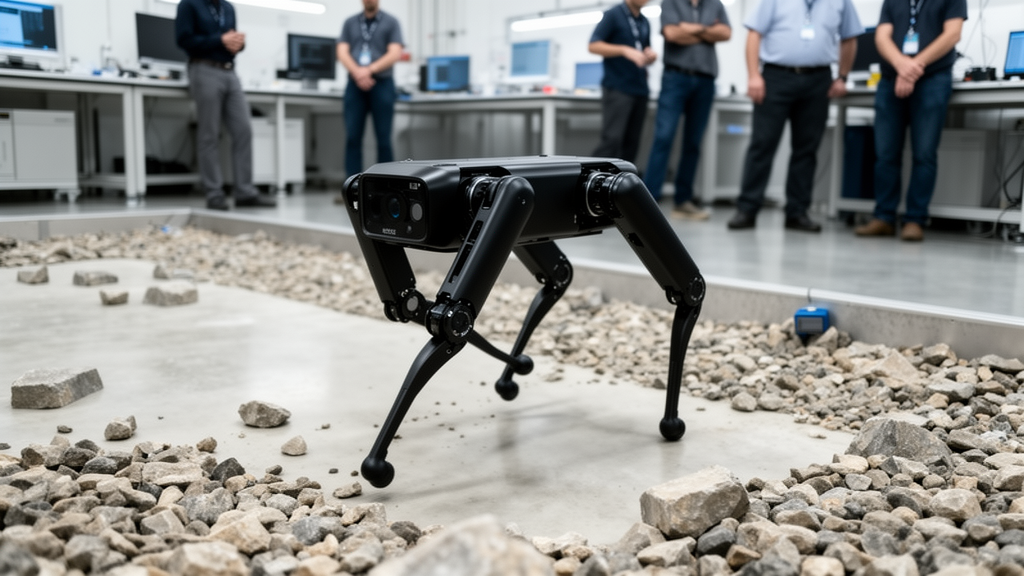
When a four-legged robot loses the use of a joint mid-stride, the consequences can be dramatic. A hip that locks at an awkward angle, a knee frozen in place, or a shoulder jammed against the body can turn a smooth, coordinated gait into a stumbling collapse. Now, researchers have developed a new meta-reinforcement learning framework that lets quadruped robots adapt on the fly to joint failures, maintaining balance, speed, and directional control even when multiple actuators seize up simultaneously. The approach, detailed in a study published in PLOS One, could make legged robots far more resilient in real-world environments where mechanical breakdowns are not just possible but inevitable.
The research team, led by Likai Wu and colleagues, focused on a particularly challenging class of faults: joints that become stuck at fixed angles. Unlike a joint that simply stops moving, a locked joint continues to resist motion, effectively becoming a rigid lever that disrupts the robot’s carefully coordinated locomotion. This type of failure reduces the available control authority, making it harder for the robot to track commanded velocities, maintain body stability, and coordinate its gait across multiple legs. The problem is compounded when several joints fail at once, or when the robot must navigate uneven terrain while compensating for the loss of mobility.
To tackle this challenge, the researchers developed a framework called Adjudicate Reconfiguration and Evolving Regularization Meta Reinforcement Learning, or ARER-MetaRL. The system combines three key components: task inference from context, modular routing tailored to each specific failure scenario, and an evolving gradient regularization mechanism that supports rapid adaptation. Rather than training a single policy that must handle every possible combination of locked joints, the framework learns to identify the nature of the fault from contextual cues and then routes control through specialized modules adapted to that particular situation.
The tasks the system must handle vary considerably. Faulty joints differ in their identities—which specific joint out of twelve actuated joints has locked—their locking angles, the number of simultaneous faults, the commanded motion direction, and the terrain the robot must traverse. This combinatorial explosion of scenarios makes single-task reinforcement learning approaches fundamentally inadequate, as a policy trained for one failure configuration may perform poorly when the fault pattern changes.
The researchers trained and evaluated their system in NVIDIA Isaac Sim, a high-fidelity physics simulation environment. During meta-training, the framework encountered scenarios with zero to three stuck joints simultaneously. For severity testing, they pushed the system further, evaluating performance with up to six joints locked at the same time—a condition that would render most conventional locomotion controllers useless.
The results are striking. ARER-MetaRL achieved higher Mean Episode Linear Velocity Tracking Reward (MELV) and Mean Episode Roll-Pitch Tracking Reward (MERP) scores than single-task reinforcement learning, ablated variants of the framework, and other evaluated learning and adaptation baselines. In the most severe single-joint failure scenario, the system achieved MELV and MERP values of 0.86 and 0.84 respectively, while the single-task baseline managed only 0.21 and 0.18. Even with six simultaneously stuck joints—a scenario that removes half of the robot’s actuated joints from active control—ARER-MetaRL maintained scores of 0.55 and 0.54, compared to a near-total collapse of the baseline at 0.05 and 0.03.
These numbers translate directly into physical capability. A robot using the new framework can continue walking in the commanded direction, maintain its body orientation, and avoid falling even when a significant portion of its actuation hardware has failed. The modular routing component appears to be critical: by directing control through task-specific pathways rather than forcing a single monolithic policy to handle all scenarios, the system can reconfigure its internal representation to match the current failure pattern without extensive retraining.
The evolving gradient regularization component addresses another persistent challenge in meta-learning: the tension between retaining knowledge from previous tasks and adapting quickly to new ones. By evolving the regularization strength during training, the framework can balance stability and plasticity, allowing rapid adaptation to novel fault configurations without catastrophically forgetting previously learned locomotion skills. Cumulative reward measurements across the experiments confirmed that combining all proposed components yields better performance than any subset, suggesting that each element contributes meaningfully to the overall robustness.
The implications extend well beyond the laboratory. Quadruped robots are increasingly deployed in industrial inspection, search and rescue, and exploration missions where mechanical failures are difficult to predict and even harder to repair on site. A robot that can compensate for a locked joint without human intervention could complete a mission that would otherwise require retrieval and repair. The framework’s ability to handle multiple simultaneous failures also provides a safety margin for extended operations in harsh environments where actuator wear and damage accumulate over time.
While the current work was conducted entirely in simulation, the results establish a foundation for future hardware validation. The severity tests, which pushed the system to its limits with six simultaneous joint failures, demonstrate that meta-reinforcement learning approaches can achieve a level of fault tolerance that conventional control strategies struggle to match. As legged robots move from controlled environments into the messy, unpredictable real world, frameworks like ARER-MetaRL may prove essential for ensuring that these machines can keep moving when their mechanical components inevitably begin to fail.
Subject of Research: Meta reinforcement learning for quadruped robot locomotion under joint failures
Article Title: Meta reinforcement learning for robust quadruped locomotion under joint failures
Article References: Wu, L., Chow, C.-O., Wong, W. R., Chuah, J. H., Kanesan, J., & Zhang, M. (2026). Meta reinforcement learning for robust quadruped locomotion under joint failures. PLOS One, 21(10), e0361099. https://doi.org/10.1371/journal.pone.0361099
Image Credits: AI Generated
DOI: 10.1371/journal.pone.0361099
Keywords: quadruped robots, meta reinforcement learning, joint failures, robot locomotion, fault tolerance, ARER-MetaRL, robotics, machine learning, adaptation, PLOS One, simulation, actuator faults
Cite Scienmag News
Denise Maddox. (October 18, 2026). Robots That Roll With the Punches: AI Teaches Four-Legged Machines to Keep Walking When Joints Seize Up. Scienmag. https://scienmag.com/robots-that-roll-with-the-punches-ai-teaches-four-legged-machines-to-keep-walking-when-joints-seize-up/
Denise Maddox. "Robots That Roll With the Punches: AI Teaches Four-Legged Machines to Keep Walking When Joints Seize Up." Scienmag, 18 October 2026, https://scienmag.com/robots-that-roll-with-the-punches-ai-teaches-four-legged-machines-to-keep-walking-when-joints-seize-up/. Accessed 18 October 2026.
Denise Maddox. "Robots That Roll With the Punches: AI Teaches Four-Legged Machines to Keep Walking When Joints Seize Up." Scienmag. October 18, 2026. https://scienmag.com/robots-that-roll-with-the-punches-ai-teaches-four-legged-machines-to-keep-walking-when-joints-seize-up/


