


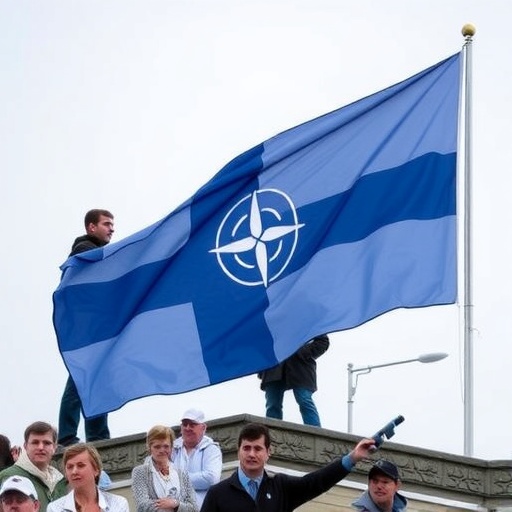
In an era marked by escalating geopolitical tensions and evolving security landscapes, public perceptions of national defence and international military alliances are undergoing profound transformations. The assumption that warfare and security policy purely reside within the domain of political elites and military strategists is increasingly untenable. The intricate interplay between global events and citizen attitudes reveals a dynamic framework through which public opinion not only reflects but also influences national security strategies. This evolving relationship forms the core of the recent research conducted by Albert Weckman, whose doctoral dissertation at Åbo Akademi University illuminates the nuanced contours of Finnish public opinion amid growing uncertainty.
Weckman’s study meticulously dissects the shifting terrain of attitudes toward key aspects of national security: support for NATO membership, readiness to engage in national defence, and approval of military aid to allied countries under duress. Rooted in extensive longitudinal survey data gathered from Finnish citizens, this research offers an invaluable lens into how ordinary people, often perceived as peripheral to policy formation, actively reinterpret their security outlook in response to tangible threats.
Traditional security research has predominantly centered on large Western military powers, particularly the United States, thus skewing our understanding of public opinion in smaller democracies with distinctive historical, political, and geographic contexts. By turning to Finland—a nation characterized by its policy of military non-alignment, reliance on conscription-based defence, and immediate proximity to a resurgent Russia—Weckman situates his analysis at a critical juncture between regional geopolitics and domestic political psychology, where public perception is both influenced by and influences security policymaking.
One of the dissertation’s most significant findings lies in the fluidity of Finnish public support for NATO. During periods of relative geopolitical calm, Finnish opinion on NATO affiliation has historically remained cautious and fragmented, reflecting longstanding ambivalence shaped by decades of military non-alignment. However, the advent of Russia’s large-scale invasion of Ukraine in 2022 fundamentally altered threat perceptions, triggering a rapid and marked increase in support for NATO membership. This pivot underlines the profound impact that an acute, proximate military threat can have on altering even deeply entrenched public attitudes.
Further exploration reveals that individual material stakes significantly correlate with willingness to defend the nation in a hypothetical foreign aggression scenario. Citizens possessing tangible assets—such as private residences or vacation homes—demonstrate a greater propensity to endorse national defence measures. This finding highlights that beyond abstract notions of patriotism or ideological alignment, personal risk assessment and tangible loss potential are potent drivers of defensive readiness, particularly when geopolitical volatility heightens the perceived immediacy of danger.
Moreover, Weckman’s research underscores the critical role of identity and transnational affinity in shaping attitudes towards collective defence obligations. Finnish citizens who express a strong emotional connection to the European project show higher levels of approval for providing military aid to NATO allies under attack. This dimension reveals that national security attitudes are not solely dictated by domestic considerations but are deeply interwoven with broader identity constructs and solidarity networks, reflecting a sophisticated matrix of loyalty, shared values, and geopolitical alignments.
Beyond mere polling data, the dissertation probes the complex mechanisms that mold public opinion. It becomes clear that defence attitudes emerge from an amalgamation of personal experience, perceived threat severity, socio-economic interests, and collective identity. These factors operate synergistically, enabling a public consensus that can either constrain or propel political actors in redefining national security paradigms.
This intricate public sentiment landscape carries profound implications for policymakers. In a world rife with political, economic, and military uncertainties, the sustainability and robustness of security policies hinge on their democratic legitimacy. As Weckman articulates, understanding the underlying drivers of public opinion is not a peripheral concern but an essential prerequisite for crafting defence policies that resonate with the populace and maintain long-term viability.
The Finnish case study additionally illustrates the significant influence of shared societal narratives and threat environments on national policy orientations. It challenges the often decontextualized paradigms of security opinion research dominated by U.S.-centric models by offering a distinct perspective rooted in regional realities and smaller state dynamics. This approach not only enriches academic discourse but also provides a practical blueprint for other nations navigating the complexities of public engagement in security policy.
In practical terms, Weckman’s findings advocate for a participatory approach to security policymaking—one that entails continuous dialogue between the citizenry and decision-makers. Such engagement acknowledges that defence is not merely a strategic calculation but a collective endeavour deeply embedded in the social fabric and emotional psyche of the nation.
Ultimately, the study presents a compelling narrative about how existential threats can crystallize public opinion, transform longstanding scepticism, and foster new solidarities. It reveals the potent agency of citizens as active architects of security frameworks rather than passive recipients of top-down policy decisions. This realization prompts a reevaluation of democratic security governance in the contemporary world, where public opinion is both a barometer and a catalyst for strategic adaptation.
Albert Weckman’s dissertation, titled Public Opinion in the Shadow of War: Attitudes on National Security in a Small Democratic State, was defended on 13 May 2026. It stands as a significant contribution to political science and security studies, providing a richly detailed empirical and theoretical foundation for understanding the complex dynamics of public attitudes in times of international crisis.
The research methodically employs surveys to chart opinion shifts over time, allowing for a robust quantitative analysis complemented by contextual interpretation. This methodological rigor enhances the reliability of its conclusions and serves as a valuable template for future inquiry into security-related public opinion across diverse contexts.
As global insecurity persists and defence paradigms adjust to emergent threats, Weckman’s insights offer a timely and critical perspective. Policymakers and scholars alike would do well to acknowledge the profound, multifaceted nature of public sentiment, appreciating its capacity both to reflect and reshape the security landscape in an ever-uncertain world.
News Publication Date: Not provided
Web References:
Albert Weckman – Åbo Akademi University
Public Opinion in the Shadow of War Dissertation
References: Albert Weckman, Public Opinion in the Shadow of War: Attitudes on National Security in a Small Democratic State, Åbo Akademi University, 2026
Cite Scienmag News
Courtney Benton. (May 26, 2026). Rising Threats Shift Perspectives: New Study Explores Finnish Attitudes Toward NATO, National Security, and Wartime Solidarity. Scienmag. https://scienmag.com/rising-threats-shift-perspectives-new-study-explores-finnish-attitudes-toward-nato-national-security-and-wartime-solidarity/
Courtney Benton. "Rising Threats Shift Perspectives: New Study Explores Finnish Attitudes Toward NATO, National Security, and Wartime Solidarity." Scienmag, 26 May 2026, https://scienmag.com/rising-threats-shift-perspectives-new-study-explores-finnish-attitudes-toward-nato-national-security-and-wartime-solidarity/. Accessed 5 September 2026.
Courtney Benton. "Rising Threats Shift Perspectives: New Study Explores Finnish Attitudes Toward NATO, National Security, and Wartime Solidarity." Scienmag. May 26, 2026. https://scienmag.com/rising-threats-shift-perspectives-new-study-explores-finnish-attitudes-toward-nato-national-security-and-wartime-solidarity/


