


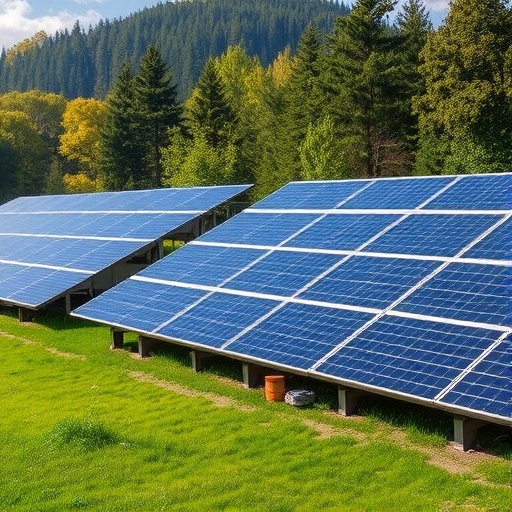
In the evolving landscape of renewable energy in the United States, recent research challenges the prevailing narrative that large-scale solar energy projects are frequently met with significant public opposition. Contrary to popular belief, the majority of solar facilities commissioned between January 2022 and November 2023 have experienced minimal conflict during their development phases. This groundbreaking study, led by researchers at the University of Massachusetts Amherst and published in the esteemed journal Energy Research & Social Science, offers a comprehensive analysis of 686 solar projects nationwide, shedding new light on the dynamics of community resistance to solar energy infrastructure.
The research project embarked on an ambitious path, employing a meticulous methodology to quantify and categorize degrees of public conflict associated with solar project developments. By parsing news reports, social media conversations, and public records for keywords related to disputes—such as “protest,” “lawsuit,” and “opposition”—the team established empirical metrics to gauge the prevalence of resistance. Remarkably, their findings reveal that a striking 56% of these solar projects fell into categories classified as “no” or “low” conflict, indicating that outright public dissent is considerably less widespread than previously portrayed.
One of the study’s pivotal contributions lies in its examination of how different regulatory frameworks influence conflict levels. Projects subject to state-level permitting processes were consistently associated with fewer instances of public contestation compared to those adjudicated under local or hybrid permitting regimes. This suggests that the centralized procedural approach at the state level might streamline approval paths and mitigate community pushback, potentially by fostering uniform standards and clearer communication channels. However, the researchers caution against interpreting this as an indictment of local permitting systems without finer-grained inquiry.
The size of the solar installations emerged as another salient factor correlating with conflict intensity. Larger projects tended to attract higher opposition, possibly due to their more visible environmental and social footprints, increased land use concerns, or the complexities involved in their integration with local ecosystems and infrastructure. Interestingly, the political composition of neighboring communities, specifically the proportion of Democratic voters, showed no statistically significant correlation with the levels of opposition, indicating that political affiliation may not be a reliable predictor of solar conflict as previously assumed.
Juniper Katz, assistant professor of public policy and lead author of the study, reflects on the impetus behind this research. Noting a pervasive media focus on controversies surrounding solar projects, Katz identified a glaring gap between public perception driven by news coverage and the empirical reality of conflict occurrence. This research aims to bridge that divide by providing an evidence-based framework for understanding conflict patterns at a national scale and offering a more nuanced narrative around renewable energy development.
This research assumes heightened importance in the context of rising electricity demand driven by the proliferation of energy-intensive technologies such as artificial intelligence platforms and large-scale data centers. As utilities and policymakers grapple with the challenge of scaling renewable capacity sustainably, insights into the sociopolitical dynamics of project siting are critical. Understanding the conditions under which public opposition flares or dissipates can inform strategies to streamline development, facilitate community engagement, and accelerate the clean energy transition.
The interdisciplinary research team includes UMass Amherst alumni Natalie Baillargeon and Alice Potapov, who contributed significantly to the data collection and analysis processes. Their work involved systematically cataloging conflict instances through media and social platforms to paint a comprehensive picture of the solar development landscape. This approach goes beyond anecdotal evidence and collections of isolated cases, enabling researchers to construct statistically robust conclusions about conflict prevalence and its drivers.
The findings of this solar-specific study diverge notably from prior academic work on wind energy projects, which often reported higher opposition levels in wealthier, predominantly white, or more politically liberal communities. The absence of similar patterns for solar developments underscores the heterogeneity within renewable energy sectors and cautions against homogenizing policies or assumptions about community attitudes toward green infrastructure. It reinforces the necessity of tailoring engagement and regulatory frameworks to the unique characteristics and concerns associated with each technology type.
While acknowledging the merits of state-level permitting systems in potentially reducing conflict, Katz emphasizes the need for further research to unpack how various regulatory structures impact not only conflict but also public participation quality, environmental outcomes, and long-term project viability. Such inquiry is vital to balancing efficiency with democratic inclusivity and fostering trust between developers, regulators, and local stakeholders.
This study was funded in part through the Elevating Equity Values in the Transition of the Energy System (ELEVATE) initiative at UMass Amherst, supported by the U.S. National Science Foundation’s Research Traineeship program. The project exemplifies how targeted funding for interdisciplinary energy transition research can address pressing societal challenges by integrating technical, political, and social science perspectives.
As the nation accelerates toward ambitious climate targets, the implications of this study resonate widely. The evidence that most solar energy projects proceed with minimal public conflict challenges stakeholders to reconsider where and why opposition arises and to develop engagement practices that anticipate and mitigate potential points of contention. Moreover, reinforcing the message that renewable energy siting conflicts are neither uniform nor inevitable helps reframe public discourse and policy design strategies essential to the American clean energy future.
In conclusion, this landmark study provides a vital corrective to the common narrative of solar opposition in the U.S. By harnessing comprehensive data and sophisticated conflict metrics, the research reveals that the path toward widespread solar energy adoption may be less obstructed by public dissent than popularly believed. As demands on the grid expand and renewable integration becomes imperative, these insights offer critical guidance for policymakers, developers, and communities striving to advance equitable and sustainable energy systems.
News Publication Date:
2026
Web References:
https://www.sciencedirect.com/science/article/pii/S2214629626002185
http://dx.doi.org/10.1016/j.erss.2026.104747
Cite Scienmag News
Courtney Benton. (May 26, 2026). America’s Solar Boom: Bright Future with Minimal Backlash. Scienmag. https://scienmag.com/americas-solar-boom-bright-future-with-minimal-backlash/
Courtney Benton. "America’s Solar Boom: Bright Future with Minimal Backlash." Scienmag, 26 May 2026, https://scienmag.com/americas-solar-boom-bright-future-with-minimal-backlash/. Accessed 4 September 2026.
Courtney Benton. "America’s Solar Boom: Bright Future with Minimal Backlash." Scienmag. May 26, 2026. https://scienmag.com/americas-solar-boom-bright-future-with-minimal-backlash/


