


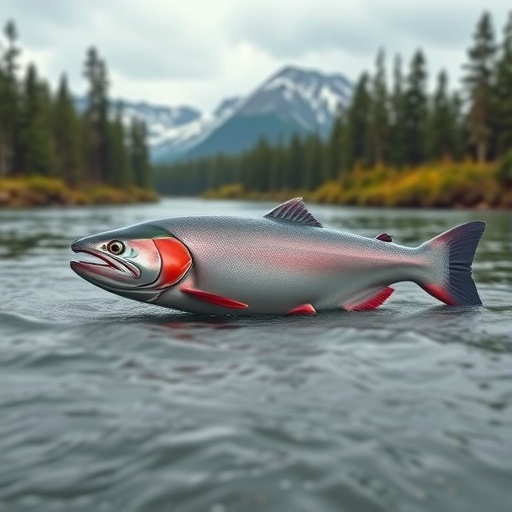
For thousands of years, Indigenous communities across Alaska and Canada’s Yukon territory have depended heavily on the Chinook salmon, a species integral not only to their diets but also to their cultural identity, languages, and traditional lifestyles. The Chinook, known for its large size and high-fat content, serves as a vital nutritional resource amid the harsh Arctic environment. Yet, over the past few decades, these communities have faced an alarming decline in Chinook salmon populations, threatening both food security and cultural continuity. This emerging crisis poses complex challenges that intertwine environmental dynamics with the deep-rooted heritage of northern Indigenous peoples.
Recent research, led by the University of Colorado Boulder and published in Scientific Reports, delves into the heart of these challenges, investigating how accelerating climate change in the Arctic affects river ecosystems, specifically those supporting Chinook salmon. The study highlights significant warming trends throughout the region’s waterways, which increasingly push the delicate balance of aquatic habitats beyond the thresholds that salmon can endure. This phenomenon is anticipated to exacerbate the already precipitous decline in Chinook numbers, potentially reshaping subsistence fishing practices and Indigenous lifeways in the coming decades.
Arctic regions have warmed nearly four times faster than the global average over the last half-century. This rapid climatic shift has led to profound environmental transformations, such as melting sea ice, permafrost thaw, and accelerating coastal erosion. These changes are actively modifying landscapes and waterways that Indigenous peoples have harmonized with for generations. The alteration of river temperatures, in particular, poses a direct threat to cold-water fish species like the Chinook salmon, which depend on specific thermal regimes for optimal growth and survival.
Historically, the Yukon River—Alaska’s largest and most significant salmon-bearing river—has seen Chinook populations decline dramatically, with an estimated 57% reduction between 2003 and 2010 alone. This downward trend has raised alarm across Indigenous communities and fisheries managers alike, prompting unprecedented management actions such as a seven-year suspension of Chinook fishing for subsistence and commercial purposes. While these measures aim to facilitate recovery, emerging data suggest that climate-induced habitat changes may limit the effectiveness of conservation efforts.
In seeking to understand the future trajectory of river ecosystems and salmon populations, the research team collaborated closely with Indigenous communities across seven major river basins spanning Alaska and Yukon. This collaborative approach integrated Indigenous knowledge and lived experiences with state-of-the-art climate and ecological modeling. By focusing on two culturally and nutritionally critical fish species—Chinook salmon and Dolly Varden trout—the study provides a nuanced forecast of shifting biological responses to warming waterways.
Model simulations indicate that by mid-century, summer river temperatures in these Arctic basins are projected to rise by approximately 1.26 degrees Celsius (2.27 degrees Fahrenheit) compared to averages recorded from 1990 to 2021. Importantly, this warming is not uniform but varies across basins and years, with the warmest predicted periods potentially exceeding the thermal tolerance limits of juvenile Chinook salmon. Such thermal stress impairs metabolism and growth rates, reducing survival chances and ultimately leading to population declines.
Conversely, Dolly Varden trout, which inhabit overlapping river habitats, may benefit from these rising temperatures. The species’ thermal preferences are higher than those of Chinook salmon, and models predict that Dolly Varden growth rates could nearly double in several rivers under future climate scenarios. This divergence in species responses suggests potential shifts in fish community composition, with implications for Indigenous subsistence and fishing traditions.
However, the social and cultural ramifications of this biological shift are complex. While Dolly Varden may become more abundant and easier to harvest during warmer summers, they are not culturally substitutable for Chinook salmon in all communities. Variations in local preferences, fishing techniques, and dietary customs mean that a mere increase in Dolly Varden populations cannot fully compensate for Chinook losses. The study underscores the importance of engaging Indigenous stakeholders continuously to navigate these adaptive challenges collaboratively.
From a broader scientific perspective, this research exemplifies the critical role of linking traditional ecological knowledge with quantitative modeling to address the multifaceted impacts of climate change on Arctic ecosystems. It also highlights the urgency of proactive resource management that can accommodate dynamic environmental conditions while respecting cultural priorities. The collaborative framework presented may serve as a model for future climate adaptation efforts across Indigenous and ecological contexts.
Moreover, these findings resonate beyond Alaska and Yukon, signaling widespread concerns for cold-water fish species globally as climate warming reshapes freshwater habitats. Riverine ecosystems, often overlooked in climate studies focused on oceans and terrestrial systems, demand urgent attention given their integral role in food webs, human livelihoods, and biodiversity conservation. The compounded stressors of warming, habitat alteration, and human exploitation present formidable challenges necessitating integrated research and adaptive governance.
In closing, the study reveals a sobering yet actionable narrative: while Chinook salmon face mounting threats from a warming Arctic, informed and inclusive approaches can help communities anticipate risks and identify alternative strategies for maintaining nutritional and cultural resilience. Moving forward, continuous monitoring, community engagement, and flexible management will be vital in navigating an uncertain future for Alaska’s rivers and the Indigenous peoples who call them home.
News Publication Date: August 6, 2025.
Web References:
- Nature article on Arctic warming rates
- DOI link to scientific study: 10.1038/s41598-025-14711-8
References:
- Thomas, P., et al. (2025). Impact of river temperature rise on Arctic salmonids: Implications for Indigenous fisheries. Scientific Reports. DOI: 10.1038/s41598-025-14711-8.
Cite Scienmag News
Russell Cooper. (September 10, 2025). Rising River Temperatures in Alaska Jeopardize Chinook Salmon and Indigenous Food Security. Scienmag. https://scienmag.com/rising-river-temperatures-in-alaska-jeopardize-chinook-salmon-and-indigenous-food-security/
Russell Cooper. "Rising River Temperatures in Alaska Jeopardize Chinook Salmon and Indigenous Food Security." Scienmag, 10 September 2025, https://scienmag.com/rising-river-temperatures-in-alaska-jeopardize-chinook-salmon-and-indigenous-food-security/. Accessed 4 September 2026.
Russell Cooper. "Rising River Temperatures in Alaska Jeopardize Chinook Salmon and Indigenous Food Security." Scienmag. September 10, 2025. https://scienmag.com/rising-river-temperatures-in-alaska-jeopardize-chinook-salmon-and-indigenous-food-security/


