


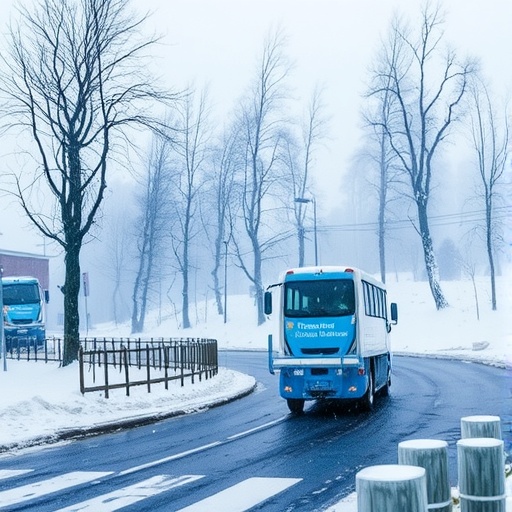
New research from Newcastle University has uncovered that winters across the United Kingdom are becoming significantly wetter, a trend directly linked to the rising concentrations of greenhouse gases emitted by human activities, particularly the burning of fossil fuels. This warming effect intensifies atmospheric moisture, leading to increased winter precipitation and raising the imminent risk of flooding across the region.
The comprehensive study analyzed over a century of winter rainfall data in the UK, spanning from 1901 to 2023. The investigation focused on discerning whether changes in the UK’s winter precipitation patterns were primarily driven by shifts in atmospheric circulation—known technically as dynamical changes—or by a thermodynamic process caused by a warmer atmosphere holding more moisture. The findings decisively pointed toward the latter: an anthropogenically warmed atmosphere is responsible for the increased rainfall.
Remarkably, the research demonstrates that for every single degree rise in either global or regional temperature, the volume of winter rainfall increases by approximately 7%. This percentage represents a compounding escalation, highlighting not only a persistent but also an accelerating intensification of rainfall associated with warming. What is striking, however, is that current state-of-the-art global climate models substantially underestimate this effect, generally projecting only around a 4% increase in winter precipitation for each degree of warming. This discrepancy suggests that existing models may be overly conservative in predicting future hydrological changes and flood risks.
The lead author, Dr. James Carruthers from Newcastle University’s School of Engineering, emphasized the urgency of these findings by stating that the pace of wetting observed in UK winters is already about two decades ahead of what climate models forecast for the 2040s. This means the UK is currently experiencing climatic shifts that were only expected in the mid-21st century, underscoring how rapidly the climate system is responding to anthropogenic forcing.
Detailed analysis of UK Met Office temperature records reveals a warming trend of roughly 0.25°C per decade since the 1980s, corresponding to nearly a 9% increase in winter rainfall compared to that period. Such changes have profound implications for water management, infrastructure resilience, and flood preparedness across the UK. Indeed, the winter half-year from October 2023 to March 2024 registered as the wettest on record, intensifying concerns over flood events and saturation levels in the soil.
Professor Hayley Fowler, an expert in Climate Change Impacts at Newcastle University and co-author of the study, contextualized the volume of additional water falling during UK winters under anthropogenic warming. She illustrated that this extra winter rainfall is sufficient to fill approximately 3 million Olympic-sized swimming pools. With the enhanced saturation of soils and the increased burden on flood defenses, the UK is more vulnerable than ever to severe flooding incidents.
This trend has dire consequences not just for immediate flooding hazards but also for long-term socio-economic impacts. The study highlights the widening gap between intensifying flood risks and the level of adaptation investments and planning currently underway. Without a significant overhaul of flood management strategies and increased funding, communities across the UK are likely to experience escalating economic damages as well as heightened risks to life from severe flooding episodes.
The research also situates the UK findings within a broader European context, building upon prior studies that identified Northern and Central Europe as regions witnessing significant increases in winter precipitation and flood risk. In stark contrast, Southern Europe and particularly Mediterranean countries are experiencing drying winters, exacerbating drought conditions and water scarcity issues. Notably, global climate models fail to fully capture the rapidity and spatial variability of these changes in winter rainfall patterns across Europe.
From a methodological perspective, the study employed computational simulations and modeling techniques, combining long-term observational datasets with climate model outputs to isolate the thermodynamic influence of a warmer atmosphere on precipitation trends. This rigorous approach allowed the researchers to unpack the relative contributions of atmospheric dynamics versus moisture availability, with clear evidence pointing to the dominance of thermodynamic scaling.
Importantly, this research underscores the critical need to address the root cause of these hydrological changes by drastically reducing greenhouse gas emissions through the cessation of fossil fuel combustion. The message from Newcastle University’s experts is unequivocal: only by mitigating global warming can the alarming trend of increasing winter rainfall—and the consequent flooding risk it poses—be arrested.
In summary, this pioneering study not only advances our understanding of climate change impacts on hydroclimate extremes in the UK but also challenges the reliability of existing climate models in predicting precipitation responses to warming. Its findings serve as a stark warning for policymakers and planners to urgently accelerate climate adaptation measures while intensifying efforts to confront climate change at its source.
News Publication Date: 4 February 2026
Web References:
DOI: 10.1029/2025GL118201
References:
Carruthers, J. G., Fowler, H. J., Bannister, D., & Guerreiro, S. B. (2026). Climate models tend to underestimate scaling of UK mean winter precipitation with temperature. Geophysical Research Letters, 53, e2025GL118201.
Cite Scienmag News
Russell Cooper. (February 11, 2026). Rising Greenhouse Gas Levels Drive Increased Winter Rainfall in the UK. Scienmag. https://scienmag.com/rising-greenhouse-gas-levels-drive-increased-winter-rainfall-in-the-uk/
Russell Cooper. "Rising Greenhouse Gas Levels Drive Increased Winter Rainfall in the UK." Scienmag, 11 February 2026, https://scienmag.com/rising-greenhouse-gas-levels-drive-increased-winter-rainfall-in-the-uk/. Accessed 3 September 2026.
Russell Cooper. "Rising Greenhouse Gas Levels Drive Increased Winter Rainfall in the UK." Scienmag. February 11, 2026. https://scienmag.com/rising-greenhouse-gas-levels-drive-increased-winter-rainfall-in-the-uk/


