


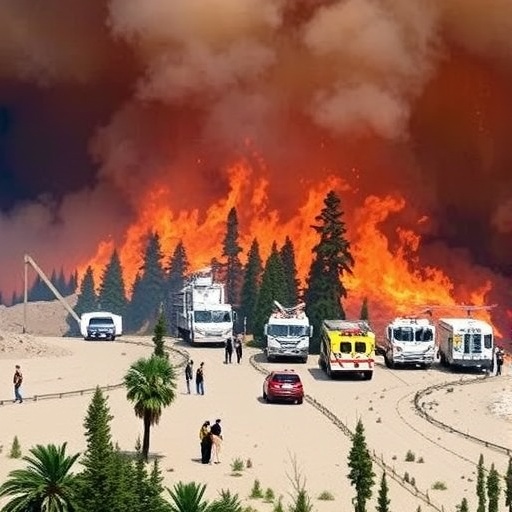
A groundbreaking study published in the Journal of Climate reveals alarming projections regarding the escalation of wildfire risk across the globe due to climate change. Employing an advanced computational simulation approach based on weighted CMIP6 multimodel ensembles, the research indicates that by the year 2100, up to 91% of fire-prone regions worldwide may face significantly intensified wildfire conditions. This unprecedented expansion of wildfire danger is set to reshape ecosystems, threaten biodiversity, and imperil human livelihoods on a scale previously unanticipated by conventional fire risk models.
The methodological innovation in this study lies in its utilization of weighted ensembles from multiple climate models within the CMIP6 framework, reducing uncertainties inherent in earlier projections. This approach combines various climate simulations to more accurately forecast future fire weather patterns, accounting for variability in emissions scenarios and regional climatic responses. Such refined modeling provides insights with greater spatial and temporal resolution, enabling targeted fire prevention strategies and enhancing the capacity for adaptive land management.
Remarkably, the study underscores that heightened fire danger will not be confined to historically fire-prone landscapes. Regions traditionally considered low risk—including parts of northern Asia, northeastern South America, and certain temperate zones in North America—are projected to experience substantial increases in fire susceptibility. These findings portend a paradigm shift in understanding wildfire threat dynamics, necessitating comprehensive reassessment of global fire management policies.
Southern Africa and the Mediterranean basin emerge as hotspots for future fire intensification, with the model ensembles indicating profound increases in fire weather severity. These regions, characterized by their unique climatology and vegetation types, are projected to face conditions analogous to extreme fire events that were virtually absent during the recent historical period. Given their ecological sensitivity and high population densities in adjacent areas, such changes pose critical challenges for both conservation and public safety.
On the other hand, northern Eurasia shows a comparable rise in fire danger owing to warming temperatures and altered precipitation regimes. The feedback mechanisms between climate warming, vegetation dryness, and fire ignition likelihood create a compounding effect, amplifying wildfire risk beyond what previous single-model studies have suggested. This signals an urgent need to integrate advanced fire risk projections into climate adaptation frameworks for boreal and temperate forest management.
The study’s projections under the most extreme emissions scenario (commonly referred to as SSP5-8.5) illustrate a near-total transformation of fire weather conditions expected in major forested regions across continents. Large zones in North and South America, Eurasia, and southern Africa could experience fire weather indices indicative of events with return periods exceeding 100 years in the recent past—translated into practical terms, wildfire-conducive conditions might become near annual occurrences.
Such dramatic changes carry profound implications not only for natural ecosystems but also for human societies. Increased fire frequency and intensity threaten critical ecosystem services such as carbon sequestration, water regulation, and soil protection. Furthermore, smoke pollution associated with wildfires exacerbates respiratory health risks globally, imposing further socio-economic burdens on vulnerable communities and straining public health infrastructure.
Researchers emphasize that many current fire management systems are ill-prepared for the projected scale of disruption. The evolving nature of wildfire risk demands a rethinking of early warning systems, firefighting resource allocation, and community resilience measures. Integrating the study’s insights into policy will be vital to mitigate fire impacts and safeguard forest-dependent livelihoods as climate change accelerates.
Moreover, this research highlights the essential role of climate science in informing sustainable land management and urban planning. By elucidating spatial patterns of emerging fire danger hotspots, it enables policymakers to prioritize adaptation investments effectively. Proactive actions, such as strategic fuel management, restoration of fire-resilient landscapes, and public education, are critical components of a comprehensive response strategy.
The interdisciplinary collaboration underpinning this research, involving institutions like the Euro-Mediterranean Center on Climate Change and Coventry University, showcases the power and necessity of combining expertise in climate modeling, fire ecology, and social sciences. This holistic perspective is indispensable for addressing the multifaceted challenges posed by the global expansion of wildfire hazard.
In conclusion, the study serves as a stark reminder that climate change-driven fire risks are no longer confined to isolated regions or future horizons. They represent an immediate and intensifying global threat with far-reaching consequences. The scientific community’s enhanced ability to project these changes marks a pivotal development, empowering decision-makers to enact informed, anticipatory policies aimed at reducing wildfire hazards and fostering resilience.
News Publication Date: 15-Oct-2025
Web References:
– Journal of Climate, DOI: 10.1175/JCLI-D-24-0540.1 (http://dx.doi.org/10.1175/JCLI-D-24-0540.1)
– Euro-Mediterranean Center on Climate Change (http://www.cmcc.it)
Cite Scienmag News
Sloane Callahan. (November 11, 2025). Rising Climate Change Threatens to Unleash Unprecedented Wildfire Risks Globally: New Study Highlights Urgent Future Challenges. Scienmag. https://scienmag.com/rising-climate-change-threatens-to-unleash-unprecedented-wildfire-risks-globally-new-study-highlights-urgent-future-challenges/
Sloane Callahan. "Rising Climate Change Threatens to Unleash Unprecedented Wildfire Risks Globally: New Study Highlights Urgent Future Challenges." Scienmag, 11 November 2025, https://scienmag.com/rising-climate-change-threatens-to-unleash-unprecedented-wildfire-risks-globally-new-study-highlights-urgent-future-challenges/. Accessed 4 September 2026.
Sloane Callahan. "Rising Climate Change Threatens to Unleash Unprecedented Wildfire Risks Globally: New Study Highlights Urgent Future Challenges." Scienmag. November 11, 2025. https://scienmag.com/rising-climate-change-threatens-to-unleash-unprecedented-wildfire-risks-globally-new-study-highlights-urgent-future-challenges/


