


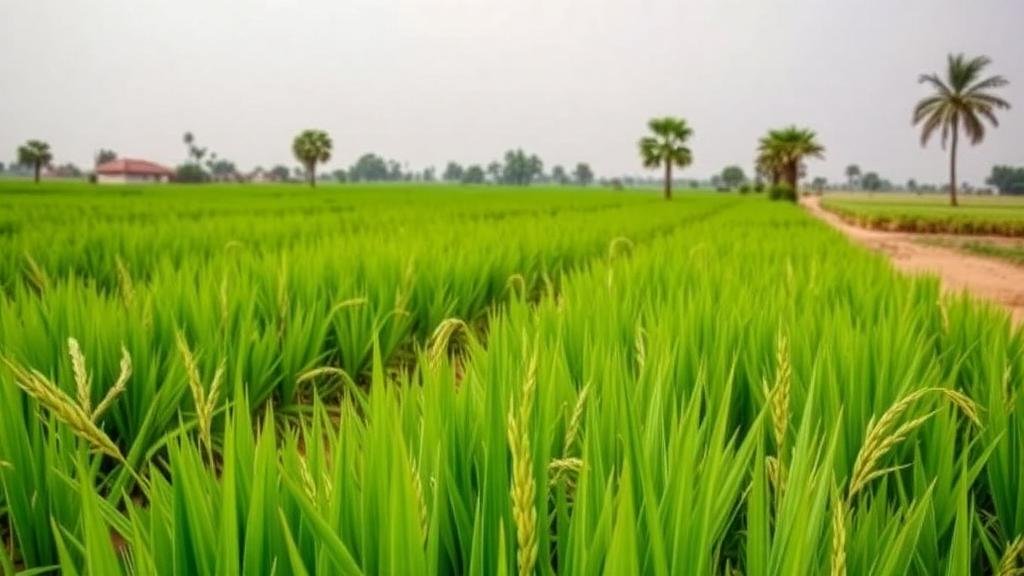
In the irrigated rice fields of Kadawa, in Nigeria’s Kano State, the weather has become an unpredictable business partner. A new three-decade analysis published in Theoretical and Applied Climatology shows that the climatic variables governing one of northern Nigeria’s most important rice-producing zones are swinging wildly from year to year, and that these swings leave measurable fingerprints on harvests. The study, led by Olushola Razak Babatunde of the Federal University of Technology Owerri together with Afeez Alabi Salami of the University of South Africa, assembled annual climate data and rice yield records spanning 1993 to 2022, offering one of the longest continuous windows into how climatic variability plays out on the ground in the West African Sahel’s agricultural heartland.
The data reveal a climate that refuses to sit still. Relative humidity in the study area fluctuated between a low of 42.46 percent in 2006 and a high of 65.09 percent in 2022, a range wide enough to alter evaporation rates, disease pressure, and the water balance of paddy fields. Maximum temperatures ranged from 36.88 degrees Celsius in 2022 to a scorching 42.27 degrees Celsius in 2010, while minimum temperatures displayed an even more dramatic spread, dipping to 5.48 degrees Celsius in 2015 and climbing to 11.96 degrees Celsius in 2017. Such nocturnal temperature swings matter enormously for rice, because cool nights slow crop development while warm nights accelerate respiration and erode the biomass a plant has spent the day building.
Rainfall, the single most consequential variable for rainfed and irrigated agriculture alike, proved the most volatile of all. Annual totals climbed from 454.9 millimeters in 2018 to an extraordinary 3,101.6 millimeters in 2021, before collapsing back to 1,505.9 millimeters in 2022. To put those numbers in perspective, the 2021 figure was nearly seven times the 2018 total, a swing that no farming calendar can comfortably absorb. The authors found that such excessive annual rainfall induced flooding, particularly during critical growth stages of the rice crop, and that these flood events translated directly into reduced yields. For a region where rice is both a staple and a commercial crop, the implications are sobering.
Methodologically, the study leaned on a battery of statistical tools designed to extract reliable signals from noisy environmental data. Descriptive statistics such as means and percentages established the baseline climatology, while Spearman’s rank correlation, tested for significance with Student’s t-test, quantified the strength and direction of associations between each climatic variable and rice yield. To detect whether the underlying climate variables were trending over time rather than merely fluctuating, the researchers applied the Mann-Kendall non-parametric trend test, a workhorse of hydro-climatological research that is robust to outliers and does not assume normally distributed data. Sen’s Slope estimator complemented the Mann-Kendall test by providing a robust measure of the magnitude of any trend, expressed as the rate of change per year.
The correlation results upended some intuitive expectations. Maximum temperature showed a positive correlation with rice yield, with a Spearman coefficient of 0.311, and minimum temperature was similarly positive at 0.301. Rainfall, by contrast, was negatively correlated with yield at -0.455, and relative humidity was also negative at -0.255. In other words, in this irrigated setting, hotter years were associated with better harvests while wetter, more humid years were associated with worse ones. The most plausible explanation lies in the fact that Kadawa’s rice is grown under the Kano River Irrigation Project, where water supply does not depend primarily on rainfall. In such systems, abundant sunshine and warmth can boost photosynthesis and crop growth, whereas torrential rainfall overwhelms drainage infrastructure and floods fields at sensitive stages such as flowering and grain filling.
This finding carries a broader lesson for climate impact research: the direction of climate-yield relationships is not universal but depends on the farming system in question. In rainfed rice systems across West Africa, rainfall and yield typically move together, and drought is the dominant threat. Kadawa’s irrigated regime inverts that logic. The negative rainfall-yield correlation of -0.455 is the strongest association in the dataset, suggesting that water excess, not water scarcity, is the principal climatic hazard facing farmers there. It is a reminder that adaptation strategies must be tailored to local hydrological realities rather than copied wholesale from other regions, and that irrigation schemes themselves can create new vulnerabilities when drainage lags behind water delivery.
The marked temporal instability documented in the study echoes a wider body of evidence on climate and agriculture. Global analyses have estimated that climate variation explains roughly a third of worldwide crop yield variability, and West Africa has repeatedly been flagged as a hotspot where rainfall variability and hydroclimatic extremes intersect with food insecurity. Within Nigeria specifically, recent studies have documented warming trends in major cities using the same non-parametric methods employed at Kadawa, and modeling work with the APSIM crop simulation platform has projected climate change effects on rice production across the wider Kano River Irrigation Scheme. The Kadawa study grounds these larger-scale findings in a concrete, thirty-year local record, showing that the variability long predicted for the Sahel is already inscribed in the region’s yield statistics.
The physiological mechanisms linking the observed climate extremes to rice performance are well understood from plant science. Rice is particularly sensitive to temperature during its reproductive phase: daytime temperatures above roughly 35 degrees Celsius can cause spikelet sterility by disrupting anther dehiscence and pollen viability, while high night temperatures increase respiration losses and shorten the grain-filling period. Cold minima, such as the 5.48 degrees Celsius recorded in 2015, can delay seedling establishment and slow early vegetative growth. Flooding, meanwhile, deprives roots and soil of oxygen, promotes toxic reduced compounds, and can fully submerge plants, with complete submergence for more than a few days often proving fatal to intolerant varieties. Humidity shapes the microclimate of the canopy and influences the incidence of fungal diseases such as sheath blight, which thrives under warm, moist conditions.
Against this backdrop, the authors argue that rice cultivation in Kadawa is growing steadily more vulnerable to climatic variability, and they outline a portfolio of adaptive responses. Chief among these are climate-resilient rice varieties, including submergence-tolerant cultivars. Breeding programs have made notable progress here: the SUB1A quantitative trait locus, originally identified in the Indian landrace FR13A, confers tolerance of complete submergence and has been introgressed into popular varieties across South and Southeast Asia, with ongoing research extending these gains and elucidating the underlying metabolic and physiological mechanisms. Deploying such genetics in West African irrigation schemes could buffer harvests against the flood years that the Kadawa record shows are increasingly disruptive.
Equally important, the study emphasizes, are engineering and water-management measures. Improved drainage infrastructure would allow excess rainfall to be evacuated from fields before it reaches damaging depths, directly addressing the negative rainfall-yield relationship at the heart of the findings. Enhanced water-management practices, from regulated irrigation scheduling to field-level water control, would help farmers exploit Kadawa’s warmth and sunshine while shielding the crop from moisture extremes. The authors frame these interventions within the broader agenda of climate-smart agriculture, which seeks to sustain high and stable yields under changing climatic conditions rather than simply maximizing output in good years. As the 2021 to 2022 rainfall collapse demonstrates, the cost of inaction is not hypothetical: a farming system calibrated to one year’s climate can be blindsided the next. With Nigeria among West Africa’s largest rice producers and demand for the grain still rising, the thirty-year Kadawa record offers both a warning and a practical roadmap for keeping harvests stable on a warming, whipsawing climate frontier.
Subject of Research: Long-term climate variability and its effects on rice yield in Kadawa, Kano State, Nigeria
Article Title: Assessing long‑term climate variability and its effects on rice yield in the Kadawa Area, Kano State, Nigeria
Article References: Babatunde, O. R., & Salami, A. A. (2026). Assessing long‑term climate variability and its effects on rice yield in the Kadawa Area, Kano State, Nigeria. Theoretical and Applied Climatology, 157(10), Article 643. https://doi.org/10.1007/s00704-026-06578-0
Image Credits: AI Generated
DOI: 10.1007/s00704-026-06578-0
Keywords: climate variability, rice yield, Nigeria, Kano State, Kadawa, rainfall, temperature, flooding, irrigation, Mann-Kendall trend test, climate-smart agriculture, submergence tolerance
Cite Scienmag News
Alan Morgan. (October 5, 2026). Rice Yields in Northern Nigeria Ride a Climate Rollercoaster, 30-Year Study Finds. Scienmag. https://scienmag.com/rice-yields-in-northern-nigeria-ride-a-climate-rollercoaster-30-year-study-finds/
Alan Morgan. "Rice Yields in Northern Nigeria Ride a Climate Rollercoaster, 30-Year Study Finds." Scienmag, 5 October 2026, https://scienmag.com/rice-yields-in-northern-nigeria-ride-a-climate-rollercoaster-30-year-study-finds/. Accessed 17 October 2026.
Alan Morgan. "Rice Yields in Northern Nigeria Ride a Climate Rollercoaster, 30-Year Study Finds." Scienmag. October 5, 2026. https://scienmag.com/rice-yields-in-northern-nigeria-ride-a-climate-rollercoaster-30-year-study-finds/


