


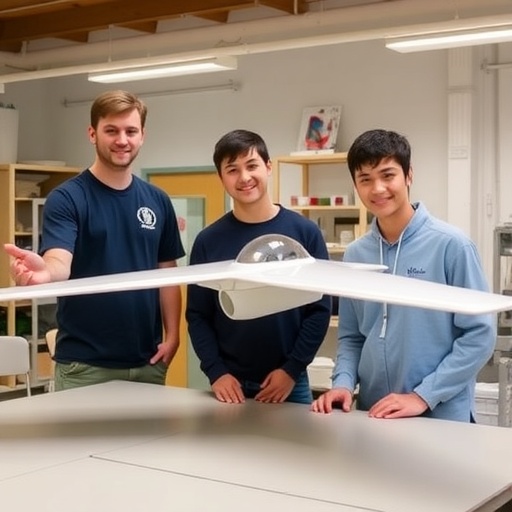
In a remarkable convergence of education and cutting-edge research, an enterprising group of students at Rice University has transformed a single-semester project into a peer-reviewed scientific breakthrough that promises to redefine the future of composite materials in aerospace engineering. Their pioneering work introduces an innovative architectural strategy to carbon fiber-reinforced polymer (CFRP) composites, significantly enhancing both their mechanical performance and resilience against catastrophic failure—a challenge that has long hindered the widespread utility of these materials in critical aerospace applications.
CFRP composites are renowned for exceptional strength-to-weight ratios, making them indispensable in aerospace structures, including the high-pressure vessels integral to propulsion systems. However, their inherent brittleness and proneness to sudden fracture have posed a persistent threat to safety and reliability. Instead of turning toward complex chemical modifications, the Rice team embarked on reimagining the microstructural design of these composites. Their inspiration came from the natural toughness of nacre, or mother-of-pearl, known for its layered architecture that imparts outstanding durability despite the fragility of its constituent materials.
The students conceived and implemented architected thermoplastic lattice interlayers—precisely engineered, compliant frameworks embedded strategically within the otherwise stiff carbon fiber matrix. This approach diverges dramatically from traditional methods that often incorporate uniform soft layers, which tend to undermine structural integrity. Instead, the discrete lattice designs preserve critical load paths and redefine the damage propagation mechanisms, enabling energy dissipation to be more distributed and gradual, thereby preventing abrupt catastrophic failure.
Through rigorous experimental characterization, including digital image correlation techniques and simulated stress analyses, the research demonstrated that these architected interlayers contribute not only to maintaining intrinsic stiffness and strength but also to an impressive fourfold increase in energy absorption. The meticulous digital tracking of crack initiation and growth patterns revealed that fractures in composites with these innovative lattices develop more slowly and over a broader area compared to conventional materials, a fundamental shift that enhances damage tolerance crucial for aerospace safety.
What sets this project apart is the full scope of student involvement and rapid execution. Under the instruction of Assistant Teaching Professor Denizhan Yavas in the fall 2025 MECH 471/571 course—Composite Materials for Aerospace Structures—undergraduate and master’s students conceived, designed, fabricated, tested, and analyzed the novel composites. The experience provided a rare, immersive blend of theoretical knowledge and practical application, affording students a firsthand role in the entire scientific process from hypothesis to publication in the prestigious journal Composites Part B Engineering.
Senior mechanical engineering student Ethan Javedan, who will soon join Honeywell Aerospace, reflected on the hands-on nature of the project, emphasizing the excitement of moving from classroom theory to physical prototyping and testing. Graduate student Ricky Miller, shortly to begin work at SpaceX, highlighted the real-world implications of their findings, noting that in aerospace, delayed or uncontrolled material failure can be enormously costly and dangerous. Their design fundamentally alters failure modes by introducing a capacity for controlled, non-catastrophic damage evolution.
Master’s student Joanna Feaster, now at NASA’s Johnson Space Center, contextualized the innovation’s importance outside Earth’s confines, underscoring how materials that optimize toughness without excess weight are imperative for spacecraft that endure extreme thermal, radiation, and vacuum conditions. By synergizing stiff carbon fibers with softer, architected thermoplastics, the composite achieves a resilience ideal for the unforgiving environment of space exploration.
This research exemplifies a paradigm shift in materials science—highlighting that performance enhancements can arise not solely from chemical composition but critically from architectural design. Such architected composites open promising pathways for the future of high-performance materials across aerospace, automotive, and transportation sectors where safety and weight efficiency are paramount.
The students’ success story underscores the transformative power of experiential learning in engineering education, demonstrating that motivated and well-guided students can contribute novel insights and tangible advancements to their fields. This achievement not only propels material science forward but also inspires educational institutions to rethink how research opportunities can be integrated into curricula, catalyzing the next generation of innovators.
Looking ahead, the implications of architected thermoplastic lattice interlayers invite expansive exploration—refining lattice topologies, exploring multifaceted loading conditions, and scaling production methods to meet industrial demands. The fusion of computational modeling, advanced manufacturing, and experimental validation embodied by the Rice project sets a robust framework for future research aiming to engineer safer, more durable materials from the ground up.
In conclusion, this student-led initiative at Rice University heralds a new era where architectural engineering at the microscale redefines material robustness, transforming carbon fiber composites into safer, damage-tolerant materials ready to meet the exigent demands of modern aerospace and beyond. The work not only advances material science but also exemplifies how education can be the crucible for impactful innovation.
News Publication Date: 22-Apr-2026
Web References:
Composites Part B Engineering Article
Keywords
Composite materials, carbon fiber-reinforced polymers, architected composites, thermoplastic lattice interlayers, damage tolerance, aerospace materials, mechanical engineering, materials architecture, energy absorption, failure prevention, digital image correlation, material safety
Cite Scienmag News
Alan Morgan. (May 7, 2026). Rice University Students Transform Classroom Project into Groundbreaking Aerospace Composites Discovery. Scienmag. https://scienmag.com/rice-university-students-transform-classroom-project-into-groundbreaking-aerospace-composites-discovery/
Alan Morgan. "Rice University Students Transform Classroom Project into Groundbreaking Aerospace Composites Discovery." Scienmag, 7 May 2026, https://scienmag.com/rice-university-students-transform-classroom-project-into-groundbreaking-aerospace-composites-discovery/. Accessed 4 September 2026.
Alan Morgan. "Rice University Students Transform Classroom Project into Groundbreaking Aerospace Composites Discovery." Scienmag. May 7, 2026. https://scienmag.com/rice-university-students-transform-classroom-project-into-groundbreaking-aerospace-composites-discovery/


