


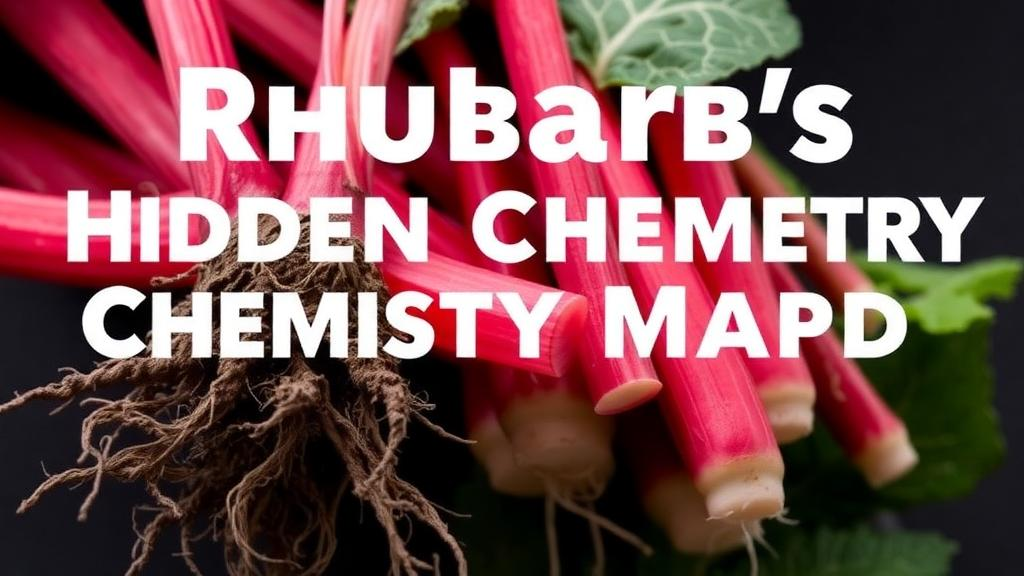
Rhubarb has fed desserts and apothecary cabinets for centuries, yet the plant’s internal economy has remained largely opaque. A new study published in npj Science of Food has now charted, in remarkable chemical and microbial detail, how the Tibetan rhubarb species Rheum tanguticum distributes its resources between its underground roots and its above-ground leaves and stalks across the growing season. The findings, from a team led by Jianan Li and Guoying Zhou of the Northwest Institute of Plateau Biology at the Chinese Academy of Sciences, suggest that the timing of harvest and the plant’s own internal microbiome could be harnessed to squeeze far more value from every part of the plant.
The research tackles a deceptively simple question with heavyweight analytical tools: when and where does a rhubarb plant store its most valuable chemistry? Rheum tanguticum is a perennial herb native to the high-altitude regions of western China, where it has long been prized in traditional medicine. Its thick roots are rich in anthraquinones, a class of pigmented aromatic compounds with well-documented laxative, anti-inflammatory and antimicrobial properties. Its tart petioles, by contrast, are the culinary rhubarb familiar to cooks worldwide, valued for their crisp acidity. The leaves, containing their own suite of metabolites, are typically discarded. Understanding how these three compartments differ chemically, and how those differences shift through the plant’s phenological stages, is the key to using the whole plant rather than a fraction of it.
To build that picture, the researchers deployed non-targeted metabolomics using ultra-high-performance liquid chromatography coupled with a Q Exactive HF-X mass spectrometer, an instrument capable of detecting and accurately mass-resolving hundreds of small molecules in a single sample run. They sampled roots, petioles and leaves at multiple phenological stages, capturing the plant as it moved through its seasonal developmental program. In parallel, they characterized the endophytic microbial communities, the bacteria and fungi living inside the plant’s tissues, to test whether the internal microbiome tracks the plant’s chemical geography.
The chemical cartography that emerged was strikingly compartmentalized. Anthraquinone compounds, the pharmacological heart of medicinal rhubarb, accumulated preferentially in the roots, confirming and quantifying the traditional focus on underground organs. The petioles, meanwhile, were enriched in organic acids, most notably malic acid and fumaric acid, the molecules responsible for rhubarb’s characteristic mouth-puckering tartness and of growing interest to the food industry as natural acidulants. This division of metabolic labor means that a single plant simultaneously produces a pharmaceutical raw material below ground and a food-grade acid profile above it, a dual output that conventional harvesting practices largely ignore.
Perhaps the most consequential analytical finding concerns the relative importance of space versus time. When the team compared metabolic variation across tissues sampled at the same phenological stage against variation within the same tissue across different stages, tissue identity won decisively. The chemical difference between a root and a leaf at any given moment was far greater than the difference within a root across the growing season. In practical terms, what a rhubarb plant is chemically depends far more on which organ you sample than on when you sample it, at least for the underground organs.
That said, phenology was not irrelevant. The root metabolome proved remarkably stable across developmental stages, a kind of chemical bedrock that growers can rely on. The above-ground tissues told a different story: leaves and petioles exhibited considerably greater sensitivity to phenological development, with their metabolite profiles shifting as the plant progressed through its seasonal cycle. For anyone timing a harvest of stalks or foliage, the calendar matters. For anyone digging roots, the window is apparently more forgiving, a finding with direct implications for reducing pressure on a slow-growing alpine medicinal resource.
The microbiomic half of the study added an unexpected layer. Endophytic microbial community structure was shaped by both the phenological stage and the plant compartment, mirroring the compartmentalization seen in the metabolome. Roots, petioles and leaves each hosted distinct internal microbial assemblages, and those assemblages changed as the season advanced. This is more than a descriptive curiosity. Endophytes are increasingly recognized as active participants in plant chemistry, capable of modulating biosynthetic pathways, supplying precursor molecules, or influencing the stress physiology of their hosts.
The critical link came from correlation analysis. The researchers found that key genera of endophytes showed a strong positive association with anthraquinone content in the plant tissues. In other words, the more abundant these particular microbial residents were, the higher the levels of the prized medicinal compounds. The study establishes correlation rather than causation, and the authors are careful on this point, but the association is strong enough to flag these genera as prime candidates for follow-up work. If experiments confirm that the microbes promote anthraquinone accumulation, the implications run from cultivation to conservation.
Imagine, for instance, inoculating rhubarb crops with tailored endophyte consortia to boost root potency, or selecting planting and harvesting regimes that favor the microbial partners associated with high anthraquinone yields. Such microbial applications could raise the medicinal output of cultivated plants, easing harvesting pressure on wild populations of a species that is endemic, rare and the focus of active protection programs in Qinghai province, where part of the research funding originates. The study’s authors explicitly frame their work as providing a theoretical foundation for whole-plant resource utilization and insights into harvesting optimization, and the data support both ambitions.
There is also a food-science angle that should not be overlooked. The enrichment of malic and fumaric acids in petioles, mapped across phenological stages, gives food processors a chemical rationale for timing stalk harvests to maximize acidity and flavor consistency. Combined with the finding that above-ground tissues are the phenologically dynamic ones, producers of rhubarb-based foods could in principle schedule harvests for peak organic acid content while leaving root chemistry essentially untouched. The study thus reads as a blueprint for treating Rheum tanguticum not as a single-product crop but as a multi-output system, with roots, stalks, leaves and even their resident microbes each offering a distinct resource. As metabolomics and microbiomics continue to converge, this integrated view of a plant’s chemical and microbial geography may become the template for how high-value medicinal and food plants are studied, cultivated and harvested worldwide.
Subject of Research: Metabolomic and endophytic microbial profiling of Rheum tanguticum across plant compartments and phenological stages
Article Title: Resource utilization and phenological dynamics in underground-aboveground parts of Rheum tanguticum via metabolomics and microbiomics
Article References: Li, J., Wang, B., Yang, X., Wang, T., Ma, H., Meng, Q., & Zhou, G. (2026). Resource utilization and phenological dynamics in underground-aboveground parts of Rheum tanguticum via metabolomics and microbiomics. npj Science of Food. https://doi.org/10.1038/s41538-026-01185-9
Image Credits: AI Generated
DOI: 10.1038/s41538-026-01185-9
Keywords: Rheum tanguticum, rhubarb, metabolomics, endophytes, anthraquinones, malic acid, fumaric acid, phenology, plant microbiome, harvesting optimization, medicinal plants, food science
Cite Scienmag News
Bethany Barker. (October 10, 2026). Rhubarb’s Hidden Chemistry Mapped: Roots, Stalks and Microbes Reveal Harvest Secrets. Scienmag. https://scienmag.com/rhubarbs-hidden-chemistry-mapped-roots-stalks-and-microbes-reveal-harvest-secrets/
Bethany Barker. "Rhubarb’s Hidden Chemistry Mapped: Roots, Stalks and Microbes Reveal Harvest Secrets." Scienmag, 10 October 2026, https://scienmag.com/rhubarbs-hidden-chemistry-mapped-roots-stalks-and-microbes-reveal-harvest-secrets/. Accessed 10 October 2026.
Bethany Barker. "Rhubarb’s Hidden Chemistry Mapped: Roots, Stalks and Microbes Reveal Harvest Secrets." Scienmag. October 10, 2026. https://scienmag.com/rhubarbs-hidden-chemistry-mapped-roots-stalks-and-microbes-reveal-harvest-secrets/


