


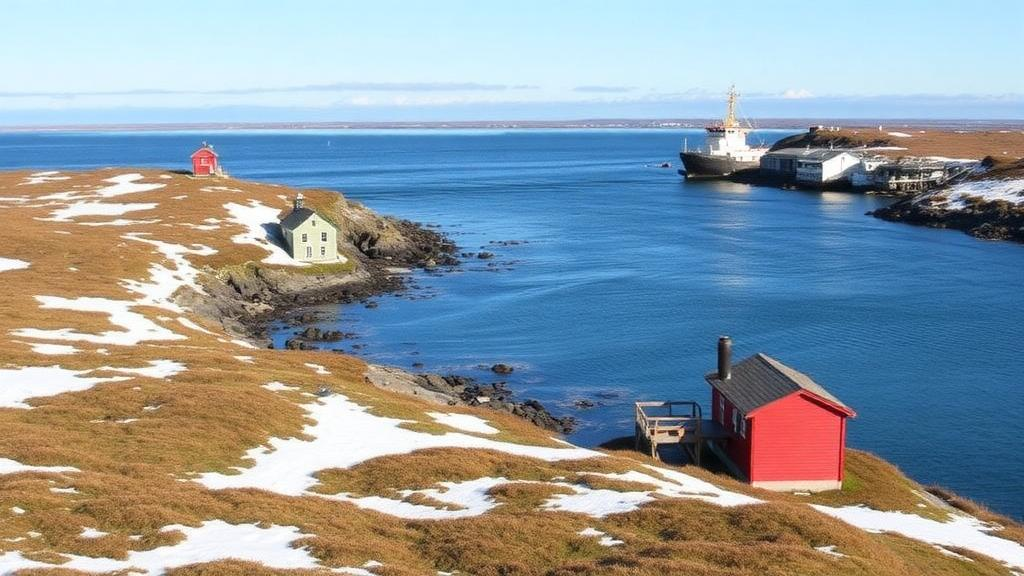
Along the rugged coastlines of Atlantic Canada, climate change is not an abstract forecast but a daily reality measured in eroding shorelines, shifting fish stocks, and storms that elders say no longer follow the patterns they once knew. A new study published in PLOS Sustainability and Transformation argues that the people best positioned to guide the region’s response are often its own residents, and that whether their knowledge actually shapes climate policy depends less on goodwill than on the design of funding programs, governance structures, and institutional rules. The research, led by Edmund Yirenkyi of Memorial University of Newfoundland’s Grenfell Campus, offers one of the first empirically grounded accounts of how local and Indigenous knowledge intersects with formal adaptation planning in a region facing acute climate risk but remaining comparatively understudied.
The study rests on 22 semi-structured interviews with municipal officials, philanthropic funders, non-governmental organization leaders, Indigenous representatives, and community organizers across Nova Scotia and Newfoundland, supplemented by participant observation at a regional climate adaptation event. Participants were recruited through purposive and snowball sampling, with data collection continuing until thematic saturation was reached. All interviews were recorded, transcribed verbatim, anonymized, and analyzed through an inductive thematic approach, allowing themes such as funding access, policy support, and barriers to collaboration to emerge from the data rather than being imposed in advance. The work received ethical approval from the Grenfell Campus Research Ethics Board and forms part of a larger transdisciplinary project on collaborative governance in financing climate adaptation and mitigation.
Conceptually, the research is anchored in the Socio-Ecological Systems framework, which treats communities not as isolated units of adaptation but as nodes embedded within interconnected social, institutional, and ecological systems. From this perspective, the most effective adaptation strategies emerge from feedback loops between community experience, institutional support, and environmental change. The author also frames the translation of local knowledge as a three-stage process: recognition, in which local knowledge is acknowledged as a valid source of environmental information; valuing, in which it gains real influence over the priorities and design of adaptation plans; and use, in which it is applied alongside scientific tools to concrete planning decisions, such as combining elders’ memories of past shoreline positions with geospatial mapping.
The findings are striking in their consistency: local knowledge is central to building climate resilience, not peripheral to it. Participants described a rich tapestry of knowledge forms, from fishers’ observations of shifting marine species to the Traditional Ecological Knowledge held by First Nations, Inuit, and Métis Peoples, which reflects generations of observation of seasonal change, animal behaviour, and land management. The study also highlights the concept of Two-Eyed Seeing, introduced by Mi’kmaq Elder Albert Marshall, which calls for weaving Indigenous and Western ways of knowing together rather than treating them as competing systems. One participant captured the grassroots ethos succinctly, explaining that the work is not about telling communities what to do but about communities receiving support and encouragement for what they are already doing and want to do.
In practice, this knowledge is being mobilized through four broad categories of adaptation activity. Education and outreach initiatives, including arts communication projects and museum preservation efforts responding to shoreline erosion, rely heavily on cultural knowledge and build public engagement. Community and skills-building efforts, such as public education sessions and community-garden knowledge-sharing, transmit expertise effectively at small scale. Natural infrastructure projects, including living shorelines and regenerative agriculture, showed the deepest integration of traditional ecological knowledge, drawing directly on longstanding local practices. Community planning initiatives, particularly municipal climate advisory committees with formal community representation, demonstrated the strongest institutional uptake. In one municipality, eight community consultation sessions on climate adaptation directly informed local plans, while in another, five of twelve council seats were held in ways that fostered trust and shared responsibility.
Yet the study documents a persistent gap between recognition and substantive use. Systemic barriers, including rigid, short-term funding programs, top-down policy frameworks, and heavy bureaucratic requirements, continue to limit the consistent and equitable application of local knowledge. One participant from a community NGO criticized federal funding structures as formulaic, with everything prescribed in advance and little room for genuine collaboration. A municipal official noted the absence of internal resources to adequately cover climate programs, and another organization described the lack of continuity between short grants as very harmful to progress. Smaller and rural communities face particular disadvantages, forced to compete against large municipalities with dedicated administrative staff for funding opportunities they often lack the capacity to pursue.
Equity concerns surfaced repeatedly. A community foundation representative pointed to Nova Scotia’s history of environmental racism and suggested it extends to adaptation efforts, underscoring the need to embed climate justice principles in planning. Volunteer burnout emerged as another strain on smaller organizations. At the same time, participants identified clear enablers: strong local leadership, grassroots engagement that lets communities define their own priorities, collaborative governance, and flexible funding arrangements. Multi-year funding commitments were described as a game changer, allowing organizations to plan and sustain projects rather than lurching from one grant cycle to the next.
The role of partnerships proved double-edged. Multi-stakeholder platforms connecting municipalities, Indigenous groups, and NGOs were praised for pooling resources and building legitimacy, with one program coordinator noting that such partnerships ensure local knowledge shapes coastal resilience projects. But power dynamics matter enormously. One community organizer observed that input is often sought while final decisions ignore community priorities, such as protecting cultural sites. This distinction between being consulted and having actual influence echoes the scholarly argument that meaningful knowledge co-production requires redistributing decision-making authority, not simply inviting participation. The clearest cases of effective collaboration in the study were precisely those where such redistribution occurred.
Federal policy frameworks received a mixed assessment. Canada’s National Adaptation Strategy was seen as supportive in principle but weak in practice, with one provincial program planner observing that it encourages local knowledge while lacking clear guidelines for implementation. Large funding programs, such as the 41-million-dollar Climate-Resilient Coastal Communities initiative running from 2023 to 2028, provided essential resources, enabling one Nova Scotia municipality to hire local experts to map erosion risks based on community input. But access inequities persist, and rigid use-case restrictions can leave communities unable to pay for what they actually need most: staff and people. By contrast, municipal-level policies establishing climate advisory committees were praised for creating goodwill by giving community members a formal voice in decision-making.
The study concludes that resilience cannot be delivered from the top down; it must be built through collaboration and continuous learning across the system. The author calls for policy shifts to institutionalize long-term, locally controlled funding, formalize community participation in decision-making, and embed equity-centered, co-productive approaches into adaptation frameworks. Without these enabling conditions, the role of local knowledge risks being reduced to a symbolic gesture rather than serving as a core driver of adaptation. The findings carry weight well beyond Atlantic Canada, offering a template for any jurisdiction grappling with how to move beyond token acknowledgment of community expertise toward climate action that is adaptive, context-specific, and grounded in the lived realities of the people who know their places best. As the author notes, the study’s qualitative design offers transferable insight into similar rural and coastal contexts rather than statistically generalizable conclusions, and future research probing how local knowledge shapes the most contentious decisions, such as managed retreat, would be a valuable extension.
Subject of Research: Integration of local and Indigenous knowledge into community climate change adaptation planning in Atlantic Canada
Article Title: Place-based climate adaptation: How Atlantic Canadian communities translate local knowledge into action
Article References: Yirenkyi, E. (2026). Place-based climate adaptation: How Atlantic Canadian communities translate local knowledge into action. PLOS Sustainability and Transformation, 5(10), e0000291. https://doi.org/10.1371/journal.pstr.0000291
Image Credits: AI Generated
DOI: 10.1371/journal.pstr.0000291
Keywords: climate adaptation, local knowledge, Indigenous knowledge, Atlantic Canada, socio-ecological systems, co-production, climate governance, funding, coastal communities, participatory planning, Nova Scotia, Newfoundland
Cite Scienmag News
Sloane Callahan. (October 10, 2026). Local Knowledge Drives Climate Resilience in Atlantic Canada, Study Finds. Scienmag. https://scienmag.com/local-knowledge-drives-climate-resilience-in-atlantic-canada-study-finds/
Sloane Callahan. "Local Knowledge Drives Climate Resilience in Atlantic Canada, Study Finds." Scienmag, 10 October 2026, https://scienmag.com/local-knowledge-drives-climate-resilience-in-atlantic-canada-study-finds/. Accessed 10 October 2026.
Sloane Callahan. "Local Knowledge Drives Climate Resilience in Atlantic Canada, Study Finds." Scienmag. October 10, 2026. https://scienmag.com/local-knowledge-drives-climate-resilience-in-atlantic-canada-study-finds/


