


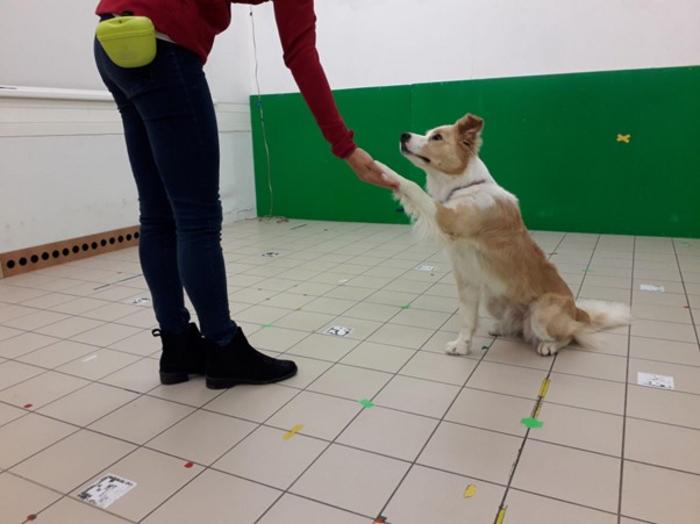
Dogs’ learning success is enhanced when they are not only rewarded with food, but also praised and petted for their good performance, according to a new study by researchers from the Department of Ethology at ELTE Eötvös Loránd University, published in Scientific Reports. The ethologists investigated the relations among emotions, learning and sleep. Their results shed light on how learning style and sleep affect dogs’ behaviour and learning success.

Credit: Photo: Timea Kovacs / ELTE Eötvös Loránd University
Dogs’ learning success is enhanced when they are not only rewarded with food, but also praised and petted for their good performance, according to a new study by researchers from the Department of Ethology at ELTE Eötvös Loránd University, published in Scientific Reports. The ethologists investigated the relations among emotions, learning and sleep. Their results shed light on how learning style and sleep affect dogs’ behaviour and learning success.
Previous research has already shown that
we remember events and information better when they are emotionally charged.
However, these studies were mainly conducted in a controlled laboratory setting, so it is particularly important to study this question in real-life situations.
“It is natural and ordinary for family dogs to learn in emotionally charged social situations, either from their owners or from dog trainers. However, our knowledge of this phenomenon so far is mainly based on studies in humans and laboratory rodents (rats, mice). Our aim was to study the phenomenon in dogs, as it is not only exciting to research the species as a model animal, but also in its own right,” explains Dr. Vivien Reicher, first author of the study.
The researchers developed a unique methodology: in the presence of the owner, dog trainers taught new command words for tricks the dogs already knew, for example, they used the command word in English ‘High five’ instead of the familiar Hungarian version ‘Pacsi’. Each dog was given two training sessions, one in ‘permissive’ style, where the trainers used lots of praise and petting in addition to a treat, and never scolded the dogs, and another ‘controlling’ style, where the dogs were reinforced only with a treat, without verbal praise or petting, and they were scolded upon unwanted behaviour.
After the training sessions, the dogs slept in the department’s sleep lab, and the researchers tested the dogs’ success in learning the new command words before and after sleep. The dogs’ sleep was analysed using EEG scans to study the brain function related to memory consolidation, i.e. the stabilisation of remembering new information.
The results showed that “controlling” training induced greater stress in the dogs:
they sought the proximity of their owners more and slept more after training, confirming previous research that sleep plays an important role in emotion processing. Interestingly, their learning was more successful the first time (compared to the second occasion) regardless of training style, and permissive or controlling styles had no effect per se. The reason for the order effect may be the well-known phenomenon in the literature that information learned first is often easier to remember than what is learned later in a similar context.
Dr. Márta Gácsi, Senior Research Fellow of the Comparative Ethology Research Group of HUN-REN-ELTE, points out, “The most exciting result is that sleep improved the dogs’ learning performance only in one specific case, when the group that received “controlling” training for the first time expected to receive similar training for the second time, but then we trained them in a “permissive” style. We believe the combined effect of positive surprise and sleep improved their learning success.”
The results of the research highlight the important role that
social reinforcement (praise, petting) plays in dogs’ well-being and learning success.
The lack of social reinforcement or scolding can cause stress to dogs, especially if they are being taught by a trainer, and this should be taken into account when choosing teaching methods.
This study not only provides a deeper insight into dog learning, but can also bring us closer to understanding some of the learning processes in humans. It also provides useful information for owners and dog trainers, as it further supports the view with scientific evidence that rewarding our pets not only with food, but also praising and petting has a positive impact on their well-being and learning success.
Journal
Scientific Reports
Article Title
Potential interactive effect of positive expectancy violation and sleep on memory consolidation in dogs
Article Publication Date
25-Apr-2024
Cite Scienmag News
Courtney Benton. (June 6, 2024). Rewarding dogs with praise and petting helps them learn more efficiently. Scienmag. https://scienmag.com/rewarding-dogs-with-praise-and-petting-helps-them-learn-more-efficiently/
Courtney Benton. "Rewarding dogs with praise and petting helps them learn more efficiently." Scienmag, 6 June 2024, https://scienmag.com/rewarding-dogs-with-praise-and-petting-helps-them-learn-more-efficiently/. Accessed 3 September 2026.
Courtney Benton. "Rewarding dogs with praise and petting helps them learn more efficiently." Scienmag. June 6, 2024. https://scienmag.com/rewarding-dogs-with-praise-and-petting-helps-them-learn-more-efficiently/

