


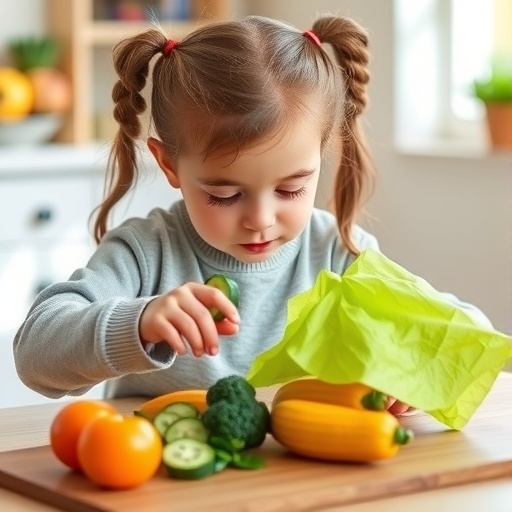
In a groundbreaking exploration of early childhood education, researchers from North Carolina State University and East Carolina University have unveiled compelling evidence that integrating food into preschool curricula can significantly enhance both scientific understanding and vocabulary development among young learners. This innovative study, recently published in the Journal of Nutrition Education & Behavior, illuminates how food-based learning transcends traditional dietary education by fostering a multisensory approach that captivates and educates children well before they ever taste the food itself.
At the heart of this new pedagogical strategy is the belief that food serves as an exceptionally versatile educational tool. By engaging preschoolers in hands-on experiences with food—examining its texture, smell, appearance, and growth process—educators can stimulate curiosity and instill a scientific mindset from an early age. This method aligns with developmental theories that emphasize experiential learning, where children construct knowledge actively rather than passively receiving information. Through such interactions, children not only absorb nutritional knowledge but also develop essential language skills as they learn new vocabulary pertinent to biology, agriculture, and sensory description.
The research team devised an innovative program dubbed “More PEAS Please!” targeting Head Start classrooms in three diverse North Carolina counties. This intervention reflected a deliberate attempt to marry nutritional education with science curricula through food. By focusing on tangible experiences—such as observing seeds, experimenting with germination under varying environmental conditions, and preparing recipes like seed salsa—the initiative contextualizes scientific concepts in relatable, concrete experiences. It challenges the conventional separation between academic learning and practical knowledge, underscoring how interdisciplinary teaching can enrich early childhood education.
Quantitative analyses of over 275 preschool children revealed striking outcomes. Preschoolers exposed to the food-centered curriculum demonstrated a fourfold increase in their understanding of scientific principles compared to those in control groups. Additionally, vocabulary acquisition surged by nearly 20 percent, a substantial leap compared to a mere 6 percent increase among peers who did not participate in the intervention. These metrics underscore the potency of integrating food exploration with cognitive development, suggesting that young minds are particularly receptive to multisensory, context-rich learning environments.
Beyond student outcomes, qualitative insights from educator feedback provide a valuable dimension to understanding the program’s efficacy. Teachers reported gaining heightened confidence and new strategies for communicating complex science topics, revealing that the intervention not only benefits students but also empowers instructors. This dual impact highlights the importance of professional development and ongoing support, as educators are pivotal to sustaining innovative teaching methods and adapting them to diverse classroom dynamics.
The “More PEAS Please!” program incorporates an array of training resources tailored to kindergarten readiness standards. Initial all-day workshops followed by supplementary YouTube whiteboard videos offer accessible, continuous professional development. These resources focus on practical communication techniques, such as how to engage four-year-olds in scientific inquiry through conversational language they can grasp and enthusiastically respond to. This emphasis on scaffolded educator training ensures that theoretical innovations translate into daily classroom practices effectively.
A particularly noteworthy dimension of this research concerns its approach to food exposure. Instead of pressuring children to consume fruits or vegetables, the program fosters non-coercive interaction, encouraging tactile and sensory exploration. This reframing of success—that tasting is not the immediate goal, but rather a gradual journey of acceptance—offers crucial insights into behavioral nutrition and early feeding psychology. A child’s willingness to touch or manipulate spinach, for instance, represents a meaningful progression toward eventual acceptance, a nuance often overlooked in conventional dietary interventions.
Scientifically, this approach aligns with principles of repeated exposure and sensory familiarization, which are known to reduce neophobia—the fear or avoidance of unfamiliar foods. By inviting children to investigate food as living entities with growth cycles and sensory attributes, the program cultivates intrinsic curiosity. This curiosity bridges the gap between abstract scientific theory and tangible, everyday experience, demystifying concepts like plant biology and ecology while promoting healthier food attitudes.
Moreover, the research sheds light on the importance of integrating multidisciplinary learning objectives in early childhood education. It reflects a holistic vision where nutritional knowledge, language development, and scientific inquiry coalesce in a single pedagogical framework. Such integration is vital in preparing children not only academically but also socially and physically, fostering a lifelong foundation of health consciousness and intellectual curiosity.
The study’s implications extend into public health and educational policy realms. Childhood dietary habits are notoriously challenging to shape, and early interventions are critical for establishing lifelong patterns. By demonstrating that educational experiences centered around food can simultaneously boost cognitive and behavioral outcomes, this research advocates for curriculum reforms that recognize food’s multifunctional educational potential. It invites educators, policymakers, and curriculum developers to consider how lessons about nutrition, science, and language can be more seamlessly interwoven.
In sum, the “More PEAS Please!” initiative represents a transformative model for early childhood education. It affirms that food, far beyond its nutritional value, holds the power to ignite scientific curiosity and language development in young children. This dual impact fosters not just better learners but also more inquisitive, open-minded, and health-aware individuals. As classrooms adapt to embrace such innovative methodologies, we may well witness a generational shift in how children relate to food, science, and learning itself—changing the narrative from simple consumption to meaningful exploration.
This work, supported by the National Institute of General Medical Sciences, involved a collaborative team that included experts in agriculture, human sciences, and nutrition education. The open-access publication can be found in the Journal of Nutrition Education & Behavior, providing a rich resource for educators and researchers interested in the nexus of early childhood development, nutrition, and science pedagogy.
—
Cite Scienmag News
Courtney Benton. (May 18, 2026). Using Food to Enhance Preschoolers’ Science Understanding and Vocabulary. Scienmag. https://scienmag.com/using-food-to-enhance-preschoolers-science-understanding-and-vocabulary/
Courtney Benton. "Using Food to Enhance Preschoolers’ Science Understanding and Vocabulary." Scienmag, 18 May 2026, https://scienmag.com/using-food-to-enhance-preschoolers-science-understanding-and-vocabulary/. Accessed 5 September 2026.
Courtney Benton. "Using Food to Enhance Preschoolers’ Science Understanding and Vocabulary." Scienmag. May 18, 2026. https://scienmag.com/using-food-to-enhance-preschoolers-science-understanding-and-vocabulary/


